
Greek deity personifying the darkness of death and the mist that veils the eyes of the dying. Rooted in Greek mythological tradition, she ranks among the primordial entities who preceded the Olympians.
Achlys
Achlys
8 min read
Frequently asked questions
Key Facts
- Mentioned in the *Shield of Heracles* (a poem attributed to Hesiod, c. 6th century BCE) as a terrifying figure with pale cheeks
- Sometimes considered older than Chaos itself, which would make her one of the most primordial entities in Greek cosmogony
- Associated with Nyx (the Night) in certain traditions, of which she is said to be an emanation or companion
- Her Greek name Ἀχλύς literally means "mist" or "darkness
- particularly the kind that clouds the eyes of the dying
- Written sources on Achlys are rare and fragmentary, reflecting her archaic and marginal status within the official pantheon
Works & Achievements
Achlys's essential function is to spread a mist over the eyes of the dying at the moment of death. This invisible yet universal act makes her a constant presence at every human death in the Greek conception of the world.
Achlys is depicted on the shield forged by Hephaestus for Heracles, alongside other funerary deities and allegories. Her presence on this central heroic object testifies to her symbolic importance in archaic Greek culture.
In Orphic cosmogonies, Achlys represents the fundamental misery and distress that precede even the creation of the world. She embodies the first state of existence, before light, before order, before the Olympian gods themselves.
The Hesiodic description of Achlys influenced the depiction of funerary deities on white-ground lekythoi and Greek funerary stelae, helping to forge a coherent iconography of personified death in ancient art.
Anecdotes
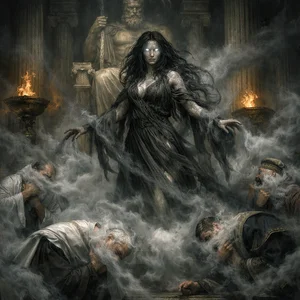
In the poem attributed to Hesiod known as the Shield of Heracles, Achlys is described with disturbing precision on the shield forged by Hephaestus: pale, emaciated, her knees swollen, her nails like claws, her nostrils oozing, her cheeks dripping with fluid. This description makes her one of the most terrifying and detailed representations of a death deity in all of Greek mythology.
Her very name, achlys (ἄχλυς), means in ancient Greek the mist or dark cloud. This is precisely the veil the Greeks believed they could see descending over the eyes of the dying in their final moments — Achlys was not merely an abstract deity; she was a lived and dreaded experience at the heart of every death agony.
According to certain Orphic traditions, Achlys is one of the oldest beings in the Greek cosmogony, having appeared even before Chaos, the primordial void. This position places her among the most archaic and mysterious entities of the Greek pantheon, predating the Olympian gods and even Night itself as embodied by Nyx.
Achlys is closely linked to Nyx, the goddess of Night, and shares her realm of darkness with the Keres, those winged spirits of violent death who hover over battlefields. Together, they form a company of chthonic deities haunting the margins of the world of the living, where light yields forever to eternal darkness.
Primary Sources
"There was Achlys, horrible and sinister, pale, withered, wasted with hunger, her knees swollen, her nails long as claws. From her nostrils ran mucus, her cheeks dripped down to the ground; she stood there grimacing, and a great quantity of dust, wet with tears, was spread across her shoulders."
Hesiod evokes the entities born of the primordial Chaos and the powers of night and death that predate the Olympian gods, among whom appear the personifications of misery, grief, and funereal darkness.
The Orphic texts, transmitted orally before being written down, mention primordial entities linked to night and death, some of them identified with Achlys, within a cosmogony older than Hesiod's, in which misery precedes the cosmos.
Before they were written down, Greek myths were passed on orally by the aoidoi and rhapsodes during ritual songs. The figure of Achlys as the personification of the veil of death belongs to this archaic body of beliefs about agony and the passage into the afterlife.
Key Places
A primordial abyss located at the deepest level of Greek cosmology, far below Hades, dwelling of the most archaic entities. Achlys, as a primordial entity predating the Olympians, is associated with these lightless cosmic depths.
The underworld ruled by Hades and Persephone, traversed by the Styx and the other infernal rivers. It is here that the souls of the dead arrive, in a domain where Achlys and the chthonic entities carry out their eternal functions.
A site in Attica where the Eleusinian Mysteries were celebrated — secret initiatory rites connected to death and rebirth. Chthonic entities such as Achlys lay at the heart of the beliefs passed on to initiates about the passage to the afterlife.
A promontory of the Peloponnese regarded in Antiquity as one of the entrances to the Underworld. In this borderland between the world of the living and the world of the dead, the Greeks imagined the presence of funerary deities, among them Achlys.
Typical Objects

The dark cloud that Achlys spreads over the eyes of the dying at the moment of death. This mist symbolizes the passage between the world of the living and that of the dead — the ultimate boundary the soul crosses at its last breath.

Described in precise detail in the Shield of Heracles, these nails as long as talons are the most distinctive attribute of Achlys. They symbolize her power to seize and mark the moment of death in an irreversible way.

In the Hesiodic description, Achlys's face oozes fluids mixed with blood and tears streaming down to the ground. These elements together represent the physical suffering and grief that accompany every death.

The flower of the Underworld in Greek mythology, the asphodel grows across the plains of Hades where the souls of ordinary mortals wander. It is associated with chthonic deities such as Achlys, who reign over this sunless subterranean world.

The Shield of Heracles mentions that dust moistened with tears covers Achlys's shoulders. This image evokes the collective grief of the living and the immemorial weight of death upon the human condition since the beginning of time.

Achlys is dressed in dark tatters — a torn, worn-out version of Greek mourning garments made from black or ash-gray himation. No ornament, no adornment: she embodies absolute destitution, the very opposite of Olympian beauty.
School Curriculum
Vocabulary & Tags
Key Vocabulary
Daily Life
Morning
At dawn, when the light of Helios begins to pierce the darkness, Achlys retreats into the depths of Tartarus. Her domains are those of absolute darkness, where neither the sun nor the stars ever penetrate. It is the hour when those who died in the night have already passed through the veil she has drawn over their forever-closed eyes.
Afternoon
Achlys wanders at the borders between the world of the living and the world of the dead, watchful at every agony that occurs on the surface of the earth. She does not wait to be summoned: her presence is inherent in every death, like the cold that accompanies winter or the shadow inseparable from all light.
Evening
Twilight is Achlys's hour par excellence — that ambiguous hour when light yields to darkness as the living yield to death. It is at nightfall that the Greeks most feared funerary spirits. Achlys then mingles with the Keres and the wandering shades of the recently deceased who have not yet reached Hades.
Food
Chthonic deities like Achlys do not feed on the nectar and ambrosia reserved for the Olympians, but on the dark libations poured into funeral pits during Greek funerary rites: blood, milk, honey, and black wine offered to the dead. Their true nourishment is the grief and lamentation of the living who mourn their departed.
Clothing
The Hesiodic description depicts Achlys covered in dark rags, her skin stained, her mourning garments transformed into tatters by the eternity of her condition. No ornament, no jewelry: Achlys is the deity of absolute destitution, the opposite of the adorned and radiant beauty of the Olympian goddesses.
Housing
Achlys resides in the depths of Tartarus, beyond even Hades, where a darkness reigns that the Greeks imagined denser than the darkest night. Her domain has no walls or doors: darkness itself is her dwelling, infinite and boundless, anterior to all cosmic order and to every luminous form.
Historical Timeline
Period Vocabulary
Liens externes & ressources
Références
Œuvres
Personnification du voile de mort sur les mourants
Origine mythologique, antérieur au VIIIe siècle av. J.-C.
Figuration sur le Bouclier d'Héraclès
VIe siècle av. J.-C.
Incarnation de la Misère primordiale dans les cosmogonies orphiques
VIe siècle av. J.-C.
Modèle iconographique des divinités funèbres dans l'art grec
Ve-IVe siècle av. J.-C.