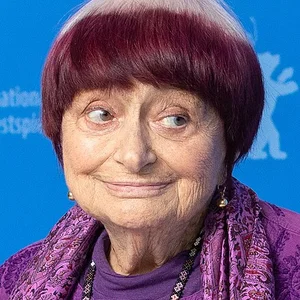

French photographer, visual artist, film director and screenwriter
Agnès Varda(1928 — 2019)
Agnès Varda
France, Belgique
7 min read
Frequently asked questions
Key Facts
- Agnès Varda réalise en 1955 'La Pointe Courte', film précurseur de la Nouvelle Vague française
- Son film 'Cléo de 5 à 7' (1962) s'impose comme une œuvre majeure du cinéma français d'auteur
- Elle cofonde avec Jacques Demy la société de production Ciné-Tamaris en 1954, affirmant son indépendance artistique
- Dans les années 2000, elle se tourne vers l'art contemporain et les installations plastiques, exposant notamment à la Fondation Cartier
- En 2017, elle devient la première femme à recevoir un Oscar d'honneur pour l'ensemble de sa carrière cinématographique
Works & Achievements
Varda's first feature film, shot in a fishing village near Sète with non-professional actors. Considered a founding film of the French New Wave before the movement existed.
A real-time film following a singer during two hours of waiting for a medical diagnosis. A masterpiece of the French New Wave and an avant-garde feminist manifesto.
A film about a young drifter found dead in a ditch. Winner of the Golden Lion at Venice, this radical film questions freedom, marginality, and society's gaze on women.
A tribute to her dying husband Jacques Demy, recreating his childhood in Nantes. A deeply sincere film of love and mourning, blending fiction and documentary.
A personal documentary shot with a lightweight digital camera, exploring the practice of gleaning in France. Varda appears in it herself, aging, reinventing the relationship between filmmaker and filmed subject.
A cinematic self-portrait in the form of a memory walk along the beaches that marked her life. Winner of the César for Best Documentary, it confirms her status as an icon of auteur cinema.
A documentary co-directed with artist JR, traveling across France to photograph and display giant portraits. Nominated for an Oscar, the film celebrates intergenerational encounters and art in public spaces.
Anecdotes
Agnès Varda made her first film, La Pointe Courte, in 1955, without ever having received any formal filmmaking training. She drew directly from American literature, particularly William Faulkner, and shot with non-professional actors in a fishing village near Sète. The film is often considered the first film of the French New Wave, predating even those of Godard or Truffaut.
In 1962, Varda made Cléo from 5 to 7, a film shot in real time following a singer during two hours of anxious medical waiting. To stay as close to reality as possible, she filmed in the actual streets of Paris without official permits, using a lightweight handheld camera — a revolutionary approach for the time.
Well into her eighties, Agnès Varda co-directed Faces Places with photographer JR, traveling through rural France in a giant photo-booth truck. The film, released in 2017, was nominated for an Academy Award, and she received an honorary Oscar. She had also become the first woman to receive an honorary Palme d'Or at Cannes, in 2015.
Agnès Varda was also a recognized visual artist. She built huts made from reels of film from her own movies and installed them in museums and galleries around the world. This approach embodied her belief that cinema was not merely a spectacle but a living material — transformable and recyclable, like memory itself.
Her husband, director Jacques Demy, died of AIDS in 1990. As a tribute to him, Varda made Jacquot de Nantes in 1991, reconstructing Demy's childhood from his own memories. She interspersed throughout the film close-up shots of his hands and face, filmed in his final days, creating a work of heartbreaking tenderness and honesty.
Primary Sources
I didn't learn cinema, I practiced it. I had a camera and I wanted to tell stories. The rest is work, curiosity, and love of people.
I thank cinema for allowing me to be curious, to travel, to meet wonderful people, and to never be bored. It is a magnificent profession when you love human beings.
The French New Wave was a freedom. You could film in the street, improvise, not have a big budget. But I was already in that freedom before anyone gave it a name.
Film stock, when it is exhausted, becomes matter. I build with what remains of my films. It is a way of not letting images die.
Key Places
Varda lived and worked her entire adult life on Rue Daguerre. She made it the subject of her documentary Daguerréotypes (1975), and it is where her home-studio is located.
The town of her adolescence and the setting of her first film La Pointe Courte (1955). Sète remains a fundamental reference in her Mediterranean and working-class imagination.
Varda presented many films there and received the Honorary Palme d'Or in 2015. She is an iconic figure in the history of the festival.
She exhibited her visual installations there, notably L'Île et Elle in 2006, confirming her status as a visual artist beyond cinema.
Varda lived several years in Los Angeles with Jacques Demy in the 1960s–1970s, a period during which she made Lions Love and documented American counterculture.
Typical Objects

Varda was among the first filmmakers to use lightweight handheld cameras to shoot on the street without constraints. This tool allowed her to capture reality with spontaneity and freedom.

Film stock was not only her working tool but also her artistic material. She built installations and huts using reels from her own used films.

Before becoming a filmmaker, Varda was a professional photographer. Her Rolleiflex allowed her to document the world of theatre and develop her singular artistic eye.

As part of her collaboration with JR, Varda travelled across France aboard a truck transformed into a giant photo booth, making it possible to print monumental portraits on the walls of villages.

Varda prepared her films with notebooks filled with visual ideas and handwritten notes. Her working method blended conceptual rigour with creative improvisation.

In The Gleaners and I, the basket used by gleaners symbolises her philosophy: reclaiming what others leave behind, whether misshapen potatoes or discarded images.
School Curriculum
Vocabulary & Tags
Key Vocabulary
Daily Life
Morning
Agnès Varda started her days early, often at her desk on Rue Daguerre where she read the press and annotated her preparation notebooks. She loved watching the shopkeepers on her street open their stores, finding in this everyday popular life a permanent source of inspiration.
Afternoon
Her afternoons were devoted to filming, editing, or production meetings in her studio adjoining her home. She was known for her constant presence on set, personally overseeing cinematography and sound.
Evening
Evenings were often social: screenings, debates at the La Pagode cinema, or dinners with filmmakers, artists, and intellectuals from the Left Bank. She remained attached, however, to her neighborhood and her neighbors, far from the social whirl of Parisian high society.
Food
Varda had a simple, Mediterranean relationship with food, inherited from her years in Sète: fish, market vegetables, cheeses. She enjoyed cooking for friends and placed symbolic importance on shared meals, as evidenced by her fascination with food gleaning.
Clothing
She had a recognizable personal style: short hair with an asymmetrical two-toned fringe (grey and auburn), and comfortable, colorful clothing — often loose tunics or dresses. She embraced a strongly asserted personal style, rejecting the codes of conventional fashion.
Housing
She lived and worked in the same house-studio on Rue Daguerre, in the 14th arrondissement of Paris. This unique space blended living quarters, an editing suite, and an art studio, reflecting her conviction that life and work cannot be separated.
Historical Timeline
Period Vocabulary
Visual Style
Esthétique documentaire à la main, lumière naturelle parisienne et méditerranéenne, mélange de noir et blanc granuleux et de couleurs saturées, avec une sensibilité d'artiste plasticienne toujours présente.
Sound Ambience
Un mélange de bruits de rue parisienne populaire, du ronronnement d'une salle de montage et des sons du bord de mer méditerranéen qui ont bercé la vie et l'œuvre de Varda.