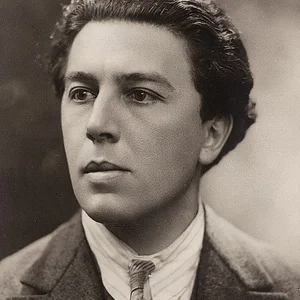

French poet and writer (1896–1966), co-founder and theorist of Surrealism. He authored the Manifestoes of Surrealism and gathered around him a generation of revolutionary artists and writers.
André Breton(1896 — 1966)
André Breton
France
9 min read
Frequently asked questions
Famous Quotes
« Beauty will be convulsive or will not be at all.»
« I seek the gold of time.»
« Leave everything. Leave Dada. Leave your wife. Leave your mistress.»
Key Facts
- 1896: Born in Tinchebray (Orne)
- 1924: Publication of the first Surrealist Manifesto
- 1928: Publication of Nadja, a landmark Surrealist novel
- 1938: Meeting with Trotsky and Diego Rivera in Mexico, manifesto Towards an Independent Revolutionary Art
- 1966: Death in Paris, guiding figure of Surrealism worldwide
Works & Achievements
The first text written entirely through automatic writing, considered the founding act of Surrealism. The two authors wrote at full speed for several days without rereading or correcting, allowing the unconscious to speak freely.
The founding text in which Breton defines Surrealism, its methods and ambitions. This manifesto, one of the most influential of the 20th century, gave the movement its name, its theory, and its artistic and philosophical program.
An autobiographical novel recounting Breton's encounter with a mysterious and visionary young woman in the streets of Paris. The book is a meditation on madness, mad love, and objective chance, illustrated with photographs.
A theoretical and political radicalization of the Surrealist movement, with an avowed alignment with Marxism. Breton settles scores with the members he has expelled and deepens the notion of the 'supreme point' where opposites are reconciled.
A lyrical essay devoted to love as a revolutionary force capable of transforming reality. It contains the famous phrase about 'convulsive beauty' and a reflection on objective chance illustrated by Breton's encounter with Jacqueline Lamba.
Written during his exile in North America, this poetic and philosophical text evokes love, freedom, and resistance in the face of Nazi barbarism. Breton develops the symbol of the star as a figure of hope and renewal.
Anecdotes
In 1924, André Breton published the first Surrealist Manifesto, in which he defined surrealism as 'pure psychic automatism'. To prove his theory, he practiced automatic writing with his friends: they would sit down, close their eyes, and let words flow without rational control, producing texts that were sometimes strange, sometimes poetic, always surprising.
Breton invented with his friends the game of the 'exquisite corpse': each participant writes part of a sentence or draws part of a body on a sheet of paper, then folds the paper to hide their contribution before passing it to their neighbor. The first result read: 'The exquisite corpse shall drink the new wine', which gave the game its name. These collective experiments aimed to liberate the unconscious.
In 1938, Breton traveled to Mexico and met León Trotsky, the Russian revolutionary in exile. Together they drafted a manifesto entitled 'Towards a Free Revolutionary Art', advocating for complete freedom of artistic creation, against totalitarian regimes that sought to put art in the service of propaganda. Diego Rivera co-signed the text to protect Trotsky.
During World War II, Breton fled occupied Europe and went into exile in New York from 1941 to 1946. There he hosted French-language radio broadcasts, met fellow European refugee artists such as Marcel Duchamp and Max Ernst, and helped spread surrealism in the United States, leaving a lasting influence on the generation of American Abstract Expressionists.
Breton was a passionate collector of unusual objects, primitive art, and curiosities. His Parisian studio at 42 rue Fontaine was nicknamed 'Ali Baba's cave': African masks stood alongside works by Picasso, strange stones, Hopi kachina dolls, and thousands of books. This space served as his laboratory of ideas and a living manifesto of surrealism.
Primary Sources
SURREALISM, n. Pure psychic automatism, by which one proposes to express — verbally, by means of the written word, or in any other manner — the actual functioning of thought. Dictated by thought, in the absence of any control exercised by reason, exempt from any aesthetic or moral concern.
Who am I? If this once I were to rely on a proverb, then perhaps everything would amount to knowing whom I 'haunt.' I must admit that this last word is misleading, tending to establish between certain beings and myself relations that are stranger, less avoidable, more disturbing than I intended.
Everything tends to make us believe that there exists a certain point of the mind at which life and death, the real and the imagined, past and future, the communicable and the incommunicable, high and low, cease to be perceived as contradictions. Now, search as one may, one will never find any other motivating force in Surrealist activity than the hope of fixing and determining that point.
Convulsive beauty will be veiled-erotic, fixed-explosive, magic-circumstantial, or it will not be at all.
We want: the independence of art — for the revolution; the revolution — for the definitive liberation of art. […] In the revolutionary struggle as in artistic creation, there is only one thing we ask: freedom.
Key Places
Breton's studio and apartment in Montmartre, nicknamed "Ali Baba's cave," where he welcomed poets, artists, and intellectuals from around the world for decades. This place was the true headquarters of the Surrealist movement.
The daily meeting place of the Surrealist group in the 1920s and 1930s, where Breton and his friends played exquisite corpse, debated theories, and solemnly expelled members deemed to have strayed from the cause. This café served as Surrealism's informal parliament.
Breton's city of exile during World War II, where he hosted French-language radio broadcasts on Voice of America and helped establish Surrealism in America. His presence directly influenced the emergence of American Abstract Expressionism.
Breton visited in 1938 and met Trotsky, who was in exile at Diego Rivera's home, as well as the painter Frida Kahlo, whom he described as "a natural Surrealist." The trip gave rise to the manifesto *Towards an Independent Revolutionary Art*.
André Breton's birthplace, born on **February 19, 1896**. He spent his childhood there before moving to Paris to study medicine, a field in which he first encountered Freudian theory.
Liens externes & ressources
Références
Œuvres
Les Champs magnétiques (avec Philippe Soupault)
1919
Manifeste du surréalisme
1924
Second manifeste du surréalisme
1930
L'Amour fou
1937
Arcane 17
1944