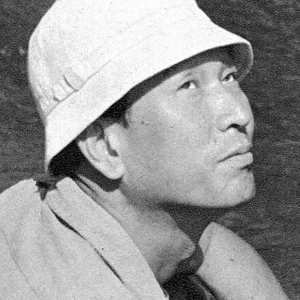

Japanese film director and screenwriter
Frequently asked questions
Key Facts
- Né en 1910 à Tokyo, Akira Kurosawa grandit dans une famille sensible aux arts et entre dans le cinéma en 1936 comme assistant réalisateur.
- En 1950, il réalise Rashômon, qui remporte le Lion d'or à Venise en 1951 et révèle le cinéma japonais au monde occidental.
- Les Sept Samouraïs (1954) est considéré comme l'un des plus grands films de l'histoire du cinéma, influençant durablement le western américain.
- Il adapte des œuvres littéraires majeures (Shakespeare, Dostoïevski, Gorki) au Japon féodal, créant un dialogue entre cultures orientale et occidentale.
- En 1990, il reçoit un Oscar d'honneur pour l'ensemble de sa carrière, consacrant son statut de maître du 7e art à l'échelle mondiale.
Works & Achievements
Revolutionary film telling a murder story from four contradictory points of view. Golden Lion at Venice 1951, it opened world cinema to Japan and introduced the narrative concept of the 'Rashomon effect' into universal culture.
A bureaucratic civil servant learns he is dying and seeks to give meaning to his life by having a children's park built. A humanist masterpiece considered one of the greatest films in cinema history about the meaning of existence.
A 3h27 epic in which seven samurai defend a village of farmers against bandits. A foundational work of world action cinema, it directly influenced Sergio Leone's westerns, Star Wars, and hundreds of other works.
A masterless samurai manipulates two rival clans into destroying each other. Adapted by Sergio Leone as 'A Fistful of Dollars', this film invented the cynical anti-hero character that dominates contemporary action cinema.
A humanist fresco about a doctor to the poor in 19th-century Japan. Kurosawa's last black-and-white film, it concludes his collaboration with Toshirō Mifune after sixteen films together.
A thief and look-alike replaces a dying warlord and must assume his role. Palme d'Or at Cannes, produced by Coppola and Lucas, this triumphant return by Kurosawa after a long absence marks the definitive international recognition of his genius.
An adaptation of Shakespeare's King Lear set in feudal Japan: an aging lord divides his kingdom among his sons with tragic consequences. The absolute visual pinnacle of color cinema, considered Kurosawa's artistic testament.
Anecdotes
During the filming of 'Seven Samurai' in 1954, Kurosawa insisted that the actors wear their costumes for weeks before shooting so they could grow naturally accustomed to them. He went as far as artificially aging and wearing down the clothes, convinced that costumes that looked too new would betray the film's historical authenticity.
Kurosawa was color-blind, which did not prevent him from directing 'Kagemusha' and 'Ran' with spectacular color palettes. For 'Ran' (1985), he personally painted hundreds of watercolors depicting every scene in the film before shooting began, working as a true painter before being a filmmaker.
When 'Rashomon' won the Golden Lion at Venice in 1951, Kurosawa and Daiei studio were stunned: the film had nearly never been released, as studio executives found it incomprehensible. It was an Italian employee of the distribution company who convinced her boss to submit it to the festival, thereby changing the course of world cinema.
After a severe depression and a suicide attempt in 1971, Kurosawa was saved by the admiration of two young American directors: Francis Ford Coppola and George Lucas produced his film 'Kagemusha' in 1980, giving him the means to start filming again. Without them, one of the greatest filmmakers of the 20th century might have ended his career.
To simulate rain during battle scenes in his films, Kurosawa mixed black ink into the water from sprinkler jets. This technique, invented on the set of 'Seven Samurai', made the rain visible on black-and-white film stock, and was subsequently adopted by many filmmakers around the world.
Primary Sources
I think that to understand my films, you must understand me. And to understand me, you must understand my films. My whole life is in my works.
I cannot explain Rashomon. If I could explain it in words, I would not have needed to make it in images. The film means exactly what it shows.
I am not yet sure that I truly understand cinema. I will keep working and perhaps one day I will understand. Thank you for giving me this award while I am still learning.
Kurosawa declares: 'A film is born three times: the first time when you write it, the second time when you shoot it, and the third time in the editing. At each birth, everything must be reinvented.'
Key Places
Kurosawa was born in Ōta, a district in southern Tokyo, in a middle-class home. He grew up in this city, which he witnessed transformed by the 1923 earthquake and the 1945 bombings — formative experiences that shaped his relationship with catastrophe and resilience.
Kurosawa's primary workplace throughout his career, the Toho Studios in Setagaya hosted the majority of his indoor shoots. It was there that he developed his revolutionary directing techniques and trained several generations of Japanese film technicians.
The majestic forest near the Nara temple served as the main natural setting for 'Rashomon'. Kurosawa experimented there with his lighting technique of reflecting direct sunlight using mirrors, creating an unprecedented visual style.
The vast plains at the foot of Mount Fuji served as the backdrop for the great battles in 'Kagemusha' (1980) and 'Ran' (1985). These volcanic landscapes, with their ochre colors and sparse grasses, give the confrontations an epic and timeless dimension.
It was in Venice that 'Rashomon' received the Golden Lion in 1951, propelling Kurosawa and Japanese cinema onto the international stage. This triumph marked the beginning of worldwide recognition of Asian film culture in the West.
Liens externes & ressources
Références
Œuvres
Kagemusha (影武者 — L'Ombre du guerrier)
1980