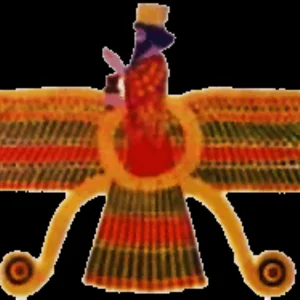

The supreme deity of Zoroastrianism, Ahura Mazda is the creator god of wisdom and light in the religion founded by Zoroaster (Zarathustra) around the 6th century BCE in Persia. He embodies the principle of Good, opposed to Ahriman, the principle of Evil, in a dualistic vision of the cosmos.
Ahura Mazda
Ahura Mazda
9 min read
Frequently asked questions
Key Facts
- Ahura Mazda means 'Wise Lord' in Old Persian
- He is at the heart of the Zoroastrian religion founded by Zarathustra around the 7th–6th century BCE
- His symbol, the fravashi (winged figure), is depicted on the bas-reliefs of Persepolis (5th century BCE)
- He stands opposed to Ahriman (Angra Mainyu), the principle of Evil, in a cosmic battle
- Zoroastrianism influenced the Abrahamic religions (Judaism, Christianity, Islam), particularly regarding the concepts of good and evil and the Last Judgment
Works & Achievements
Seventeen sacred hymns in Old Avestan directly attributed to the prophet Zoroaster, forming the founding text of Ahura Mazda's theology. They express a vision in which the wise god is the sole creator, opposed to the principle of Evil, in a direct relationship with the prophet.
A collection of 72 liturgical chapters forming the heart of the Zoroastrian service, containing prayers and invocations to Ahura Mazda. The Yasna is recited daily by priests during ceremonies of the sacred fire, keeping the ritual relationship with the god alive.
A corpus of inscriptions by Persian kings that systematically invoke Ahura Mazda's protection and credit him with their victories. These texts are the most direct historical source on the official cult of the god and his role as legitimizer of imperial power.
The section of the Avesta setting out the laws of ritual purity revealed by Ahura Mazda to Zoroaster, and detailing the cosmic opposition between the god and Ahriman through rules of daily life. The text illustrates how Zoroastrian religion permeates every aspect of existence.
A Pahlavi text describing the creation of the world by Ahura Mazda, the cosmic struggle against Ahriman, and the final eschatology. It is the principal source on Zoroastrian mythology and on Ahura Mazda's place in the cosmic cycle of creation, fall, and redemption.
Anecdotes
According to Zoroastrian tradition, the prophet Zoroaster (Zarathustra) received the revelation of Ahura Mazda around the age of 30, beside a river during a purification ritual. The god appeared to him in the form of a being of light and entrusted him with the mission of reforming the Iranian religion, proclaiming that he alone was the true god, opposed to the principle of Evil embodied by Ahriman.
The name 'Ahura Mazda' literally means 'Wise Lord' in Old Persian: 'ahura' denotes the lord and 'mazda' wisdom. This etymology reveals the essence of the god: his power rests not on brute force, but on an infinite wisdom capable of ordering the cosmos. It is one of the earliest conceptions of a god defined by intelligence rather than by violence.
Achaemenid kings such as Darius I and Xerxes I placed themselves under the direct protection of Ahura Mazda
inscribing on their palaces the formula:
A great god is Ahura Mazda, who created this earth, this sky, and mankind." By making the wise god their official protector, they legitimized their empire as a divine work in the service of Good.
Ahura Mazda is represented by the symbol of the Faravahar, a winged figure visible on the bas-reliefs of Persepolis: a man within a solar disk surrounded by eagle wings, holding a ring. This symbol, still worn today by Zoroastrians around the world, expresses the idea that the human soul is in constant movement toward divine perfection, guided by light.
Zoroastrianism, the religion founded around Ahura Mazda, profoundly influenced Judaism, Christianity, and Islam. The notions of final judgment, paradise, hell, a saving messiah, and the resurrection of the dead found in these three religions have their earliest parallels in Zoroastrian texts, making Ahura Mazda an indirect ancestor of the theology of the three monotheisms.
Primary Sources
I beseech you, O Ahura Mazda, with raised hands and reciting the true prayer… grant me through truth and good thought the blessings of existence and the powers of life.
By the grace of Ahura Mazda, I am king. Ahura Mazda granted me the kingdom. May the protection of Ahura Mazda be upon me.
A great god is Ahura Mazda, who created this earth, who created that sky, who created man, who created happiness for man, who made Darius king.
Ahura Mazda created first the light, then the waters, then the earth, plants, animals, and finally man. Ahriman, the evil spirit, attacked each of these creations to corrupt them, but Ahura Mazda repaired each assault through his wisdom.
By the grace of Ahura Mazda, I destroyed those sanctuaries of demons and proclaimed: “You shall not worship the demons!” Where the demons had been worshipped before, I paid homage to Ahura Mazda.
Key Places
Ceremonial capital of the Achaemenid Empire founded by Darius I around 518 BCE. Its palaces are covered with bas-reliefs depicting the Faravahar and inscriptions invoking Ahura Mazda, making this site the foremost archaeological testimony to the official worship of the god.
A cliff in the Kermanshah province where Darius I had a massive trilingual inscription carved recounting his victories under the protection of Ahura Mazda. This text, deciphered in the 19th century, unlocked the understanding of cuneiform and reveals Persian royal theology.
An Iranian city regarded as the heart of world Zoroastrianism, home to the Atash Behram fire temple whose flame has burned continuously since 470 CE. It remains today the principal living place of worship of Ahura Mazda.
An ancient city of Bactria associated in several traditions with the place of activity of Zoroaster, the prophet who revealed Ahura Mazda. This region of Central Asia was one of the earliest cradles of Zoroastrianism before its spread westward into the Persian world.
An extinct volcano in northwestern Iran associated in Zoroastrian tradition with the place of retreat and meditation of Zoroaster, where he is said to have received the revelations of Ahura Mazda. This mountainous site is still venerated as a holy place by Zoroastrian faithful.
Typical Objects

The main symbol of Ahura Mazda, fire represents his divine light and truth (Asha). In fire temples (ateshkadeh), a sacred flame is kept burning at all times and must never go out, as it symbolizes the continuous and eternal presence of the god.

A winged figure visible on the bas-reliefs of Persepolis: a male form within a solar disc surrounded by eagle wings, holding a ring. This symbol expresses the elevation of the soul toward Ahura Mazda through the practice of good, and remains the universal emblem of Zoroastrianism.

A bundle of plant stems (originally branches, later replaced by metal rods) held by the priest during Zoroastrian rituals. It symbolizes the connection between the living world and Ahura Mazda, and accompanies all recitations of the Avesta.

A sacred white wool cord that every Zoroastrian believer ties around their waist during the initiation ceremony. It is untied and retied several times a day while reciting prayers to Ahura Mazda, symbolizing the daily renewal of one's commitment to truth.

A collection of liturgical texts constituting the holy scripture of Zoroastrianism. The Avesta contains the Gathas (hymns of Zoroaster), prayers to Ahura Mazda, and descriptions of divine cosmogony, transmitted orally for centuries before being committed to writing.

A sacred plant whose pressed juice is consumed during Zoroastrian rituals and offered to Ahura Mazda as a sacrifice. Analogous to the Vedic soma, haoma symbolizes life and divine immortality, and its preparation is codified in the Avesta.
School Curriculum
Vocabulary & Tags
Key Vocabulary
Tags
Daily Life
Morning
According to Zoroastrian texts, Ahura Mazda radiates perpetually from the 'Light without Beginning' (Anagra Raocha), his eternal celestial kingdom. At dawn, his priests (Athravan) rise before the sun to ritually kindle the sacred fire — symbol of his divine presence — turning their backs to prevent their breath from defiling the flame, then recite the Gathas facing the rising east.
Afternoon
In mythological tradition, Ahura Mazda reigns over his six Amesha Spenta (Holy Immortals) — divine entities embodying truth, good thought, and piety — who administer the cosmos in his name. His worshippers offer him prayers and haoma during the midday ceremonies, the moment of greatest luminous intensity when the solar symbol of the Faravahar shines in its full glory.
Evening
At sunset — the symbolic hour of struggle between the light of Ahura Mazda and the darkness of Ahriman — the faithful recite the Kusti, untying and retying their sacred cord while pronouncing prayers, to renew their commitment to truth. The sacred fire burns throughout the night in the temples, affirming that divine light never yields to the powers of darkness.
Food
As Ahura Mazda is a purely spiritual being, the texts attribute no food to him whatsoever. His priests, however, consumed haoma during rituals — a pressed drink made from a sacred plant whose complex preparation was codified in the Avesta — and offered libations of pure water and milk, symbols of the god's creative purity.
Clothing
On Achaemenid bas-reliefs, Ahura Mazda is depicted in the form of the Faravahar: a male figure dressed in a long robe with carefully arranged folds, typical of Persian aristocracy. His priests wore a white tunic (sudreh) symbolizing purity, belted with the kusti, a sacred cord tied as a sign of obedience to the will of the wise god.
Housing
Ahura Mazda dwells in the 'Light without Beginning' (Anagra Raocha), the celestial abode described in the Avesta as a kingdom of pure and infinite radiance, opposed to the 'Darkness without End' (Anagra Temah) of Ahriman. On Earth, he is present in every fire temple (ateshkadeh) — a simple, unadorned structure centered on the sacred flame, his only visible 'body' in the material world.
Historical Timeline
Period Vocabulary
Liens externes & ressources
Références
Œuvres
Les Gathas
VIe siècle av. J.-C.
Yasna (Avesta liturgique)
VIe-IVe siècle av. J.-C.
Inscriptions royales achéménides (Persépolis, Behistun, Suse)
522-330 av. J.-C.
Vendidad (Loi contre les démons)
IVe siècle av. J.-C. - IIe siècle apr. J.-C.
Bundahishn (Grande Cosmogonie)
IXe siècle apr. J.-C. (traditions antiques)