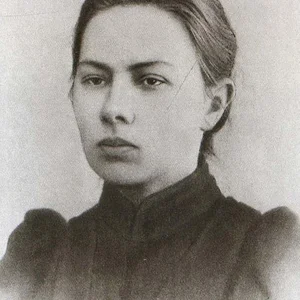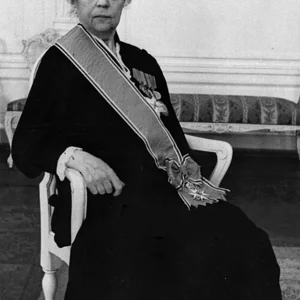

A Russian Bolshevik revolutionary, Alexandra Kollontai was one of the first women in the world to hold a diplomatic post. A theorist of socialist feminism, she championed women's emancipation and freedom from traditional marriage.
Frequently asked questions
Famous Quotes
« The new woman is free in her feelings as in her work.»
« Love is a social feeling, not a private privilege.»
Key Facts
- 1872: born in Saint Petersburg into an aristocratic family
- 1917: appointed People's Commissar of Social Welfare following the October Revolution
- 1923: becomes ambassador to Norway, the first female ambassador in modern history
- 1926–1930: ambassador to Mexico, then to Sweden
- 1952: died in Moscow at the age of 79
Works & Achievements
Kollontai's first major theoretical work, it bridges feminism and Marxism by analyzing the oppression of women as a product of capitalism. A founding text of Russian socialist feminism.
A comparative study of maternity protection policies across Europe, arguing for the collective assumption of motherhood by the socialist state, thereby freeing women from economic dependence on their husbands.
A polemical pamphlet denouncing the bureaucratization of the Soviet Communist Party and demanding workers' control of the economy. The text earned her fierce opposition from both Lenin and Trotsky.
A collection of three stories exploring new forms of love and romantic relationships in Soviet society. Scandalous to some, liberating to others, it remains her best-known literary work.
An autobiographical account in which Kollontai traces her journey as a revolutionary and feminist. A valuable document for understanding the tensions between political commitment and personal life in the early twentieth century.
Kollontai's diplomatic masterpiece, conducted from Stockholm: she facilitated secret contacts between Helsinki and Moscow, leading to the separate peace of September 1944 that brought Finland out of the Second World War.
Anecdotes
In 1917, Alexandra Kollontai was appointed People's Commissar for Social Welfare, making her one of the very first women to hold a ministerial position in modern history. She served in the Bolshevik government that came to power through the October Revolution — a world first that sent shockwaves through the chancelleries of Europe.
Kollontai was a formidable public speaker: at a rally in 1905, she addressed thousands of St. Petersburg workers despite Cossacks stationed at the doors. Her voice carried so far that people said she could 'turn a crowd like turning a glove inside out.'
In 1923, she published 'Love of Worker Bees,' a collection of short stories championing women's sexual and emotional freedom, which scandalized conservative circles and several Bolshevik leaders alike. Lenin himself criticized her theories on 'free' love, which he considered incompatible with revolutionary discipline.
Appointed ambassador to Norway in 1923, then to Mexico and Sweden, Kollontai became the first woman in history to hold the rank of plenipotentiary ambassador. Among her greatest achievements, she brokered the 1944 peace settlement between Finland and the USSR — a major diplomatic feat that earned her a nomination for the Nobel Peace Prize.
Born into a wealthy aristocratic family, Alexandra walked away at 26 from a comfortable marriage and a bourgeois life to join revolutionary circles. She left behind her engineer husband and her young son Mikhail to go into exile in Western Europe, where she moved in the same circles as Marx, Engels, and Rosa Luxemburg.
Primary Sources
A woman cannot be truly free as long as she remains economically dependent on man. Economic emancipation is the primary, sine qua non condition of any real liberation.
The new society demands a new type of relationship between the sexes, founded not on property or dependence, but on comradeship, equality, and mutual freedom.
The organization of the management of the national economy belongs to the trade unions. This is the fundamental principle that the Workers' Opposition defends against the growing bureaucratization of the Party.
I leave you my deepest conviction: no society can call itself just if it keeps half of its members in domestic subjugation and political invisibility.
My entire life has been lived under the sign of a double struggle: one for social revolution and one for the liberation of women. In my eyes, these two fights are absolutely inseparable.
Key Places
Kollontai's birthplace and the epicenter of her revolutionary involvement. It was here that she spoke during the events of 1905 and 1917, and where she was appointed to the first Bolshevik government.
The city where Kollontai studied political economy from 1898 and moved in European socialist exile circles, including Lenin and Plekhanov.
The first capital where Kollontai served as Soviet ambassador from 1923, marking a historic first in world diplomacy.
The longest diplomatic posting of her career (1930–1945), where she quietly negotiated the armistice between Finland and the USSR in 1944 — one of her greatest diplomatic achievements.
Kollontai briefly served as ambassador here in 1926–1927, helping to strengthen ties between the USSR and Latin American countries at a time of growing left-wing movements across the region.
Typical Objects

A symbol of her decades of exile and diplomatic missions, the suitcase accompanied Kollontai from Saint Petersburg to Zurich, from Stockholm to Mexico City. It held manuscripts, coded correspondence, and Marxist literature banned in tsarist Russia.

Kollontai was a prolific writer: pamphlets, short stories, diplomatic reports, correspondence — her pen never stopped. She often wrote at night, after long days of political meetings.

Hung in her various offices across Europe, Marx's portrait symbolized the theoretical foundation of her revolutionary commitment, a legacy of her years of study in Zurich.

As the world's first female ambassador, Kollontai had to navigate the dress codes of male-dominated diplomacy: she adopted elegant yet understated attire, asserting a feminine presence in spaces that had until then been exclusively reserved for men.

During the Second World War, Kollontai communicated with Moscow via coded telegrams from Stockholm. These messages played a crucial role in the secret peace negotiations between Finland and the Soviet Union.

Before 1917, Kollontai covertly transported and distributed Marxist pamphlets across Europe. These limited-print materials passed from hand to hand among workers' and socialist circles.
School Curriculum
Vocabulary & Tags
Key Vocabulary
Tags
Daily Life
Morning
Kollontai rose early, at 6:30 a.m., and spent the first hour of her day reading the international press and diplomatic dispatches. She ate a frugal breakfast — strong black tea, rye bread, and cottage cheese — before dictating the previous day's correspondence to her secretary.
Afternoon
Her afternoons were taken up with political meetings or diplomatic audiences, whether negotiating with Norwegian ministers or running Zhenotdel cells. She always found time to write: theoretical articles, short stories, confidential reports for Moscow.
Evening
Her evenings were often spent at diplomatic receptions, which she attended alone in an almost exclusively male environment. Back in her apartment, she would read Marx, Bebel, or Tolstoy, and sometimes begin lengthy correspondence with her revolutionary comrades scattered across Europe.
Food
Her diet was simple and unpretentious, shaped by years of exile and underground life: cabbage soup (shchi), buckwheat porridge, black bread, and plenty of tea. At official receptions, she adapted to local customs but ate little, preferring to observe and listen.
Clothing
Kollontai dressed carefully but soberly: dark suits (navy blue, charcoal grey), an immaculate white collar, sometimes a discreet brooch. She rejected bourgeois ostentation while still minding her appearance, well aware that her image as a woman diplomat was constantly scrutinized and judged.
Housing
During her years as ambassador, she lived in the official Soviet residences in Oslo, Mexico City, and then Stockholm — functional apartments she turned into places of work as much as of living. Her walls were lined with books, maps, and portraits of revolutionary figures.
Historical Timeline
Period Vocabulary
Visual Style
Esthétique constructiviste soviétique aux couleurs franches et géométriques, mêlée à la sobriété des intérieurs diplomatiques nordiques, reflétant la double identité révolutionnaire et diplomatique de Kollontaï.
Sound Ambience
Un mélange de bruits de machine à écrire, de meetings ouvriers animés et du silence feutré des salons diplomatiques scandinaves, évoquant la double vie de révolutionnaire et d'ambassadrice de Kollontaï.
Liens externes & ressources
Références
Œuvres
Les bases sociales de la question féminine
1909
Société et maternité
1916
L'Opposition ouvrière
1921
L'Amour des abeilles travailleuses (recueil de nouvelles)
1923
Autobiographie d'une femme sexuellement émancipée
1926
Négociation de l'armistice finno-soviétique
1944