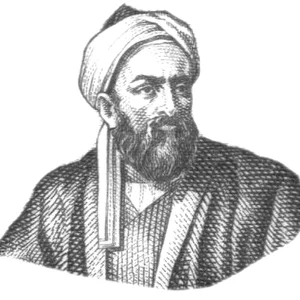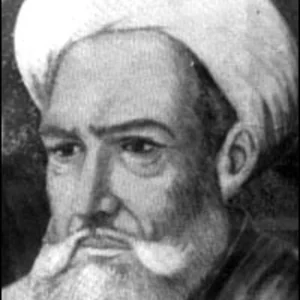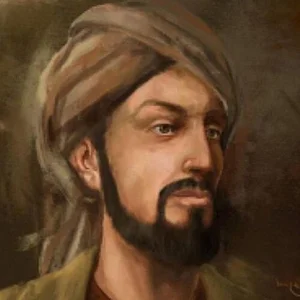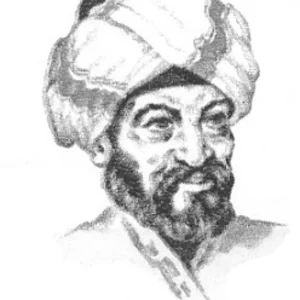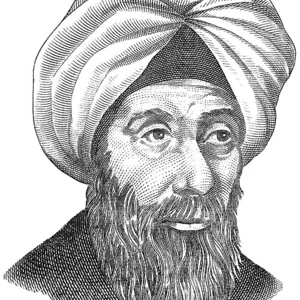

Arab mathematician, physicist, and astronomer born in Basra around 965 and died in Cairo in 1039. Considered the father of modern optics, he revolutionized the understanding of light and vision. His major work, the Kitāb al-Manāẓir, profoundly influenced European scholars of the Middle Ages.
Frequently asked questions
Key Facts
- Born around 965 in Basra (present-day Iraq) and died around 1039 in Cairo
- Wrote the Kitāb al-Manāẓir (Book of Optics) around 1011–1021, translated into Latin in the 12th century
- Demonstrated that vision results from light reflected by objects into the eye, refuting Greek theories
- Invented the camera obscura to study the rectilinear propagation of light
- A pioneer of the experimental method, he based his conclusions on observation and experimentation
Works & Achievements
A landmark scientific work in seven volumes that revolutionized the theory of vision and light, demonstrating through experiment that light travels from objects to the eye. Translated into Latin in the 12th century, it profoundly influenced Roger Bacon, Kepler, and Descartes.
A short treatise devoted to the nature of light, in which Alhazen demonstrates that the Moon is a sphere that reflects sunlight, and that every light source emits in all directions.
A treatise on physical astronomy that seeks to reconcile Ptolemy's mathematical models with a physical reality of the celestial spheres, foreshadowing later debates on the structure of the universe.
A treatise reflecting the breadth of Alhazen's interests, in which he also explored music theory in connection with mathematics and acoustics.
A work on statics and the principles of the balance, illustrating the experimental and mathematical approach that Alhazen applied across all areas of physics.
Alhazen measured and analyzed the refraction of light in the atmosphere, estimating its height at approximately 15 km — a value remarkably close to modern measurements.
Anecdotes
Alhazen, hoping to convince the Fatimid caliph Al-Hakim to fund a project to regulate the flooding of the Nile, proposed an ambitious system of dams. But once he arrived in Egypt, he realized the project was technically unfeasible. Fearing the caliph's wrath, he feigned madness for several years until Al-Hakim's death in 1021.
To prove his theory of vision, Alhazen built the first experimental camera obscura in history: a darkened room with a small hole that let light through. He observed the inverted image of the outside world projected onto the opposite wall, demonstrating that light travels in straight lines.
Unlike Greek scholars such as Euclid and Ptolemy, who believed the eye emits rays of light toward objects, Alhazen experimentally demonstrated the opposite: it is light reflected by objects that enters the eye. This conceptual revolution permanently transformed our understanding of vision.
Alhazen was one of the first thinkers to apply a rigorously experimental method to science. He repeated his experiments, varied the conditions, and recorded his observations with precision — an approach that foreshadows the modern scientific method by several centuries, long before Galileo and Descartes.
Primary Sources
Light travels in straight lines from every point of a luminous object in all directions. The eye perceives objects by means of the light rays that emanate from them and enter the eye.
The light of the sun and the light of the moon are of the same nature; the moon merely reflects sunlight. Every luminous body emits its light in all directions in a spherical manner.
Celestial bodies are solid spheres whose movements are regular and circular, and their arrangement can be deduced through reason and observation.
Alhazen measured the density of air and estimated the height of the atmosphere at approximately ten miles, by observing the duration of twilight.
Key Places
Alhazen's birthplace and a major intellectual and commercial center of the medieval Islamic world, where he received his early scientific and mathematical education.
The city where Alhazen spent most of his adult life, near the Fatimid Dar al-Hikma; it was here that he wrote his major works, including the Kitāb al-Manāẓir.
Capital of the Abbasid Caliphate and a world center of learning in Alhazen's era, home to the famous House of Wisdom where Greek and Persian texts were translated and compiled.
Alhazen proposed a flood regulation project on the Nile to Caliph Al-Hakim; after recognizing the technical impossibility of the undertaking, he feigned madness to escape the caliph's wrath.
Typical Objects

Alhazen was the first to scientifically describe and use the camera obscura — a darkened chamber with a small hole — to study the straight-line propagation of light and produce inverted images.

Alhazen conducted in-depth studies of curved mirrors, mathematically analyzing the reflection of light and laying the groundwork for what became known as "Alhazen's problem" — determining the point of reflection on a curved mirror.

The essential tools of any medieval Arab scholar, the reed pen (qalam) and ink allowed Alhazen to record his observations, geometric proofs, and treatises in classical Arabic.
An astronomical measuring instrument used by Alhazen in his studies of the altitude of celestial bodies, atmospheric refraction, and his estimates of the height of Earth's atmosphere.

Indispensable geometric instruments for Alhazen, whose work in optics was grounded in rigorous mathematical proof drawing on Euclidean geometry.

A light source used in Alhazen's experiments on the propagation of light; he used it to demonstrate that every point on a light source emits light in all directions.
School Curriculum
Vocabulary & Tags
Key Vocabulary
Daily Life
Morning
Alhazen rose before dawn for the Fajr prayer, then devoted the early hours of the day to reading and reviewing his notes. After a light meal of bread and dates, he would begin his writing or geometric calculations in the morning light, which he considered most favorable for observation.
Afternoon
Afternoons were reserved for optical experiments in his specially arranged dark chamber, or for verifying his mathematical calculations. He sometimes received students or copyists tasked with transcribing his treatises, and corresponded by letter with other scholars across the Islamic world.
Evening
In the evening, after the Maghrib prayer, Alhazen continued his astronomical observations, studying the refraction of starlight near the horizon. He would dictate or write up his conclusions by the light of an oil lamp, before the Isha prayer that closed his day.
Food
Like any observant Muslim scholar, Alhazen followed Islamic dietary laws: halal meats, legumes, bread, rice, figs, and dates. In Fatimid Cairo, he had access to a rich cuisine featuring Nile vegetables, fish, Eastern spices, and olive oil.
Clothing
Alhazen wore the typical dress of a learned man in 11th-century Fatimid Cairo: a long robe (djellaba or qamis) in linen or cotton depending on the season, a white or colored turban indicating his scholarly status, and soft leather sandals. In cooler weather, he added a woolen cloak (bisht).
Housing
Alhazen most likely lived in a courtyard house (dar) typical of Fatimid Cairene architecture, organized around a patio with a fountain. His workroom was specially fitted out for his experiments, with shutters that allowed him to control the amount of light entering the space.
Historical Timeline
Period Vocabulary
Visual Style
Style miniature islamique fatimide du XIe siècle, avec arabesques dorées, calligraphie coufique et jeux de lumière géométriques reflétant les travaux d'optique d'Alhazen.
Sound Ambience
Atmosphère studieuse d'une medersa cairote médiévale : calame sur parchemin, appel à la prière, bruissement de la ville arabe et tintement discret des instruments d'optique dans la pénombre.
Liens externes & ressources
Références
Œuvres
Kitāb al-Manāẓir (Livre d'optique)
vers 1011-1021
Maqāla fī al-Daw' (Traité sur la lumière)
vers 1010
Maqāla fī Hay'at al-'Ālam (Traité sur la configuration du monde)
vers 990
Kitāb al-Mūsīqā (Traité sur la musique)
vers 1020
Maqāla fī al-Qarastun (Traité sur la balance)
vers 1025
Traité sur la réfraction atmosphérique
vers 1020