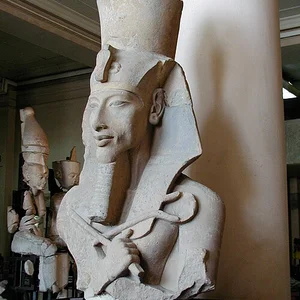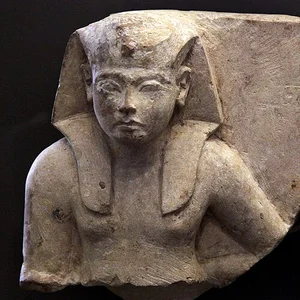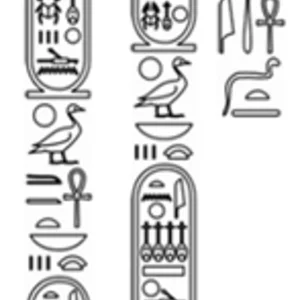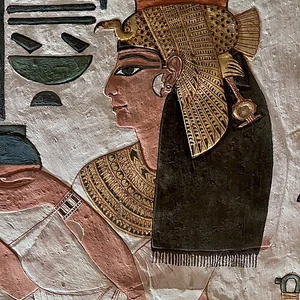

Pharaoh of the 18th Egyptian dynasty (c. 1391–1353 BC), he ruled Egypt at the height of its diplomatic and artistic power. His reign was marked by relative peace, intensive building activity, and exceptional cultural refinement.
Amenhotep III(1399 av. J.-C. — 1350 av. J.-C.)
Amenhotep III
Égypte antique
10 min read
Frequently asked questions
Key Facts
- Reigned from approximately 1391 to 1353 BC during the 18th Dynasty
- Built the Temple of Luxor and expanded the Karnak complex
- Erected the Colossi of Memnon at Thebes, standing 18 meters tall
- Father of Amenhotep IV (later Akhenaten), who would revolutionize Egyptian religion
- Conducted intensive diplomatic exchanges with Mitanni, Babylon, and the Hittite kingdom through the Amarna Letters
Works & Achievements
A masterpiece of New Kingdom architecture dedicated to the Theban triad (Amun, Mut, and Khonsu), begun by Amenhotep III and completed by Ramesses II. Its colonnades with open papyrus-capital columns and harmonious proportions make it one of the most beautiful religious complexes of the ancient world.
The largest mortuary temple ever built in Egypt, guarded by two 18-meter quartzite colossi. Though largely destroyed, it originally housed hundreds of royal statues, sphinxes, and stelae, some of which are preserved in the Cairo Museum.
A temple built in Nubia dedicated to Amun-Ra and to the pharaoh's own living divinity. Its finely carved reliefs — some depicting Amenhotep III making offerings before his own divine statue — bear witness to the exceptional artistic refinement of his reign.
A palatial complex spanning several hectares, including royal residences, temples, storehouses, workshops, and an artificial lake. Excavations have uncovered remarkably delicate wall paintings depicting birds, fish, and plants of the Nile.
Amenhotep III constructed the third pylon of the great Temple of Amun at Karnak, incorporating blocks from earlier monuments into its foundations. This massive structure reflects his determination to inscribe his name in Egypt's most powerful sanctuary.
A unique set of over 200 faience scarabs distributed throughout the empire to announce official events of the reign — royal marriages, hunts, and building projects. These objects represent an exceptional primary historical source with no equivalent elsewhere in pharaonic history.
Anecdotes
Amenhotep III had hundreds of blue faience scarabs crafted to commemorate the great occasions of his reign: his marriage to Tiye, his lion hunts, the construction of the royal lake. These small engraved objects circulated as far as Syria and Nubia, serving both as good-luck charms and as official bulletins of pharaonic power.
The so-called 'lion hunt scarabs' record that Amenhotep III killed no fewer than 102 lions during the first ten years of his reign. This feat, perhaps partly symbolic, asserted his divine power: the pharaoh, like the god Ra, was vanquishing the chaos embodied by wild beasts.
To honor his Great Royal Wife Tiye — who was of non-royal origin, the daughter of a provincial nobleman — Amenhotep III had an artificial lake nearly 2 kilometers long dug in just fifteen days near his palace at Malkata. The first ceremonial sailing on this lake was celebrated with a series of commemorative scarabs bearing the inscription 'Aten gleams.'
Amenhotep III went further than any pharaoh before him: he had himself worshipped as a living god during his own lifetime, identified with Amun-Ra. At Soleb, in Nubia, he dedicated a temple to his own divinity — an exceptional practice that prefigures the divine cults of the Ptolemaic pharaohs.
The two Colossi of Memnon, statues approximately 18 meters tall carved from red quartzite, guarded the entrance to his mortuary temple on the west bank of Thebes. After an earthquake in the 1st century BC, one of them began emitting a strange sound each morning at sunrise that Greek travelers identified as the voice of the Trojan hero Memnon greeting his mother, the goddess of Dawn.
Primary Sources
"In year 1, under the majesty of King Nebmaatre, son of Re Amenhotep ruler of Thebes, given life, and of the Great Royal Wife Tiye, may she live. The name of her father is Yuya, the name of her mother is Thuya. She is the wife of a mighty king whose southern border is at Karoy and whose northern border is at Naharina."
"List of lions that His Majesty killed with his own hand from year 1 to year 10: 102 fierce lions."
"His Majesty commanded that a lake be dug for the Great Royal Wife Tiye in the town of her father Djarukha. Its length is 3,700 cubits, its width 700 cubits. His Majesty celebrated the festival of the opening of the lake in the third month of the first season, on the first day, when His Majesty sailed upon it in the barque Aten-gleams."
"Why has my brother not sent me a daughter in marriage? If you give me a daughter, I will send you back gold in great quantity." Amenhotep III replies by justifying Egyptian matrimonial policy and the restrictions placed on royal unions.
The temple is dedicated to Amun-Re and to a deified Amenhotep III himself, designated as "Nebmaatre, lord of Nubia." The reliefs show the pharaoh officiating before his own divine image, attesting to the royal cult practiced during his lifetime.
Key Places
The religious capital and main residence of Amenhotep III, Thebes was home to the great temples of Amun-Ra. It was here that he built the Temple of Luxor and greatly expanded the Karnak complex, erecting the third pylon.
A vast royal palace built on the western bank of the Nile, comprising royal apartments, temples, workshops, and the famous artificial lake dug for Queen Tiye. It is the largest known palatial complex of the New Kingdom, its halls adorned with vivid nature paintings.
Two colossal statues standing roughly 18 meters tall in red quartzite once marked the entrance to Amenhotep III's mortuary temple, the largest ever built in Egypt. They became a tourist attraction in Greek antiquity after an earthquake caused one of them to emit a mysterious "singing" sound.
A temple built in Nubia and dedicated to Amun-Ra as well as to the living deity of the pharaoh himself. It reflects the reach of Egyptian influence and stands as one of the earliest examples of a royal cult devoted to a reigning sovereign during his own lifetime.
The ancient administrative capital of Egypt where Amenhotep III maintained a secondary court and commissioned several monuments. The city remained a major economic and political hub, serving as a gateway for international trade with the Near East.
Typical Objects

A combination of the red crown of Lower Egypt and the white crown of Upper Egypt, worn by the pharaoh to symbolize his sovereignty over the Two Lands. Amenhotep III is frequently depicted wearing the pschent during official ceremonies and in the reliefs of Luxor.

The crook (heqa) and the flail (nekhekh), royal regalia held crossed over the chest, symbolize the pharaoh's authority over his people and his role as shepherd of humanity. They appear consistently in official representations of Amenhotep III in the Osirian pose.

Amenhotep III had hundreds of blue-green faience scarabs produced to announce major events of his reign — marriages, hunts, and building projects. Distributed to foreign courts and temples, these objects served a unique role as official royal propaganda.

The rearing cobra affixed to the pharaoh's forehead, symbol of the goddess Wadjet protecting the king from his enemies. On the colossi and the many surviving statues of Amenhotep III held in museums around the world, the uraeus is carved with extraordinary care.

A broad, semicircular pectoral collar made of gold, carnelian, turquoise, and lapis lazuli, emblematic of the divine status of the pharaoh and high dignitaries. The reign of Amenhotep III is associated with an exceptional refinement in royal jewelry-making.

Amenhotep III is famous for his lion-hunting exploits, commemorated on official scarabs. The bow symbolized royal valor and the pharaoh's ability to push back chaos — a fundamental divine duty of every pharaonic monarchy.

Used to preserve the organs of the deceased during mummification, with stoppers shaped as divine heads. Canopic jars bearing the name of Amenhotep III, discovered in the Valley of the Kings, bear witness to the exceptional luxury of his funerary preparations.
School Curriculum
Vocabulary & Tags
Key Vocabulary
Tags
Daily Life
Morning
Amenhotep III rose before dawn to take part in the awakening rituals of the god Amun in the inner sanctuary of the temple, assisted by the high priests. As son of the god, the pharaoh was theoretically the only one entitled to open the naos, wash and dress the divine statue, and present the morning offerings. These ceremonies gave strict structure to the beginning of each day.
Afternoon
Afternoons were devoted to affairs of state: audiences with the two viziers (for the North and the South), receiving tribute from the provinces and foreign ambassadors, and dictating decrees to scribes. Amenhotep III also conducted an intense diplomatic correspondence with the rulers of Babylon, Mitanni, and Arzawa, exchanging gold, diplomatic gifts, and princesses in marriage.
Evening
Evenings at the palace of Malkata were given over to banquets and court entertainment. Musicians played the lyre, lute, and double flute; Nubian dancers performed for the guests. The pharaoh and Tiye presided over these festivities surrounded by their family and senior dignitaries, in halls whose walls were painted with scenes of Nilotic nature.
Food
The royal table was richly supplied: several types of oven-baked bread, roasted meats (beef, duck, goose), dried or grilled fish from the Nile, vegetables (onions, leeks, lettuce), fruits (figs, dates, grapes, pomegranates), and honey cakes. Quality barley beer was the everyday drink; wine from the oases or the Delta was reserved for special occasions and ceremonies.
Clothing
Amenhotep III wore a fine, immaculate white linen kilt held in place by a golden belt, complemented by a pleated triangular apron for official ceremonies. A black wig streaked with gold thread, or the blue-and-gold striped nemes headdress, covered his head, topped by the double crown or the blue khepresh war crown in battle. His jewelry — a broad usekh collar in gold, scarab bracelets, carnelian rings — announced his divine rank.
Housing
The palace of Malkata, on the western bank of the Nile opposite Thebes, was a complex spanning several hectares that included the main palace, Tiye's apartments, the royal harem, storehouses, workshops, and several small temples. The walls were plastered and decorated with brightly colored paintings depicting the plants, birds, and fish of the Nile. The floors of the reception halls were painted in blue-green, evoking the waters of the great river.
Historical Timeline
Period Vocabulary
Visual Style
L'art d'Amenhotep III représente l'apogée du raffinement égyptien : des visages royaux idéalisés aux traits doux et sereins, un modelé sculptural d'une finesse inégalée, et une palette dominée par l'or solaire, le bleu lapis-lazuli et le blanc calcaire.
Sound Ambience
L'atmosphère sonore d'Amenhotep III mêle les chants liturgiques des prêtres d'Amon, le bruit sourd des grands chantiers de construction et les mélodies raffinées des musiciens de cour dans les palais de Thèbes.
Liens externes & ressources
Références
Œuvres
Temple de Louxor
v. 1380 av. J.-C.
Colosses de Memnon et temple funéraire de Kom el-Hetan
v. 1360 av. J.-C.
Temple de Soleb (Nubie)
v. 1370 av. J.-C.
Troisième pylône de Karnak
v. 1375 av. J.-C.
Série des grands scarabées commémoratifs
v. 1391–1353 av. J.-C.