
Anat is a warrior goddess of the Ugaritic pantheon (ancient Syria), venerated in the 2nd millennium BCE. A fierce virgin warrior, she is the sister of the god Baal and ranks among the most formidable deities of the ancient Near East.
Anat
Anat
8 min read
Frequently asked questions
Key Facts
- Attested in the cuneiform texts of Ugarit (Ras Shamra, modern-day Syria) as early as the 14th century BCE.
- Described in Ugaritic myths as a goddess who slaughters her enemies in an ecstatic frenzy of violence.
- Sister and companion of the storm god Baal, she avenges him against Mot, the god of death.
- Also venerated in Egypt during the New Kingdom, notably by Ramesses II, who regarded her as his protector.
- Her cult extended across the Levant, Mesopotamia, and Egypt, reflecting the cultural exchanges of the Late Bronze Age.
Works & Achievements
A major Ugaritic mythological poem recounting Baal's battles to dominate the cosmos, in which Anat plays the crucial role of avenging warrior and protector of the storm god. It is the richest text for understanding her divine personality.
A Ugaritic myth in which Anat covets the bow of a human hero and plots his death when he refuses to give it up. This story reveals the dark, jealous side of the goddess, capable of violent acts even against mortals.
Fragments of liturgical hymns sung in honor of Anat during ceremonies at Ugarit, describing her beauty, her strength, and her role as protector of kingship. They testify to the cultic and ritual dimension of her worship.
A mythological text written in Egypt drawing on Canaanite traditions, in which Anat is sent by El to appease the god of the sea. This papyrus proves the international spread of Ugaritic myths.
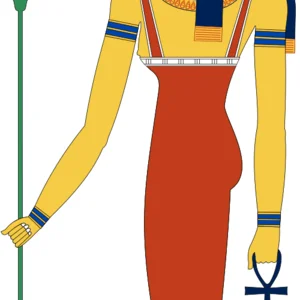
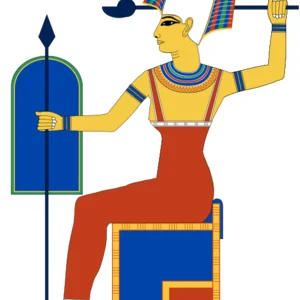
A collection of steles and pictorial representations found in Egypt depicting Anat as a helmeted warrior holding a spear and shield, sometimes seated on a throne. They testify to her integration into the official religion of the pharaohs.
Anecdotes
In the Baal Cycle, the Ugaritic tablets describe Anat massacring warriors in a palace hall with terrifying frenzy: she wades through blood up to her knees and ties the severed heads of her enemies to her back, their hands to her belt. This hyperbolic scene is not a simple tale of violence, but a symbolic demonstration of the absolute power of a goddess whom nothing can stop.
Anat is designated in Ugaritic by the title *btlt*, translated as 'virgin' or 'young girl'. This term does not necessarily imply chastity in the modern sense, but the fierce independence of a goddess who cannot be subjugated, dominated, or possessed by any man or any god. This paradox — invincible warrior and untamed maiden — makes her unique throughout the entire ancient Near East.
When Mot, the god of death, kills her beloved brother Baal, Anat does not grieve for long. She goes alone to confront Mot, seizes him, cuts him with a sickle, sifts him like grain, burns him, and grinds him to dust. This spectacular act of vengeance, described in the Ras Shamra tablets, makes her the guardian of the cosmic order and the only being capable of breaking the cycle of death.
In Egypt, from the New Kingdom onward (around 1550 BCE), Anat was adopted into the Egyptian pantheon as a foreign warrior goddess. Ramesses II held a particular devotion to her: he gave her name to one of his daughters — *Bint-Anat*, literally 'Daughter of Anat' — and invoked her protection for his warhorses during the famous Battle of Kadesh in 1274 BCE.
A mythological text discovered in Egypt, sometimes called “The Tale of Anat and Yam,” features Anat and the goddess Astarte sent by the supreme god El to appease Yam, the furious god of the sea. This text, copied by Egyptian scribes, proves that Ugaritic myths traveled far from their Syrian homeland and circulated throughout the eastern Mediterranean during the Late Bronze Age.
Primary Sources
Anat fights in the valley, she strikes the peoples of the seashore, she slaughters the men of the east. Heads roll beneath her like balls, hands fly above her like locusts.
Anat covets the bow of the young hero Aqhat and offers him immortality in exchange. When he refuses, she plots his death, illustrating the dark and merciless side of the goddess.
Anat and Astarte are like a shield for you, O pharaoh. By their power, your enemies fall beneath your war horses.
El said: 'Anat and Astarte, go and bring tribute to Yam, lord of the sea.' The two goddesses departed, their hearts trembling like a bird, toward the throne of the god of the waters.
Key Places
A Canaanite city-state on the Syrian coast where the cult of Anat was central and where the mythological tablets describing her were written. It was the heart of her worship during the 2nd millennium BCE.
The sacred mountain of the Ugaritic pantheon, mythical home of the god Baal and a place of residence associated with Anat. Rising to 1,770 meters and visible from the entire coastline, this mountain was considered the axis of the world.
The great Egyptian capital where Anat was integrated into the local pantheon during the New Kingdom, with a temple dedicated to her cult. It was from Memphis that her image spread throughout the Egyptian empire.
A Canaanite city where a stele dedicated to Anat was discovered, attesting to the spread of her cult far beyond Ugarit, reaching into Palestine. This strategically important military site was placed under her protection.
Typical Objects

Anat's primary weapon in the Ugaritic texts, the lance embodies her role as an invincible warrior. She wields it during her mythical massacres and hurls it at her enemies like a thunderbolt sent by the gods.

The tool and weapon with which Anat dismembers the god Mot to avenge Baal's death. The sickle, an agricultural harvesting tool, takes on a cosmic dimension here: Anat “harvests” death itself in order to bring life back.

A symbol of the divine protection Anat grants her allies, especially the kings and armies who invoke her. In Egypt, texts liken her to a living shield for the pharaoh on the battlefield.

In the Legend of Aqhat, Anat passionately covets the human hero's exceptional bow, going so far as to offer him immortality in exchange for it. The bow is thus associated with her aspect as a huntress and her relentless drive for power.

The Ugarit tablets describe Anat clad in blood after her battles — a striking image that captures her total immersion in combat. She washes her hands in the blood of warriors before readying herself for new feats of arms.

Objects recovered from Ugaritic sanctuaries, inscribed in alphabetic cuneiform, on which scribes recorded the prayers and myths dedicated to Anat. These tablets are the only direct testimony of her cult that survives.
School Curriculum
Vocabulary & Tags
Key Vocabulary
Daily Life
Morning
In the Ugaritic mythic imagination, Anat begins her day by arming herself with her spear and shield, patrolling the boundaries of the cosmos to ensure that no threat hangs over the order established by El and Baal. The priests of Ugarit would recite formulas at dawn to invoke her protective vigilance over the city.
Afternoon
The texts describe Anat at the heart of her mythic battles during the height of the day, confronting the forces of chaos — whether enemy armies or rival gods such as Mot. In the sanctuaries, afternoon rituals were dedicated to her, with offerings of meat and wine poured upon the altar.
Evening
In the evening, Anat is described in the texts as returning victorious, her hands red from battle, before washing and feasting with the other gods on Mount Sapanu. The divine banquets were occasions for singing and celebration, and the priests would re-enact these sacred feasts during nocturnal ceremonies held in her honor.
Food
In the divine banquets described by the Ugaritic texts, the gods feast on beef, mutton, wine, and olive oil — the prized foods of the Levant in the Late Bronze Age. The offerings made to Anat in the temples reflected these preferences: sacrificed animals, jars of wine, and barley flatbreads.
Clothing
Anat is depicted wearing a short warrior tunic, sometimes a feathered or horned helmet as a symbol of divine power, and a round shield. In Egypt, artists portray her with the atef crown or a warrior goddess headdress, blending Levantine iconography with Egyptian visual conventions.
Housing
Anat's mythic home is Mount Sapanu, the sacred mountain of the Ugaritic gods, where she shares her brother Baal's celestial palace of cedar and gold. The priests of Ugarit dedicated a space to her within the city's great temple, whose archaeological excavations have revealed traces of ritual burning and votive offerings.
Historical Timeline
Period Vocabulary
Liens externes & ressources
Références
Œuvres
Le Cycle de Baal (tablettes KTU 1.1–1.6)
vers 1400–1200 av. J.-C.
La Légende d'Aqhat (tablette KTU 1.17–1.19)
vers 1400–1200 av. J.-C.
Hymne à Anat (fragments de Ras Shamra)
vers 1350 av. J.-C.
Papyrus Chester Beatty VII — Conte d'Anat et Yam
vers 1200 av. J.-C.
Stèles votives égyptiennes (Nouvel Empire)
vers 1550–1070 av. J.-C.