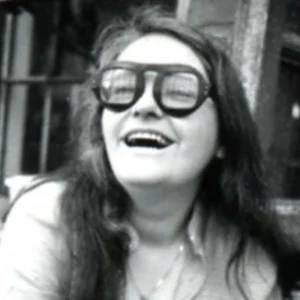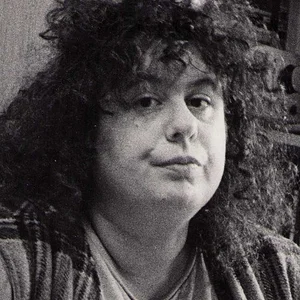

A radical American feminist (1946–2005), Andrea Dworkin is known for her theoretical work on pornography, violence against women, and patriarchy. A prolific activist and essayist, she profoundly shaped the feminist movement of the 1970s–1990s.
Frequently asked questions
Famous Quotes
« Pornography is the theory, rape is the practice.»
« Equality is not a concept. It is not something we feel. It is something we do.»
Key Facts
- 1946: Born in Camden, New Jersey
- 1974: Publication of 'Woman Hating', her first major essay
- 1979: Co-founded the feminist anti-pornography movement with Catharine MacKinnon
- 1981: Publication of 'Pornography: Men Possessing Women', a central theoretical work
- 2005: Died in Washington D.C. at the age of 58
Works & Achievements
Dworkin's first major theoretical essay, analyzing misogyny in fairy tales, pornography, and cultural practices. A foundational work of American radical feminism in the 1970s.
A systematic, documented analysis of the pornography industry as a system of male power over women. The text sparked a worldwide debate and remained the theoretical reference of the feminist anti-pornography movement for two decades.
An essay that seeks to understand why some women support conservative policies that run counter to their own interests. Dworkin analyzes female complicity with patriarchy as a survival strategy within a hostile system.
Dworkin's most controversial work, analyzing heterosexual intercourse through the lens of male dominance in a patriarchal context. Frequently misquoted and misunderstood, it provoked fierce controversy in both feminist and conservative circles.
An intense autobiographical novel in which a young woman named Andrea endures repeated sexual violence from childhood into adulthood. The book fuses personal testimony and theoretical critique in a radically charged narrative form.
A collection of essays and speeches spanning twenty years of feminist activism, addressing prostitution, pornography, rape, and political resistance. A clear-eyed and combative stocktaking of her thought at the close of the twentieth century.
Political memoirs in which Dworkin traces the disillusions and victories of her life as an activist. A testament text marked by anger and dignity, written three years before her death.
Anecdotes
In 1965, at just 18 years old, Andrea Dworkin was arrested during an anti-Vietnam War protest outside the United Nations in New York. While in custody, she was subjected to a forced and brutal gynecological examination, which she publicly denounced. This trauma became one of the cornerstones of her radical commitment against institutional violence toward women.
After her marriage to Dutch anarchist Ivar Drogghe in Amsterdam in 1969, Andrea Dworkin endured years of severe domestic abuse. She managed to escape to the Netherlands in 1971 with the help of other women, and this personal experience directly shaped her entire theoretical framework on male violence and patriarchy.
In 1983, Andrea Dworkin collaborated with feminist legal scholar Catharine MacKinnon to draft a groundbreaking municipal ordinance in Minneapolis that defined pornography as a violation of women's civil rights. It was the first time a law treated pornography not as a question of morality but as sex discrimination — an unprecedented legal approach that caused an uproar.
When testifying before the Meese Commission on Pornography in 1986 in Washington, Dworkin delivered a one-hour speech that moved several commission members to tears. With clinical precision, she described the mechanisms of exploitation and violence present in the pornography industry, forcing her audience to confront realities society preferred to ignore.
Andrea Dworkin was known for writing while standing at a tall table, for hours on end. She produced her essays in a near-trance state, refusing to stop as long as the ideas kept flowing. Her manuscripts were often covered in crossings-out and penciled additions — evidence of a mind that built its arguments directly on the page.
Primary Sources
Porn is the theory, and rape is the practice. The hatred of women is a source of sexual pleasure for men in this culture.
In pornography, women are defined as objects to be dominated, used, hurt, and discarded. The power is all on one side; the submission and the injury are on the other.
Intercourse remains a means, or the means, of physiologically making a woman inferior: communicating to her cell by cell her own inferior status, impressing it on her, making it real.
I am here asking the Attorney General of the United States to help women in this country who are being hurt by pornography. We are not here to argue about the First Amendment. We are here about the fact that women are being hurt.
The measure of women's oppression is that we are not believed about our own lives. We tell what happens to us and no one believes us.
Key Places
An industrial working-class city in New Jersey where Andrea Dworkin was born on September 26, 1946, into a middle-class Jewish family. Her father, Harry Dworkin, was a teacher and union activist — influences that would leave a lasting mark on her political consciousness.
Dworkin lived in Amsterdam from 1968 to 1971, initially with her abusive husband Ivar Drogghe. It was there that she experienced extreme poverty, coerced prostitution, and domestic violence — formative experiences that would shape her entire feminist theory on patriarchy and the exploitation of women.
The city where Dworkin settled permanently from the 1970s onward and produced the bulk of her theoretical work. She became an active part of New York's radical feminist intellectual and activist scene, moving in circles of writers and organizers.
In 1983, Dworkin and MacKinnon drafted and argued their landmark anti-pornography ordinance before the City Council. Though the ordinance was adopted twice by the council, it was each time struck down by the mayor or the federal courts.
Dworkin testified here before the Meese Commission in 1986 and died here on April 9, 2005. The federal capital was the stage for several of her most significant political and legal battles for the recognition of women's rights.
Typical Objects

Andrea Dworkin produced a considerable body of work — essays, novels, and speeches. She would write for hours at a time, often late into the night, surrounded by handwritten notes and research documents.

Dworkin wore denim work overalls almost exclusively throughout her life, as a conscious rejection of the feminine dress codes imposed by patriarchal society. This choice of clothing became her trademark and a political statement in its own right.

A voracious reader and tireless researcher, Dworkin drew on a dense library of philosophical, legal, and literary texts to build her arguments. She cited Nietzsche just as readily as police reports on domestic violence.

A powerful and formidable speaker, Dworkin delivered hundreds of speeches at universities, courtrooms, and activist rallies. Her voice and stage presence were widely recognized as major political tools throughout her years of activism.

The collaboration with attorney Catharine MacKinnon produced unprecedented legal documents — ordinances, briefs, testimonies — that sought to translate feminist theory into American positive law.

An activist since the age of 18, Dworkin took part in countless direct actions against the Vietnam War, and later against pornography and violence against women. The leaflets she wrote and distributed in the 1970s are now considered archival documents of feminist history.
School Curriculum
Vocabulary & Tags
Key Vocabulary
Tags
Daily Life
Morning
Dworkin often rose late, having worked through part of the night. She began her day with intensive reading — press, activist correspondence, books in progress — and prepared her notes for upcoming writing or lectures. She lived simply, in modest New York apartments.
Afternoon
Afternoons were devoted to writing, standing at a high table, or to activist meetings and speech preparation. She frequently met with legal scholars, feminist activists, or survivors of violence to inform her research and political work.
Evening
Dworkin often spent evenings at academic conferences, public readings, or feminist organization meetings. She was also known for animated late-night discussions with fellow intellectuals and activists, centered on questions of political strategy or feminist theory.
Food
Dworkin frequently lived under difficult financial circumstances, particularly during her younger years in Amsterdam and New York. Her diet was frugal and unpretentious — she paid little attention to food compared to her intellectual and activist work.
Clothing
Her signature look was denim overalls worn over a simple t-shirt or shirt, with flat, comfortable shoes. This deliberate choice rejected the codes of femininity imposed by society and asserted that women's bodies were not objects of adornment for the male gaze.
Housing
Dworkin lived in modest housing in New York, sometimes in conditions of considerable precarity. She shared her apartment for many years with her partner John Stoltenberg, a feminist author. Her living space was overrun with books, files, and manuscripts in progress.
Historical Timeline
Period Vocabulary
Liens externes & ressources
Références
Œuvres
Woman Hating
1974
Pornography: Men Possessing Women
1981
Right-Wing Women
1983
Intercourse
1987
Life and Death: Unapologetic Writings on the Continuing War Against Women
1997
Heartbreak: The Political Memoir of a Feminist Militant
2002