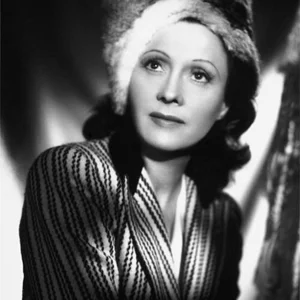

French actress and singer (1898–1992), an icon of French cinema in the 1930s and 1940s. Discovered by Marcel Carné, she is best remembered for her roles in *Children of Paradise* and *Hôtel du Nord*.
Arletty(1898 — 1992)
Arletty
France
7 min read
Frequently asked questions
Famous Quotes
« Atmosphere, atmosphere — do I look like the atmospheric type?»
Key Facts
- 1898: born in Courbevoie under the name Léonie Bathiat
- 1938: memorable role in Marcel Carné's *Hôtel du Nord*
- 1945: filming of *Children of Paradise* (1945), a masterpiece of French cinema
- 1945: arrested at the Liberation for her romantic involvement with a German officer
- 1992: died in Paris at the age of 94
Works & Achievements
A film by Marcel Carné, with a screenplay by Henri Jeanson. Arletty plays Raymonde and delivers the famous line "Atmosphère!", which immediately entered the collective memory of French cinema.
A masterpiece by the Carné-Prévert duo, starring Jean Gabin. Arletty plays Clara, the devoted lover of a hunted factory worker; the film is considered the pinnacle of French poetic realism.
A medieval fantasy film made in the midst of the Occupation, in which Arletty plays Dominique, a servant of the devil. At the time, it was widely read as an allegory of spiritual resistance against Nazism.
The undisputed masterpiece of French cinema, directed by Marcel Carné from a screenplay by Jacques Prévert. Arletty plays Garance, a free-spirited courtesan of the Boulevard du Temple; the film is consistently ranked among the greatest films in the history of world cinema.
Before her film career, Arletty honed her craft in Parisian revues and music halls, developing the sense of rhythm, comic timing, and stage presence that would set her screen performances apart.
Anecdotes
Léonie Bathiat, born in Courbevoie into a working-class family, chose the pseudonym "Arletty" in tribute to an operetta character she had played on stage in the early 1920s. This improvised nickname became an identity in its own right, to the point that she never signed her name any other way than this single first name.
During the filming of Hôtel du Nord (1938), screenwriter Henri Jeanson wrote for Arletty the line "Atmosphère! Atmosphère!… Do I look like I've got any atmosphere?
delivered with such nonchalance that it sealed the scene in legend. This tirade is today one of the most famous quotes in French cinema
reproduced in dozens of advertisements
stage plays
and television programs.
During the Occupation
Arletty had a love affair with Hans Jürgen Soehring
an officer in the German Luftwaffe. At the Liberation of Paris in 1944
she was arrested for
sentimental collaboration
and placed under supervised house arrest at the Château de La Houssaye-en-Brie. To justify her conduct
she reportedly declared with her characteristic irony:
My heart is French, but my ass is international.
The filming of Children of Paradise (1943–1944) was an extraordinary challenge: made in the midst of the Occupation, the film secretly employed several resistance fighters and Jewish people hidden among the extras and crew. Arletty plays Garance, the character of a free-spirited courtesan, in what is often ranked among the greatest films in French cinema history.
Toward the end of her life, Arletty gradually lost her sight due to serious eye complications. Blind in her final years, she continued to give interviews with the same sharp wit and irony that had made her famous. She died in Paris on July 24, 1992, at the age of 94.
Primary Sources
Atmosphere! Atmosphere!… Do I look like someone with atmosphere?
I am like water, I take the shape of whatever vessel I am poured into… but I always remain water.
My heart is French, but my ass is international.
I never took myself seriously. What interested me was freedom. Freedom of tone, freedom of manner, freedom pure and simple.
Key Places
A working-class town in the Paris suburbs where Léonie Bathiat was born on May 15, 1898. Her humble origins would shape her throughout her life, giving her the distinctive working-class accent and casual manner that set her apart.
The iconic setting of the film *Hôtel du Nord* (1938), recreated in the studio by set designer Alexandre Trauner. This popular Parisian landmark came to symbolize the poetic realism of Marcel Carné's cinema.
Major film studios where parts of *Children of Paradise* were filmed in 1943–1944, far from occupied Paris. The vast set recreating the Boulevard du Temple was built entirely on site.
The place of supervised residence where Arletty was confined from 1944 following her arrest at the Liberation. She remained there for roughly eighteen months, cut off from Parisian artistic life.
The city where Arletty built her entire career as an actress and singer, and where she died on July 24, 1992. She embodied its working-class speech, its irony, and its effortless elegance.
Typical Objects

An indispensable fashion accessory for actresses of the 1930s–1940s, the cigarette holder signaled elegance and female emancipation. Arletty sports one in several of her films, giving her an immediately recognizable silhouette.
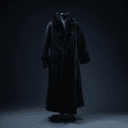
A symbol of luxury and social ascent, the fur coat was the emblematic garment of 1930s film stars. It embodies Arletty's transformation from a worker's daughter into a glamorous icon.
A technical instrument used to synchronize picture and sound, the clapperboard marks the rhythm of every take. It symbolizes both the industrial craft and the artisanal spirit of French golden-age cinema.
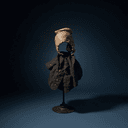
The paper script, read through and annotated by actors, was the central working tool of classic cinema. Arletty's celebrated lines, written by Henri Jeanson or Jacques Prévert, came to life on these pages.
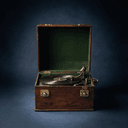
A sound-reproduction device found in homes throughout the 1930s, the gramophone broadcast the songs and revues that artists like Arletty recorded on 78 rpm discs.
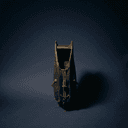
During the Occupation, Parisian film shoots required permits issued by Continental Film, the German company that controlled French production. This document symbolizes the constraints imposed on artists between 1940 and 1944.
School Curriculum
Vocabulary & Tags
Key Vocabulary
Daily Life
Morning
Shooting days began early: hair and makeup at six or seven in the morning in the studio dressing rooms. Arletty, who by her own admission disliked early mornings, made up for it with an ironic vitality that immediately brought the set to life.
Afternoon
Afternoons were spent under the studio lights at Billancourt or the Buttes-Chaumont, rehearsing scenes with demanding directors like Carné. Between takes, the actors read or chatted in sometimes difficult conditions — especially during the Occupation, when heating and food were in short supply.
Evening
Evenings could stretch on in the cafés and brasseries of Montparnasse or Saint-Germain-des-Prés, where artists, screenwriters, and journalists gathered. Arletty moved in these cultural, late-night circles, weaving the networks that fueled Parisian artistic life in the interwar years.
Food
Everyday Parisian fare was the staple of show-business people: the local bistrot, the plat du jour, café au lait in the morning. During the Occupation, food rationing (ration books) affected all French people, including the most celebrated artists.
Clothing
On stage and on screen, Arletty wore gowns by leading couturiers for her glamorous roles, but in everyday life she favored a simple, unpretentious elegance. Her style, like her famous lines, blended the chic and the popular with effortless ease.
Housing
Arletty lived in a Parisian apartment, as did most artists of her generation. Her house arrest at the Château de La Houssaye-en-Brie after the Liberation marked a radical break from her urban life, before she eventually returned to her Parisian routines.