
Titan of Greek mythology, son of Iapetus and Clymene. Condemned by Zeus to hold up the sky on his shoulders after the defeat of the Titans in the Titanomachy. He is also the father of the Pleiades and the Hesperides.
Atlas
Atlas
10 min read
Frequently asked questions
Key Facts
- Son of the Titan Iapetus and the Oceanid Clymene
- Condemned by Zeus to bear the heavenly vault after the Titanomachy (War of the Titans)
- Heracles briefly relieves him during his eleventh labor, to fetch the golden apples of the Hesperides
- Turned to stone by Perseus, who holds up the head of Medusa — the mythical origin of the Atlas Mountains in North Africa
- Father of the Pleiades, the Hyades, and the Hesperides
Works & Achievements
A cosmic punishment imposed by Zeus: Atlas bears the sky on his shoulders for eternity, preventing the celestial vault from crashing down upon the earth. This titanic function makes him an unwilling yet fundamental player in the order of the cosmos.
His seven daughters, transformed into stars, played an essential role in the Greek agricultural and maritime calendar. Their heliacal rising in May signaled the start of the sailing season and the harvest, while their setting in November marked the arrival of winter and plowing time.
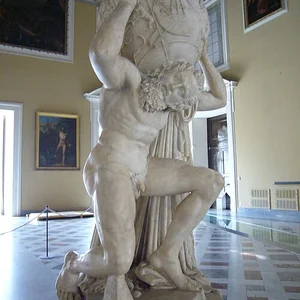
A sculpture housed in the National Archaeological Museum of Naples, depicting Atlas bent under the celestial sphere engraved with constellations. It is one of the oldest known representations of the celestial globe with its stars mapped out.
A bas-relief depicting Heracles supporting the sky while Atlas returns with the golden apples. This masterpiece of classical Greek sculpture attests to the central place of the Atlas myth in Greek religious and heroic culture.
A collection of geographical maps by Flemish cartographer Gerardus Mercator, whose cover depicted Atlas carrying the terrestrial globe. This publication gave its name to all geographical atlases around the world — a direct legacy of the ancient myth.
The first cervical vertebra, which supports the weight of the skull, was named 'atlas' by Andreas Vesalius in direct reference to the Titan. This anatomical term, still universally used today, is a testament to the enduring vitality of the myth in Western scientific thought.
Anecdotes
During the Titanomachy, the great war between the Titans and the Olympian gods led by Zeus, Atlas sided with the Titans. After ten years of fierce fighting, the Olympians emerged victorious. Zeus then imposed an especially harsh punishment on Atlas: he would be condemned to hold up the heavens on his shoulders for eternity, standing at the edge of the western world, forever keeping the sky and the earth apart.
For his eleventh labor, the hero Heracles had to retrieve the golden apples from the garden of the Hesperides. Since Atlas knew the location of this garden — his own daughters were its guardians — Heracles struck a deal: he would hold up the sky in Atlas's place while Atlas went to fetch the apples. Atlas agreed, but upon his return, he had no desire to take back his burden. Heracles then used his wits: he asked Atlas to hold the sky for just a moment while he adjusted a pad on his shoulders, then slipped away with the precious apples.
The hero Perseus, returning after slaying the Gorgon Medusa, stopped in Atlas's kingdom to rest. Atlas, warned by a prophecy that a son of Zeus would steal his golden apples, refused him hospitality. In retaliation, Perseus drew out Medusa's severed head and held it before the Titan, whose body instantly turned to stone and transformed into a vast mountain range: the Atlas Mountains, which today span Morocco and Algeria.
Atlas is the father of many celebrated nymphs. His seven daughters, the Pleiades, were transformed into stars by Zeus to save them from Orion's pursuit. Their heliacal rising marked the start of the sailing season for Greek mariners, and their setting announced the arrival of winter. The Hesperides, his other daughters, guarded the garden of golden apples at the far western edge of the known world.
The name Atlas has traveled through the centuries to describe very tangible realities. The first cervical vertebra, which supports the weight of the skull, is called the atlas in anatomy — a direct reference to the sky-bearing Titan. In the sixteenth century, the cartographer Gerardus Mercator placed an image of Atlas holding the celestial globe on the cover of his collection of maps, giving birth to the word 'atlas' as the name for any book of maps.
Primary Sources
Atlas bears the wide heaven with his head and tireless arms, standing at the borders of the earth, before the clear-voiced Hesperides; for this is the lot that wise Zeus assigned to him.
Calypso is the daughter of destructive Atlas, who knows the depths of all the seas and with his own shoulders props the great columns that keep the sky and earth apart.
Atlas, son of Iapetus, surpassed all mortals in stature. He ruled the ends of the world and the sea upon which the setting Sun abandons his weary horses. A thousand herds roamed his pastures, and as many flocks of cattle.
Heracles came to Atlas and asked him to fetch the apples of the Hesperides, promising to hold up the sky in his place while he was gone. Atlas set the sky upon Heracles' shoulders and went to gather three apples from the garden of the Hesperides.
When the Pleiades, daughters of Atlas, rise, begin the harvest; and begin the ploughing when they set. They hide for forty nights and forty days.
Key Places
A mountain range identified by the ancients with the Titan petrified by Perseus. The westernmost edge of the known world, this landscape became the symbolic site of Atlas's punishment — holding up the sky at the very place where the earth ends and the ocean begins.
The mythical boundary of the inhabited world in Greek geography, and the domain of Atlas at the edge of the known earth. Ancient sailors regarded this strait as the point beyond which darkness and bottomless waters held sway.
A wondrous garden at the far western edge of the world, guarded by the daughters of Atlas and an immortal dragon. Here grew the apple tree bearing golden apples, a gift from Gaia to Hera on the occasion of her marriage to Zeus.
Home of the Olympian gods who defeated the Titans in the Titanomachy. It was from Olympus that Zeus pronounced the sentence condemning Atlas to carry the sky for eternity, sealing the Olympians' victory.
The deep abyss beneath the earth into which Zeus cast most of the defeated Titans. Atlas received a different punishment — bearing the sky — likely because of his prominent role as a leader of the Titan rebellion, which explains why his fate was one of endless toil above ground rather than imprisonment below it.
Typical Objects

Atlas's defining attribute: the Titan is condemned to hold up the sky on his shoulders for eternity. In ancient art, he is consistently depicted bent under a celestial sphere engraved with constellations, keeping heaven and earth apart.

An astronomical instrument representing the circles of the heavens, often shown in Atlas's arms in Hellenistic and Roman art. It symbolizes his knowledge of the cosmos and his unwilling role as guardian of the celestial movements and the stars.

Precious fruits from the garden guarded by Atlas's daughters and an immortal dragon, the central prize of Heracles' eleventh labor. Atlas alone knows their exact location, which gives him a bargaining advantage over the hero.

The two pillars erected at the entrance to the Strait of Gibraltar, the western boundary of the known ancient world. They mark the domain of Atlas, where the Titan endures his eternal punishment at the edge of the inhabited world and the endless ocean.

Though Atlas is not chained like Prometheus, the weight of the sky pins him irrevocably to the ground. This invisible burden symbolizes the absolute power of Zeus and the final subjugation of the defeated Titans after the Titanomachy.

Perseus's weapon, which turned Atlas to stone by holding up the petrifying face. This object embodies the Titan's helplessness against heroes favored by the Olympian gods, and mythologically explains the origin of the Atlas Mountains in North Africa.
School Curriculum
Vocabulary & Tags
Key Vocabulary
Tags
Daily Life
Morning
From dawn, Atlas is already bearing the sky as it brightens above him. The first rays of Helios launching his solar chariot bathe his bruised shoulders in a cruel golden light. He cannot turn his head to look at the horizon: his gaze is fixed eternally on the rocky ground beneath his feet.
Afternoon
At its zenith, the sky is at its heaviest, heated by Helios at the peak of his course. Atlas feels every movement of the celestial bodies through the weight of the vault of heaven. Occasionally a divine messenger or a passing hero stops to watch him, but few are those who speak to him.
Evening
At sunset, Atlas watches his daughters the Pleiades light up one by one in the very sky he carries. This sight is one of his few comforts amid his endless suffering. As night falls, the sky grows colder and the stars seem to weigh more heavily still — yet the Titan endures, as he has endured since time immemorial.
Food
As an immortal Titan, Atlas has no need of mortal food. He subsists through his divine nature, sustained by the primordial energy of the cosmos he bears against his will. Some myths tell of the Hesperides nymphs who occasionally bring him wondrous fruits from their garden — the only sweetness in his eternal torment.
Clothing
In ancient Greek art, Atlas is depicted nude or half-draped in a rough cloak, in the manner of heroes and Titanic figures. His heroic nudity emphasizes his superhuman physical power. His only 'adornment' is the celestial sphere he carries, marking at once his condemnation and his fundamental cosmic importance.
Housing
Atlas has no home: the far western edges of the world, at the foot of the mountains that bear his name, form the space of his eternal punishment. He stands on rocky, barren ground, between earth and sky, with no shelter — an unwilling guardian of the boundary between the world of mortals and the boundless ocean.
Historical Timeline
Period Vocabulary
Visual Style
Style grec antique monumental inspiré de la sculpture hellénistique — Titan colossal ployant sous la sphère céleste étoilée, mêlant force héroïque et souffrance éternelle dans une palette contrastant ocres terreux et bleus célestes.
Sound Ambience
Paysage sonore des confins du monde : vents puissants, grondements cosmiques et gémissement sourd d'un Titan condamné à soutenir éternellement la voûte céleste à la limite entre terre et ciel.
Liens externes & ressources
Références
Œuvres
La soutenance éternelle de la voûte céleste
Temps mythiques
Les Pléiades — constellation calendaire
Antiquité
Statue Atlas Farnèse
Copie romaine du IIe siècle ap. J.-C., original grec vers IIe siècle av. J.-C.
Métope du temple de Zeus à Olympie
vers 460 av. J.-C.
Atlas de Mercator
1595
La vertèbre atlas (C1)
Nommée par Vesalius en 1543