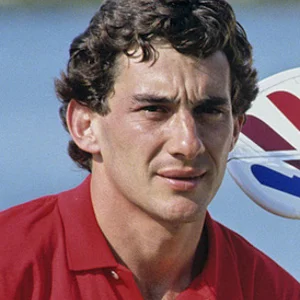

Ayrton Senna was a Brazilian Formula 1 racing driver and three-time world champion (1988, 1990, 1991). Regarded as one of the greatest drivers in history, he died in a racing accident at the Imola circuit in 1994.
Ayrton Senna(1960 — 1994)
Ayrton Senna
Brésil
6 min read
Frequently asked questions
Key Facts
- Born on 21 March 1960 in São Paulo (Brazil)
- First Formula 1 world championship title in 1988 with McLaren
- Consecutive world titles in 1990 and 1991, for a total of three crowns
- Famous rivalry with the Frenchman Alain Prost in the late 1980s
- Died in an accident on 1 May 1994 at the Imola circuit during the San Marino Grand Prix
Works & Achievements
Crowned with McLaren-Honda during a historically dominant season, he won 8 of the 16 races.
Won at the end of a season marked by his intense rivalry with Alain Prost, sealed by the collision at Suzuka.
His final title, crowned by an emotional home victory at the Brazilian Grand Prix, finished almost without a gearbox.
Senna long held the record for pole positions, a testament to his exceptional speed over a single flying lap.
At the European Grand Prix, he overtook five cars on the opening lap in the rain, a feat regarded as legendary.
An all-time record for victories on the most demanding circuit of the calendar, earning him the nickname the “King of Monaco.”
A foundation created after his death by his sister, funding the education of millions of Brazilian children through his final wishes and his fortune.
Anecdotes
Ayrton Senna was a true genius in the rain. During the 1985 Portuguese Grand Prix, his first Formula 1 victory, he drove through a downpour so violent that most of the other drivers crept along cautiously, while he extended his lead lap after lap, finishing more than a minute ahead of the runner-up.
Senna and the Frenchman Alain Prost formed one of the most famous rivalries in sport. In 1989 and 1990, their duels ended in collisions in Japan that decided the world title. Yet after Senna's death, Prost would admit how much he missed his rival, revealing a relationship built as much on respect as on tension.
Deeply religious, Senna sometimes said he saw God during his fastest laps. In qualifying for the 1988 Monaco Grand Prix, he set a time so far superior to the others that he later confided he had felt as if he were driving in a trance, almost unconscious, guided by a force beyond himself.
Despite his fortune, Senna quietly devoted millions to helping poor children in Brazil. This generosity, revealed mostly after his death, gave rise to the Instituto Ayrton Senna, which to this day still funds the education of millions of young Brazilians.
On 1 May 1994, his death on the Imola circuit plunged Brazil into national mourning. Three days of mourning were declared, and millions of people followed his funeral procession in São Paulo, a sign that he had become far more than an athlete: a national hero.
Primary Sources
“I was already on pole position and I kept going faster and faster. It was as if I was driving in a tunnel. I had gone way beyond my own conscious understanding.”
“If you have a goal and you want to reach it, but you decide to stop the moment a risk appears, then you are not a true competitor.”
“I am not afraid of dying because I have faith in God, who is everything to me. But what I want is to live life to the fullest.”
During the weekend of the 1994 San Marino Grand Prix, Senna, shaken by the fatal crash of Roland Ratzenberger the day before, discussed with other drivers the need to revive an association for safety.
Key Places
Senna's birthplace and the site of his state funeral. The Interlagos circuit, where he won two Brazilian Grands Prix, is located here.
Setting of the San Marino Grand Prix where Senna lost his life on 1 May 1994, at the Tamburello corner. The site is now marked by a memorial.
A street circuit where Senna excelled more than anyone else, with a record six victories. Monaco was the stage for his finest displays of virtuosity.
Site of the 1993 European Grand Prix, where Senna pulled off one of the greatest opening laps in Formula 1 history in the rain.
The circuit where two of Senna's world titles were decided during his collisions with Alain Prost in 1989 and 1990.
Typical Objects

Senna's iconic helmet, bearing the colors of the Brazilian flag on a yellow background. It became one of the most recognizable symbols in motor racing.

The open-wheel racing car driven by Senna, notably the McLaren-Honda MP4/4. It is the driver's working tool, pushing the limits of automotive technology.

A racing outfit made of fire-resistant fibers (Nomex), worn over protective underwear. It shields the driver from the risk of fire in the event of an accident.

The single-seater's compact steering wheel, through which Senna felt every reaction of the car. In his era, it was beginning to incorporate a few electronic controls.

The black-and-white flag waved at the finish line to signal the end of the race. Senna crossed it as the winner 41 times in Formula 1.

The award presented to the driver crowned Formula 1 World Champion. Senna lifted three of them, in 1988, 1990 and 1991.
School Curriculum
Vocabulary & Tags
Key Vocabulary
Daily Life
Morning
On a race weekend, Senna woke up early and devoted himself to his physical and mental preparation. He studied his car's technical data and held long discussions with his engineers about the adjustments to make.
Afternoon
Afternoons were dedicated to practice sessions and qualifying on the circuit. Senna reeled off lap after lap, hunting for the hundredth of a second that would make the difference, fully focused in his cockpit.
Evening
In the evening, he analyzed his day, sometimes late into the night, with an obsessive demand for excellence. Reserved, he often preferred quiet to social life, recharging in the company of those close to him.
Food
As a high-level athlete, Senna followed a balanced diet to maintain optimal physical condition. Driving an F1 car demands extreme endurance, and he kept a close watch on his hydration and energy.
Clothing
While racing, he wore his fireproof suit covered in sponsor logos and his yellow helmet. Off the track, he adopted a simple elegance, with designer clothes and the casual outfits of his generation.
Housing
Senna lived between several residences, notably in Portugal and Brazil. Wealthy, he owned a property near São Paulo and enjoyed pastimes such as planes and boats.
Historical Timeline
Period Vocabulary
Liens externes & ressources
Références
Œuvres
Premier titre de champion du monde de Formule 1
1988
Deuxième titre de champion du monde
1990
Troisième titre de champion du monde
1991
Record de pole positions (65)
1984-1994
Victoire de Donington sous la pluie
1993
Six victoires à Monaco
1987-1993
Instituto Ayrton Senna
1994