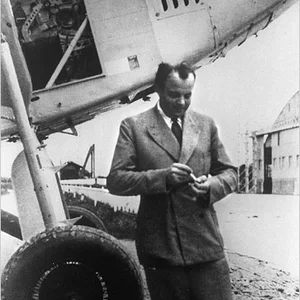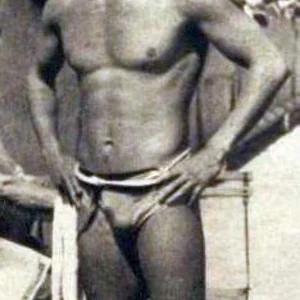

Alfred Nakache (1915-1983) was a French swimmer and water polo player, nicknamed “the swimmer of Auschwitz.” The 1941 world record holder in the 200 m breaststroke, he was deported to Auschwitz in 1944, where he survived, before returning to competition and taking part in the 1948 Olympic Games.
Alfred Nakache(1915 — 1983)
Alfred Nakache
France
6 min read
Frequently asked questions
Key Facts
- Born on 18 November 1915 in Constantine (French Algeria), into a Jewish family
- Broke the world record in the 200 m butterfly breaststroke in 1941
- French champion and Olympic selection (1936 Berlin Olympics)
- Deported to Auschwitz in January 1944 with his wife and daughter, who perished; he survived the camps
- Returned to swimming after the war and took part in the 1948 London Olympic Games; died on 4 August 1983
Works & Achievements
Nakache represents France in swimming at the Berlin Games, asserting his presence as a Jewish swimmer in the face of the Nazi regime.
In the midst of the Occupation, he sets a world record over this distance, a performance all the more remarkable given the context of Vichy's antisemitic laws.
Nakache wins numerous national titles, establishing himself as one of the best French swimmers of his generation.
Just one year after his return from Auschwitz, he takes part in a world relay record, a symbol of exceptional resilience.
A survivor of the camps, he joins the French water polo team at the first post-war Games, at the age of 32.
After his sporting career, Nakache passes on his passion for swimming by training and coaching young swimmers.
Anecdotes
In 1936, Alfred Nakache, a French and Jewish swimmer, competed in the Berlin Olympic Games hosted by Nazi Germany. Selected for the 100 m freestyle, his very presence challenged the racist ideology of Hitler's regime, which was using these Games as a showcase.
In 1941, in the midst of the Occupation and after the Vichy regime had already enacted the “Statute on Jews,” Nakache kept swimming and broke the world record in the 200 m butterfly breaststroke in Marseille. One of his rivals reportedly helped denounce him to the authorities, which would later lead to his arrest.
Deported to Auschwitz, Nakache was sometimes forced by SS guards to dive and swim in a pool of icy water at the camp for their amusement. The other prisoners, struck by his feats, nicknamed him “the swimmer of Auschwitz.”
When he was liberated in 1945, Nakache weighed barely more than forty kilos and had lost his wife Paule and his little girl Annie, who both died in deportation. Yet less than a year later, he broke a world record again in a relay, proving an extraordinary strength of will.
In 1948, at the age of 32 and forever marked in body by the camps, he still took part in the London Olympic Games as a member of the water polo team. He died in 1983 of a heart attack while swimming in the Mediterranean at Cerbère, faithful to the very end to the water that had shaped his entire life.
Primary Sources
Alfred Nakache is among the deportees of Convoy 66, which left Drancy for Auschwitz on 20 January 1944, a document that records by name the Jews deported from France.
Sports newspapers report that Alfred Nakache, of the Dauphins du TOEC, set a new world record in the 200 m butterfly breaststroke in Marseille.
Like all prisoners registered at Auschwitz, Nakache was given a prisoner number tattooed on his forearm, an administrative trace of the dehumanization organized by the camp.
Alfred Nakache is among the French selections for the Olympic water polo tournament, three years after his return from the camps.
Key Places
Algerian city where Alfred Nakache was born in 1915, into a Jewish family. It was there that he discovered swimming before pursuing his career in mainland France.
City where Nakache settled, swam for the Dauphins du TOEC and worked as a teacher. It was from there that he was arrested in 1944.
Site of the 1936 Olympic Games where Nakache competed in swimming, under the gaze of the Nazi regime that sought to glorify a supposed Aryan superiority.
Nazi concentration and extermination camp in Poland where Nakache was deported in 1944 and survived. His wife and daughter died there.
Internment camp in the Paris region, an antechamber to deportation. It was from Drancy that the convoy departed carrying Nakache to Auschwitz.
Resort town on the Mediterranean coast, near the Spanish border, where Nakache died in 1983 of a heart attack while swimming in the sea.
Typical Objects

In the 1930s, swimmers wore knitted woollen swimsuits that grew heavy in the water. Nakache swam with this type of gear, a far cry from today's high-tech racing suits.

The needle stopwatch was used by officials to measure race times to a tenth of a second. It was the device that validated Nakache's world records.

The rubber cap protected the hair and slightly improved glide through the water. It was part of the standard gear of a competitive swimmer between the two World Wars.

Performances were rewarded with medals and official diplomas certifying titles and records. Nakache amassed them as a French champion and world record holder.

Water polo, a team water sport, is played with a ball that teams try to put into the opposing goal. Nakache also excelled in this discipline, right up to the 1948 Games.

At Auschwitz, inmates wore a striped uniform that stripped them of their individuality. Nakache, a top-level athlete, was reduced like the others to this garment of dehumanisation.

At Auschwitz, each inmate was given a number tattooed on the forearm, replacing their name. This registration number remains one of the most striking symbols of the Holocaust.
School Curriculum
Vocabulary & Tags
Key Vocabulary
Daily Life
Morning
A top-level swimmer, Nakache often began his days with a morning training session at the pool. The repeated laps and breaststroke work built his endurance before the rest of the day had even started.
Afternoon
His afternoons combined his work as a teacher with further swimming or water polo sessions with his club, the Dauphins du TOEC in Toulouse. The demands of amateur training rested on personal discipline.
Evening
Evenings were devoted to rest, recovery and family life with his wife Paule and their daughter Annie, before the war shattered this routine.
Food
Like every athlete of his era, he favored a simple, nourishing diet suited to physical effort. During his deportation, however, the deliberate starvation of the camps reduced his athlete's body to extreme thinness.
Clothing
In training and competition, he wore the woolen swimsuit, the rubber cap and the athletic gear of the 1930s. At Auschwitz, he was forced to wear the striped uniform of the deportees.
Housing
Nakache lived in Toulouse, in a France where the Jewish community was gradually persecuted. Once deported, he experienced the overcrowding and inhumanity of the barracks at Auschwitz.
Historical Timeline
Period Vocabulary
Liens externes & ressources
Références
Œuvres
Participation aux Jeux olympiques de Berlin
1936
Record du monde du 200 m brasse papillon
1941
Titres de champion de France de natation
années 1930-1940
Record du monde en relais après les camps
1946
Participation aux Jeux olympiques de Londres (water-polo)
1948
Carrière d'enseignant et d'entraîneur de natation
après 1945