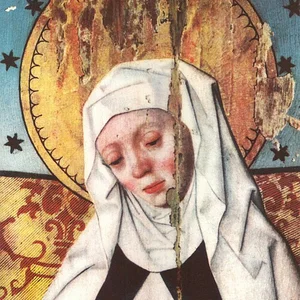

Flemish Cistercian nun (c. 1200–1268), abbess of the monastery of Nazareth near Lier. Author of The Seven Manners of Love, one of the earliest mystical works written in the vernacular Dutch language.
Beatrice of Nazareth(1200 — 1268)
Beatrice of Nazareth
comté de Flandre
8 min read
Frequently asked questions
Famous Quotes
« The soul desires to love freely, without measure, without rule, without end, and beyond all human power.»
Key Facts
- Born around 1200 in Tienen (Tirlemont), in Flemish Brabant
- Trained from childhood in several Cistercian monasteries, including Florival
- Founder and first abbess of the monastery of Nazareth in Lier (1236)
- Author of The Seven Manners of Love (c. 1250), the first mystical prose treatise in Middle Dutch
- Died on 29 July 1268; beatified by Pope Pius X in 1905
Works & Achievements
A mystical prose treatise written in Middle Dutch describing seven stages of the soul's progression toward union with God. It is one of the earliest mystical works in the vernacular of the Low Countries, and the founding text of the entire Flemish Minnemystiek tradition.
A personal spiritual journal written in Dutch by Beatrice herself, used as the primary source by her confessor when composing the Latin Vita Beatricis.
A spiritual biography written in Latin by an anonymous monk-confessor based on Beatrice's own notes. This foundational text preserves excerpts of her mystical experience and reconstructs the story of her life.
Anecdotes
Beatrice of Nazareth was born around 1200 in Tienen (Tirlemont), in the Flemish Brabant. Her father, Bartholomew, was a devout burgher who, after his wife's death, entered religious life himself along with his children. He placed young Beatrice, at just five years old, in a beguinage where she learned to read and write in Latin — a truly exceptional education for a girl of that age in the thirteenth century.
As a teenager, Beatrice was sent as an apprentice to the Cistercian monastery of La Ramée in Hainaut, where she learned the art of manuscript copying. She transcribed sacred texts with remarkable precision and care, developing not only her mastery of writing but also a deep meditation on the texts she reproduced. This rigorous intellectual training was rare for women of her era.
Beatrice experienced intense states of mystical ecstasy that she described in her writings. She felt divine love as a physical force that overwhelmed her — to the point where she was sometimes unable to rise or carry out her monastic duties. These experiences gave rise to her major work, The Seven Manners of Love, in which she attempts to describe the soul's progression toward union with God.
Beatrice wrote her mystical work directly in Middle Dutch, rather than in Latin as was customary for learned religious writing. This bold choice of the vernacular allowed her to reach a wider audience, particularly beguines and nuns who did not always have command of Latin. She is thus one of the earliest authors to have produced a mystical prose work in Dutch, paving the way for Hadewijch of Antwerp and the entire tradition of Minnemystiek.
Having become prioress and then abbess of the monastery of Nazareth near Lier (founded in 1236), Beatrice led her community with both firmness and gentleness for more than thirty years. Her reputation for holiness was such that, shortly after her death in 1268, a monk confessor wrote a Latin Vita — a spiritual biography — drawing on Beatrice's own autobiographical notes, now lost.
Primary Sources
The first manner of love is when the soul desires to repay Our Lord for all that it owes Him out of love, for His honor and glory, seeking no benefit for itself.
She sometimes suffered such violence of divine longing that her limbs seemed to break apart, and her heart to shatter under the assault of a love that no creature could contain.
Sister Beatrice, abbess of this house, wrote in the vernacular tongue several treatises on divine love, the fame of which spread throughout all the Cistercian monasteries of the Low Countries.
Key Places
Beatrice's birthplace, where her devout bourgeois father raised her in an environment of piety. It was here that she entered a beguinage as a child to receive her Latin education.
A female Cistercian monastery where Beatrice learned the art of the scriptorium. This intellectual and spiritual training shaped her vocation as a mystical writer.
The first Cistercian monastery where Beatrice took her final vows. There she developed her earliest mystical experiences and began writing her spiritual texts.
Founded in 1236, this was the place where Beatrice truly flourished: she served as its prioress and later abbess, wrote her Seven Manners of Love there, and died on July 29, 1268.
Typical Objects

An illustrated prayer book containing the Psalms, essential to the Liturgy of the Hours. Beatrice memorizes it from childhood, and her meditation on the psalms nourishes her entire mystical life.

Tools of the monastic scriptorium that Beatrice masters during her training at La Ramée. It is on parchment that she writes her Seven Manners of Love in the vernacular language.

A white woolen robe cinched with a belt and covered by a black scapular — a sign of belonging to the Cistercian order and a symbol of purity and penance.

An essential light for the night offices and vigils. In her ecstasies, Beatrice describes the divine flame that consumes and sets the soul ablaze from within — a recurring image in her writings.

A small bell used to mark the canonical hours and call the sisters to the office. Beatrice, as abbess, uses these signals to set the rhythm of the entire communal life.

An instrument of mortification worn against the skin, mentioned in the Vita as a sign of intense asceticism. Beatrice practices severe bodily penance to purify her soul and advance through the degrees of love.
School Curriculum
Vocabulary & Tags
Key Vocabulary
Tags
Daily Life
Morning
The day begins before dawn with the offices of Matins and Lauds, sung in choir in the abbey church. Beatrice rises in darkness, puts on her white woolen habit, and joins her sisters for the liturgical prayers. These early hours, steeped in silence and Gregorian chant, are for her the privileged moment of mystical encounter with God.
Afternoon
The afternoon is devoted to manual work — copying manuscripts in the scriptorium, tending the garden, or handling administrative duties — interspersed with the offices of None and Vespers. As abbess, Beatrice receives her sisters for spiritual counsel, settles questions of monastery governance, and ensures the strict observance of the Cistercian Rule.
Evening
After the meal taken in silence in the refectory, during which a sister reads aloud from a sacred text, comes the office of Compline, the final communal prayer before night. Beatrice withdraws to her cell for personal meditation and writing — it is often in the evening that she records her inner mystical experiences.
Food
The Cistercian diet is simple and vegetarian: rye bread, vegetables from the kitchen garden (cabbage, leeks, broad beans), fish on permitted days, and limited amounts of cheese and milk. Meat is forbidden except for the sick. Fasting is observed during Advent and Lent, and Beatrice, according to her Vita, sometimes goes beyond what the rule prescribes in her ascetic fervor.
Clothing
The Cistercian women's habit consists of a white woolen robe, symbolizing purity, covered by a black scapular and a black veil for professed sisters. In winter, a dark woolen cloak completes the dress. These rough garments are worn in all seasons as a sign of mortification and humility.
Housing
Beatrice's monastic cell is a plain stone-walled room furnished with a wooden plank bed, a prie-dieu, and a writing desk. The monastery of Nazareth, built in the Cistercian tradition, favors ordered spaces — a cloister around an enclosed garden, proximity to water — with a Flemish stream often running alongside the abbey buildings.
Historical Timeline
Period Vocabulary
Visual Style
Un style d'enluminure flamande du XIIIe siècle : sobriété cistercienne, lumière dorée sur vélin crème, habits blancs dans un cloître gothique, palette austère et lumineuse.
Sound Ambience
L'univers sonore de Béatrice est celui du cloître cistercien : plain-chant, cloches liturgiques, silence habité et bruissement de la plume sur parchemin, dans un paysage flamand traversé par les eaux.
Liens externes & ressources
Références
Œuvres
Seuen maniren van heileger minne (Sept degrés de l'amour)
v. 1235-1268
Autobiographie spirituelle (perdue)
v. 1240-1268
Vita Beatricis
v. 1268-1290