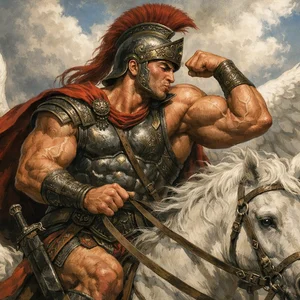

Hero of Greek mythology from Corinth, Bellerophon tames the winged horse Pegasus and slays the Chimera. A victim of his own hubris, he attempts to reach Olympus and is cast down to earth by Zeus.
Bellerophon
Bellerophon
9 min read
Frequently asked questions
Key Facts
- Son of Glaucus (or Poseidon in some versions), prince of Corinth in the Greek tradition
- Receives a golden bridle from Athena (or Poseidon) to tame Pegasus, the winged horse born from the blood of Medusa
- Sent to Lycia by King Proetus to carry out deadly missions; most notably kills the Chimera
- Kills the Chimera by flying above it on Pegasus and riddling it with arrows
- Punished by Zeus for attempting to ascend to Olympus; cast to the ground, he wanders alone and lame until his death
Works & Achievements
Using Athena's golden bridle, Bellerophon was the only mortal ever to tame the winged horse born from the blood of Medusa. This founding feat gave him access to the celestial realm and shaped his entire heroic career.
Bellerophon's first and greatest exploit: riding Pegasus through the air, he slew this fire-breathing hybrid monster that had terrorized Lycia. The act of deliverance won him the admiration of King Iobates and the hand of his daughter.
A warlike people of Anatolia sent against Bellerophon by Iobates to have him killed. The hero defeated them single-handedly, demonstrating exceptional valor that ultimately convinced the king of his near-divine nature.
Bellerophon was sent to battle the formidable legendary warrior women of Asia Minor. This third seemingly impossible victory definitively convinced Iobates that he was dealing with a being of extraordinary distinction.
Intoxicated by his successes, Bellerophon attempted to ride Pegasus all the way to Olympus. This act of *hubris* is paradoxically the most celebrated episode of his myth, handed down as a moral lesson on the limits of the human condition.
Anecdotes
In the Iliad, Bellerophon is presented as the grandson of Sisyphus, famed for his cunning, and the supposed son of Glaucus, king of Corinth. But the most widespread tradition makes him the secret son of Poseidon, god of the sea, which accounts for his exceptional destiny. This dual lineage — human and divine — is characteristic of the great Greek heroes, poised halfway between the world of mortals and that of the gods.
To tame Pegasus, the winged horse born from the blood of Medusa, Bellerophon received guidance in a dream from Athena, goddess of wisdom. The goddess gave him a magical golden bridle with which he was able to approach the divine horse at the Pirene spring, near Corinth. This alliance between intelligence (Athena) and heroic strength is typical of Greek mythological tales.
King Proetus of Tiryns was convinced by his wife Stheneboea, who had been unjustly rebuffed by Bellerophon, to send the young hero to his death. He entrusted him with a tablet engraved with mysterious signs to deliver to King Iobates of Lycia — those signs contained an order to kill the bearer. This episode, often called the “letter of Bellerophon,” is one of the earliest references to writing in Greek literature.
The Chimera was a fire-breathing monster with a composite body: the head of a lion, the belly of a goat, and the tail of a serpent. Thanks to Pegasus, which allowed him to fight from the air, Bellerophon drove a lead-tipped spear into the flaming jaws of the beast. The heat melted the metal, suffocating the creature — a trick as worthy of the Greek heroes as any feat of brute strength.
Intoxicated by his victories over the Chimera, the Amazons, and the Solymi, Bellerophon committed the ultimate act of hubris: he attempted to fly up to Olympus on Pegasus to join the gods. Zeus, incensed by this overreach, sent a gadfly to sting the winged horse. Pegasus reared and threw his rider to the ground. Bellerophon survived but spent his remaining days alone, lame and blind, wandering the Aleian plain.
Primary Sources
Glaucus was the son of Hippolochus, and Hippolochus was the son of Bellerophon, upon whom the gods bestowed beauty and noble valor. But Proetus laid a trap for him [...] he gave him deadly tablets, with murderous signs engraved in great number on a folded tablet, and ordered him to show them to his father-in-law so that he might be put to death.
Bellerophon, seeking to capture Pegasus the winged son of the Serpent, spent the night beside the altar of the goddess [...] Athena brought him a bridle to tame horses and said: ‘Do you sleep, king of the line of Aeolus? Take this charm for horses and show it to your father Poseidon the Tamer of Horses.’
She breathed a raging fire, the terrible Chimera, great and swift, fleet-footed, with three heads — one of a blazing-eyed lion, another of a goat, the third of a serpent, a mighty dragon. A lion in front, a serpent behind, a goat in the middle, breathing the terrifying force of a blazing flame.
Bellerophon, having received a golden bridle from Athena, mounted Pegasus and flew toward the Chimera, which he slew from a distance with arrows. After defeating the Solymi and the Amazons, Iobates gave him his own daughter in marriage and half his kingdom, for he saw in him a being of superhuman abilities.
Key Places
The city of Bellerophon's origin, home to the Pirene spring at the foot of the Acrocorinth — the legendary site where he captured Pegasus using the bridle given to him by Athena. Corinth claimed him as its protective hero and the founder of its martial glory.
The kingdom of King Iobates where Bellerophon accomplished his three great feats — defeating the Chimera in the local mountains, and winning victories over the Solymi and the Amazons. The site of Yanartaş ('burning mountain') is sometimes identified as the lair of the Chimera.
The mythic peak and dwelling of the gods, toward which Bellerophon attempted to fly on Pegasus. It was in seeking to reach it that the hero committed the supreme act of hubris that brought about his downfall and his final punishment by Zeus.
The mythological place where Bellerophon wandered alone after his fall from Pegasus, lame and blind, rejected by gods and men alike. Its name means 'plain of wandering' — a symbol of the tragic fate of the hero destroyed by his own excessive pride.
The sacred spring at the foot of the citadel of Corinth where Bellerophon patiently waited to capture Pegasus as it came to drink. This place of worship was still venerated and visited in Roman times, according to Pausanias.
Typical Objects

Offered to Bellerophon in a dream by the goddess Athena, this magical bridle allowed him to tame Pegasus where all others had failed. It symbolizes the triumph of intelligence and divine favor over brute force.

Born from the blood of Medusa after she was slain by Perseus, Pegasus is the indispensable instrument of Bellerophon's exploits. Without him, the hero could never have fought the Chimera from the air nor reached the celestial realm.

A clever weapon used to defeat the Chimera: by thrusting the lead-tipped end into the fire-breathing maw, the molten metal smothered the monster. It illustrates the hero's cunning as much as his martial valor.

Tablets inscribed with mysterious signs — one of the earliest mentions of writing in Greek literature. Bellerophon carried them without knowing their deadly contents, revealing both his innocence and his naive trust in his hosts.

In some versions, Bellerophon also fights with a bow from Pegasus's back. The bow symbolizes distance and strategy as opposed to hand-to-hand combat, marking a hero who relies on intelligence as much as brute force.

Like every aristocratic Greek hero, Bellerophon is depicted wearing bronze armor — crested helmet, breastplate, greaves — attesting to his rank and martial valor in the Mycenaean society idealized by the epics.
School Curriculum
Vocabulary & Tags
Key Vocabulary
Tags
Daily Life
Morning
In the Greek mythological imagination, a hero like Bellerophon begins his day with libations and prayers to the gods — particularly Poseidon, his divine father, and Athena, his protector. He trains in combat, with bow and sword, as any Mycenaean aristocrat would. In Lycia, his mornings are devoted to preparing expeditions against the monsters and enemy peoples sent by Iobates.
Afternoon
The afternoon belongs to martial exploits: Bellerophon rides Pegasus to survey territories, approach monsters, and plan his attacks from the air. Between campaigns, he takes part in the aristocratic assemblies of Iobates' palace, where military missions are decided. The Mycenaean society idealized in the epics values deliberation among warriors as much as individual bravery.
Evening
On evenings of victory, Bellerophon feasts with the Lycian nobles at a banquet (*dais*): roasted meats, wine mixed with water, and the songs of bards celebrating his deeds. These banquets are spaces of social recognition where the hero receives precious gifts — weapons, horses, lands. After his fall from Pegasus, his solitary evenings on the Aleian plain stand in tragic contrast to that former glory.
Food
The heroic diet in the Greek epics centers on roasted meat (beef, mutton) offered during sacrifices to the gods, with a portion returned to the participants. Barley bread (*maza*) and wine diluted with water form the daily staple. On military campaign in Lycia, Bellerophon eats like a soldier — simple rations supplemented by hunting.
Clothing
Bellerophon is dressed as an aristocratic hero of the Bronze Age: a linen tunic (*chiton*) cinched with a belt, and a wool cloak (*chlamys*) fastened at the shoulder. In battle, he wears bronze armor — a crested helmet, breastplate, greaves (*knemides*), and a round shield. Riding Pegasus, he is often depicted in lighter attire so as not to burden his winged mount.
Housing
In his youth in Corinth, Bellerophon resides in a royal palace befitting a prince of divine lineage. In Lycia, after his exploits, he is welcomed into the *megaron* — the great throne room — of Iobates' palace, then establishes his own home after marrying the king's daughter. These Mycenaean palaces are stone-and-timber structures decorated with frescoes, organized around a sacred central hearth.
Historical Timeline
Period Vocabulary
Liens externes & ressources
Références
Œuvres
La capture de Pégase à la source Pirène
Âge héroïque (mythologique)
Défaite de la Chimère en Lycie
Âge héroïque (mythologique)
Victoire sur les Solymes
Âge héroïque (mythologique)
Victoire sur les Amazones
Âge héroïque (mythologique)
La tentative de l'ascension de l'Olympe
Âge héroïque (mythologique)