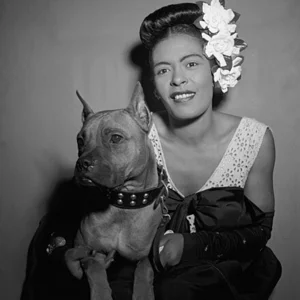

African-American jazz singer
Billie Holiday(1915 — 1959)
Billie Holiday
États-Unis
8 min read
Frequently asked questions
Key Facts
- Née en 1915 à Philadelphie, Billie Holiday grandit dans la pauvreté et connaît une enfance difficile marquée par l'absence de son père
- Dans les années 1930, elle débute sa carrière à Harlem et enregistre ses premiers disques avec le clarinettiste Benny Goodman en 1933
- En 1939, elle interprète 'Strange Fruit', une chanson dénonçant les lynchages des Noirs américains dans le Sud, considérée comme l'un des premiers actes militants de la musique populaire américaine
- Victime de discrimination raciale tout au long de sa carrière, elle est interdite de séjour dans certains hôtels et restaurants malgré sa renommée internationale
- Elle meurt en 1959 à New York à l'âge de 44 ans, laissant une œuvre majeure qui influencera des générations de chanteurs de jazz et de soul
Works & Achievements
A protest song against lynchings in the American South, considered one of the first political protest songs in the history of American popular music. Time Magazine named it the Song of the Century.
Composed by Billie Holiday herself, this song about financial independence and dignity became one of her most covered titles and one of the standards of vocal jazz.
A romantic ballad recorded for Decca Records, a massive commercial success that perfectly illustrates her art of inhabiting a lyric with deep melancholy.
A George Gershwin standard reinterpreted with Teddy Wilson, a recording that revealed to the wider public her unique ability to slow the tempo and color each word with intense emotion.
A classic blues recorded on the B-side of the first 'Strange Fruit' single, and performed again during a legendary 1957 television broadcast alongside Lester Young, Coleman Hawkins, and Ben Webster.
An autobiography co-written with William Dufty, a poignant account of her life, segregation, drugs, and the jazz world. An essential document on the condition of African-American artists in the 20th century.
Anecdotes
In 1939, Billie Holiday performed 'Strange Fruit' for the first time at Café Society in New York. The song, which depicts the lynching of Black men in the American South, was met with stunned silence in the room before applause broke out. Her record label Columbia refused to record it, deeming the subject too controversial.
Billie Holiday had a habit of wearing a white gardenia in her hair on stage. The flower became her visual signature. Legend has it she began wearing it to hide a burn caused by a curling iron, but the gardenia soon became her emblem, recognized the world over.
In 1947, following a conviction for drug possession, Billie Holiday had her cabaret card revoked by New York City. Without this permit, she could no longer perform in New York clubs. Despite this, she sold out Carnegie Hall in 1948, proving her fame extended far beyond the club circuit.
Billie Holiday grew up in extreme poverty in Baltimore and New York. As a teenager, she sang in Harlem clubs for a few dollars in tips. It was by listening to Louis Armstrong and Bessie Smith on records that she developed her unique style, blending jazz phrasing with the intensity of the blues.
The FBI, under J. Edgar Hoover, kept Billie Holiday under surveillance for years, largely because of 'Strange Fruit'. Harry Anslinger, head of the Federal Bureau of Narcotics, reportedly orchestrated her 1947 arrest personally, viewing her as a subversive figure as much as an artist.
Primary Sources
Mom and Pop were just a couple of kids when they got married. He was eighteen, she was sixteen, and I was three. They were both pieces of work, all right.
I've been told that nobody sings the word 'hunger' like I do. Or the word 'love'. Maybe I remember what those words mean.
I'm not asking for charity. I'm asking for the right to work, the right to sing, the right to live like any other human being in this city.
I plead guilty. But I want the court to know that I have been trying to get help for my illness. I am not a criminal. I am sick.
Key Places
Neighborhood where Billie Holiday began her career in the clubs and speakeasies of the 1930s, at the heart of the Harlem Renaissance. It was there that she forged her style and met the great jazz musicians.
New York's first integrated club (Black and white together), where Billie Holiday debuted 'Strange Fruit' in 1939 before a mixed and progressive audience. This venue embodies her activist dimension.
Prestigious concert hall where Billie Holiday triumphed in 1948, shortly after her release from prison, before an enormous crowd. This concert proved that her talent transcended legal and social obstacles.
Billie Holiday's hometown, where she grew up in poverty. She spent a difficult childhood there, marked by her father's absence and the economic hardships of the African American community.
During her 1954 European tour, Billie Holiday was welcomed in Paris as a true star, adored by French intellectuals and jazz enthusiasts, far from American segregation.
Typical Objects

This iconic microphone from the studio era of the 1930s–1950s captured the nuances of Billie Holiday's voice with unmatched warmth. It was with this type of equipment that she recorded her albums at Columbia and Verve Records.

A flower worn in her hair on stage, it became Billie Holiday's visual emblem. This styling detail turned every appearance into an instantly recognizable iconic image.

The recording medium of the era — fragile and heavy — on which jazz tracks were pressed. Billie Holiday recorded hundreds of them between 1933 and the 1950s.

Billie Holiday performed in long, elegant gowns, often in white or black satin, which heightened her stage presence in the smoky clubs of Harlem and the grand concert halls.

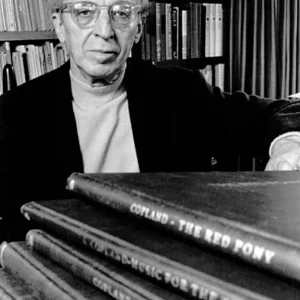
The song, written by Abel Meeropol under the pseudonym Lewis Allan, was originally a protest poem against lynchings. The score became a historic document of African-American resistance.

Billie Holiday wore a gardenia-scented perfume that completed her olfactory signature on stage. Her musicians and those close to her would often recognize her by this fragrance before even seeing her.
School Curriculum
Vocabulary & Tags
Key Vocabulary
Daily Life
Morning
Billie Holiday rarely woke before noon, as concert nights often stretched into the early hours of the morning. She would have a late breakfast of black coffee and toast, sometimes in the company of her beloved dogs. Mornings were a time for rest, reading the newspapers, and phone calls to her musicians.
Afternoon
Afternoons were devoted to rehearsals with arrangers and musicians, often in rehearsal rooms or directly in the clubs before they opened. She worked through the interpretation of each song down to the finest detail, reworking emotional nuances rather than pure technique. Studio recording sessions were also held at this time.
Evening
Evenings began with the first performances around 9 PM, sometimes two or three shows a night at the clubs. Billie Holiday took great care with her outfit and hair, always impeccable with her signature white gardenia. After concerts, she would often stay on to drink with musicians, journalists, and admirers until dawn.
Food
Her diet reflected her humble origins: Southern soul food (fried chicken, pork ribs, mac and cheese, red beans and rice). She frequented restaurants in Harlem and the Lower East Side. The hard years of her life had left her with an ambivalent relationship to food, swinging between feasting during prosperous periods and austerity in times of crisis.
Clothing
On stage, Billie Holiday wore long gowns in white or black satin, often adorned with jewelry. She favored long gloves, furs, and elegant hats for her outings. Her white gardenia in her hair was an absolute signature, complemented by bright red lipstick and carefully applied makeup that highlighted her expressive features.
Housing
Billie Holiday lived in several apartments in Harlem and Manhattan depending on the fortunes of her career and income. Her homes were decorated with care — wooden furniture, heavy curtains, photographs of musicians on the walls. She always kept dogs (notably boxers and Chihuahuas) and a few plants. Periods of prosperity allowed her to live comfortably, but she died without any savings.
Historical Timeline
Period Vocabulary
Visual Style
Esthétique photographique des années 1940, clair-obscur des clubs de jazz, lumière dorée de scène sur fond noir velouté, grain de pellicule vintage.
Sound Ambience
Ambiance des clubs de jazz de Harlem et de la 52e Rue à New York dans les années 1930-1950, avec basse, piano, batterie feutrée et atmosphère intime enfumée.