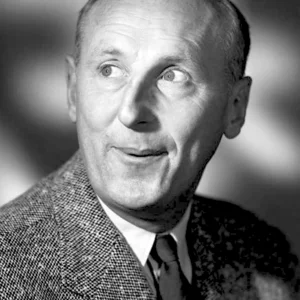

Bourvil (1917-1970) was a French comic actor and singer, famous for his roles in *La Grande Vadrouille* and *Le Corniaud*. Portraying naive and endearing characters, he is one of the most beloved actors in twentieth-century French cinema.
Bourvil(1917 — 1970)
Bourvil
France
7 min read
Frequently asked questions
Famous Quotes
« I am a peasant who got lucky.»
« Laughter is the sunshine of life.»
Key Facts
- Born on 27 July 1917 in Prétot-Vicquemare (Seine-Maritime)
- First breakthrough with the song *Les Crayons* in 1945
- Starred in *Le Corniaud* alongside Louis de Funès in 1965, the highest-grossing film in France that year
- *La Grande Vadrouille* (1966) remained the most-watched French film in France for decades
- Died on 23 September 1970 in Paris from multiple myeloma, aged 53
Works & Achievements
A comic song that introduced him to the general public through radio and music halls. Its naive style and gentle humor made it an immediate popular success that truly launched his career.
One of his most celebrated songs, now a classic of French comic chanson. It perfectly showcases his talent for soft, absurdist humor rooted in everyday situations.
A film by Claude Autant-Lara in which Bourvil stars alongside Jean Gabin. His dramatic performance earned him the Silver Lion at the Venice Film Festival, revealing an acting range far broader than comedy.
A comedy by Gérard Oury with Louis de Funès that drew over 11 million viewers. The Bourvil–de Funès duo, built on the contrast between naivety and cunning, became an absolute benchmark of French comic cinema.
A historical comedy about the Occupation directed by Gérard Oury, which held the French box-office record for 32 years with 17.3 million admissions. A masterpiece of popular cinema, blending laughter with a tribute to the Resistance.
A crime film by Jean-Pierre Melville in which Bourvil plays a melancholy police commissioner. Shot while he was gravely ill, this restrained and intense role definitively confirmed his stature as a complete actor.
Anecdotes
Bourvil owes his stage name to the village of Bourville, in Seine-Maritime, where he grew up in a family of Norman farmers who had adopted him. He chose the name as a tribute to his rural roots, which would inspire his characters of endearing simpletons throughout his entire career.
In 1956, Bourvil received the Silver Lion for Best Actor at the Venice International Film Festival for his role in Crossing Paris, alongside Jean Gabin. This international recognition came as a surprise: known until then as a popular comedian, he revealed to the entire world an unsuspected dramatic depth.
La Grande Vadrouille (1966), filmed with Louis de Funès and directed by Gérard Oury, attracted more than 17 million viewers in France upon its release. This all-time record for French cinema stood for 32 years, until Titanic arrived in 1998 — proof of the exceptional bond audiences formed with this unforgettable comic duo.
During the filming of Jean-Pierre Melville's The Red Circle in 1970, Bourvil was already suffering from a particularly painful osteosarcoma. He nonetheless completed his role with exemplary professionalism, never letting his suffering show in front of the camera. He died on September 23, 1970, shortly after filming wrapped.
Before becoming an actor, Bourvil worked as an apprentice baker and sang at Norman fairs to make ends meet. It was thanks to a talent discovery show on the radio, around 1939, that he was spotted and began his national career as an entertainer.
Primary Sources
I am a Norman peasant. I always have been and I always will be. That is my strength and what people love about me, I believe.
Silver Lion for Best Actor awarded jointly to Jean Gabin and André Raimbourg known as Bourvil for their performance in *La Traversée de Paris*.
Bourvil reveals here a gravity and depth that few would have suspected in him. He creates a character of troubling humanity, far removed from his usual comic roles.
André Raimbourg known as Bourvil, Norman entertainer, will present his comic and musical creations in an entirely new revue.
Key Places
The birthplace of André Raimbourg, born on July 27, 1917. It is in this rural Norman village that the story begins of the man who would become Bourvil.
The village where Bourvil grew up with his adoptive family of farmers. He borrowed its name for his stage name as a tribute to his Norman peasant roots, which remained the foundation of his art.
The famous Parisian performance venue where Bourvil made his professional debut in the 1940s and enjoyed his first great popular successes as a comic entertainer.
France's leading film studios, where *La Traversée de Paris*, *Le Corniaud*, and *La Grande Vadrouille* were shot. Bourvil spent the greater part of his film career working here.
The Parisian district where Bourvil passed away on September 23, 1970, from bone cancer, at the age of 53, at the height of his popularity.
Typical Objects
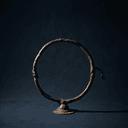
A wool cap worn by French peasants and workers, emblematic of the naive, country-bumpkin characters Bourvil so often played on screen. It became one of his signature props, reinforcing his popular image as a good-natured provincial everyman.
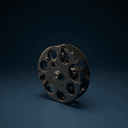
A cellulose acetate photographic medium on which the images of the golden age of French cinema were recorded. It was on this film stock that Bourvil's comic characters were immortalized for posterity.
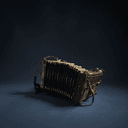
A bellows instrument hugely popular in France during the 1940s–1960s, associated with village dances and comic songs. Bourvil, a self-taught musician, played it on stage to accompany his variety acts.

France's beloved people's car, launched in 1948 and a symbol of the post-war economic boom known as the *Trente Glorieuses*. It appears in several of Bourvil's films, most notably *Le Corniaud*, where it fuels the slapstick comic chaos.
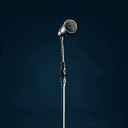
A stage microphone characteristic of the 1940s–1950s, used in music halls and on the radio. It was in front of this type of microphone that Bourvil performed his first comic songs and was discovered by the wider public.
A document containing a film's dialogue and stage directions. Despite his image as a spontaneous comic, Bourvil was known for studying his scripts carefully, working to build psychologically coherent characters beneath the apparent naivety.
School Curriculum
Vocabulary & Tags
Key Vocabulary
Daily Life
Morning
Bourvil woke up early, true to his Norman peasant habits. On film sets, he studied his lines from the early morning, known for his discipline and punctuality — far removed from the image of the freewheeling comic improviser.
Afternoon
Afternoons on set were devoted to shooting scenes, often repeated many times to achieve the precise comic timing he sought. Away from filming, he enjoyed gardening and walking in the countryside, activities that reminded him of his Norman childhood.
Evening
A reserved and unostentatious man, Bourvil preferred quiet evenings with his family over Parisian social gatherings. He read widely, prepared for future roles, and learned to play new musical instruments — a lifelong passion.
Food
Deeply attached to Norman cuisine, Bourvil favored the simple, hearty dishes of his home region: cheeses (camembert, livarot), cider, slow-cooked meats. His wife Jeanne kept a traditional family table, far from Parisian extravagance.
Clothing
On screen, he often wore the clothes of a peasant or small tradesman (grey work smock, beret, corduroy trousers). In everyday life, he dressed plainly and without pretension, reflecting his modest character and wariness of outward appearances.
Housing
Bourvil lived for many years in a house in Vitry-sur-Seine before moving to a Parisian apartment. Far from the ostentatious luxury of some stars, he always maintained a simple family home, close to the rural values he grew up with.