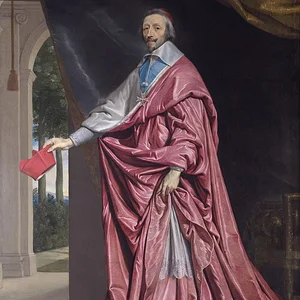

Cardinal and chief minister to Louis XIII, Richelieu strengthened royal authority and centralized power in France. He fought against the rebellious nobility and the Protestants, while drawing France into the Thirty Years' War.
Cardinal de Richelieu(1585 — 1642)
Armand Jean du Plessis de Richelieu
royaume de France
8 min read
Frequently asked questions
Famous Quotes
« If you give me six lines written by the hand of the most honest of men, I will find something in them which will hang him.»
« France is made to be governed by a single master.»
Key Facts
- 1622: Named cardinal by Pope Gregory XV
- 1624: Becomes chief minister to Louis XIII
- 1627–1628: Siege of La Rochelle, submission of the Huguenots
- 1635: Foundation of the Académie française
- 1635: France enters the Thirty Years' War against the Habsburgs
Works & Achievements
A major military and diplomatic operation that ended the political autonomy of French Protestants. Richelieu personally directed the campaign, overseeing the construction of the dike that strangled the city into submission.
A sweeping ordinance reforming royal justice and administration, which reinforced the king's authority over the parlements and local institutions. It laid the groundwork for the centralized administrative monarchy.
An institution created to codify, protect, and enrich the French language. The Académie, of which Richelieu was the "protector," remains to this day an embodiment of his vision of a culturally unified France under state authority.
The strategic decision to formally commit France to the Thirty Years' War alongside the Protestants against the Habsburg powers of Spain and Austria. This pragmatic choice — placing raison d'état above Catholic solidarity — reshaped the balance of power in Europe.
A synthesis of his political thought, setting out his vision of the state, the role of the king, and the art of government. A foundational text of absolutist thinking, it left a lasting mark on the French conception of centralized power.
Major architectural projects reflecting the Cardinal's cultural ambitions. The Palais-Cardinal (later the Palais-Royal) and the planned ideal town in Touraine illustrate his determination to leave a permanent imprint on France.
Anecdotes
In 1628, Richelieu personally supervised the construction of a gigantic 1,500-meter dike across the bay of La Rochelle to prevent English ships from resupplying the besieged Protestants. This titanic undertaking, completed in just a few months, astonished all of Europe and forced the city to surrender after fourteen months of siege.
On November 11, 1630, the queen mother Marie de Médicis believed she had convinced Louis XIII to dismiss Richelieu. She was wrong: the king chose to keep his minister, and it was Marie de Médicis who was sent into exile. That day went down in history as the 'Day of the Dupes' because all those who thought they had triumphed had been deceived.
Richelieu was so fond of cats that he kept an entire colony of them at the Palais-Cardinal. He gave them fanciful names and included them in his will, tasking two servants with feeding them after his death — an eccentricity that raised smiles among his contemporaries.
In 1635, Richelieu formalized a group of men of letters who had been meeting at Valentin Conrart's home by founding the Académie française. Its mission: to standardize and refine the French language. Forty “immortals” were charged with compiling an official dictionary — an undertaking that would ultimately take more than fifty years.
Plagued by chronic migraines, abscesses, and relentless fevers, Richelieu often governed from his bed, dictating his letters and receiving ambassadors while bedridden. His tenacity despite his failing health earned the admiration of his enemies: he died exhausted at 57, having literally consumed his life in the service of the state.
Primary Sources
Reason must be the rule and guide of a State; and the principal function of the sovereign is to establish its reign throughout all his kingdoms and states, and to always prefer the public good over particular inclinations.
We must ruin the Huguenot party, humble the pride of the Grands, bring all subjects back to their duty, and restore the king's name among foreign nations to where it ought to be.
When one serves a king, one must devote oneself entirely to his service, withholding nothing for oneself, and those who divide their efforts between their own satisfaction and the care of his affairs never render him more than half a service.
We wish and intend that all said temples, forts, and places of security be demolished and razed, without those of the so-called Reformed Religion being able to erect new ones.
Its principal function shall be to work with all possible care and diligence to give fixed rules to our language and to render it pure, eloquent, and capable of treating the arts and sciences.
Key Places
Richelieu's main residence in Paris, built from 1629 onwards in the heart of the capital. He bequeathed it to the king upon his death, and it became the Palais-Royal. It was here that he governed France, receiving ambassadors and ministers in his private apartments.
France's principal Protestant stronghold, besieged by Richelieu from 1627 to 1628. The construction of the famous sea dike and the city's subsequent surrender marked the end of the Huguenots' political and military power.
The cardinal had this model town built from scratch in Poitou, laid out on a geometric plan by the architect Jacques Lemercier. Wishing to showcase the greatness of his family name, he made it one of the first planned towns in France.
Richelieu's favorite country retreat, where he enjoyed resting and entertaining those close to him. It was in this château that he died on **4 December 1642**, worn down by illness and years of government.
Richelieu's first ecclesiastical post, which he held from **1607** to **1624**. This poor diocese taught him the craft of administration and allowed him to sharpen his abilities before making his mark on the national stage.
Typical Objects

The cardinal's scarlet red robe symbolized the blood shed for the faith. Richelieu wore this garb even during political councils, reminding everyone that his authority rested on two foundations: religion and service to the State.

Richelieu dictated or drafted thousands of letters, memoranda, and diplomatic instructions. His vast correspondence, preserved in the National Archives, bears witness to a statesman who governed as much by the written word as by speech.

The large maps spread across working tables were indispensable for planning military campaigns and diplomatic alliances. Richelieu thought of politics in terms of natural borders and the balance of European powers.

As chief minister, Richelieu used the king's great seal to authenticate edicts and treaties. Affixing this seal to a document meant pledging the word of the sovereign and the entire State.

Despite his total political commitment, Richelieu remained a churchman who recited his daily prayers. His breviary accompanied him on all his travels, including during military sieges.

Often too ill to ride on horseback, Richelieu traveled by sedan chair or litter. It is said that he sometimes had holes broken through city walls to avoid having to climb out of his litter during inspections.
School Curriculum
Vocabulary & Tags
Key Vocabulary
Daily Life
Morning
Richelieu rose early, often as early as five in the morning, to recite his office and attend Mass in his private chapel. He would then dictate his first instructions to his secretaries before he was even dressed, so pressing were the affairs of state.
Afternoon
Afternoons were devoted to diplomatic audiences, sessions of the Royal Council, and meetings with ambassadors and great lords of the realm. Richelieu often received visitors from his bed due to his frequent illnesses, dictating his responses with an energy that impressed all who came to see him.
Evening
Evenings were an occasion for literary gatherings at the Palais-Cardinal, Richelieu being a passionate patron who welcomed poets and playwrights alike. He also revised his memoirs and political writings, sometimes working deep into the night by candlelight.
Food
Richelieu's table was refined, but his fragile health required him to follow strict diets prescribed by his physicians. He enjoyed roasted meats, soups, and wines from his native Poitou region, while regularly consuming broths and herbal infusions to combat his chronic fevers.
Clothing
Richelieu wore the cardinal's red robe and mozzetta in all circumstances, symbols of both his ecclesiastical and political standing. Beneath his prelate's vestments he wore fine linen, reflecting his taste for refinement, even when his health often prevented him from appearing in full ceremonial dress.
Housing
Richelieu lived at the Palais-Cardinal in Paris, a vast complex he had expanded with formal French gardens, picture galleries, and luxurious apartments. Outside Paris, he stayed at his château at Rueil, always traveling with a retinue of secretaries, physicians, and bodyguards.
Historical Timeline
Period Vocabulary
Visual Style
Le style visuel de Richelieu s'inscrit dans le baroque solennel de la monarchie absolue : dominantes écarlates et noires, portraits hiératiques à la Champaigne, architecture classique grandiose et atmosphère de pouvoir calculé.
Sound Ambience
L'univers sonore de Richelieu oscille entre le silence studieux des cabinets de travail où s'élaborent les stratégies d'État et le fracas des sièges militaires, le tout ponctué par les cloches et les chants liturgiques d'une France profondément catholique.
Liens externes & ressources
Références
Œuvres
Code Michau (Ordonnance de 1629)
1629
Fondation de l'Académie française
1635
Entrée en guerre contre les Habsbourg
1635
Testament politique
rédigé vers 1638-1642, publié en 1688
Construction du Palais-Cardinal et de la ville de Richelieu
1629-1642
See also
Related Characters
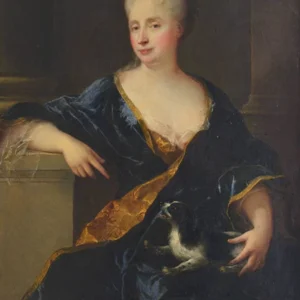
Anne Thérèse de Marguenat de Courcelles, marquise de Lambert
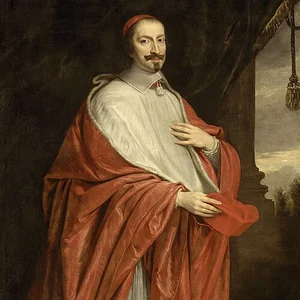
Cardinal Mazarin
1602 — 1661
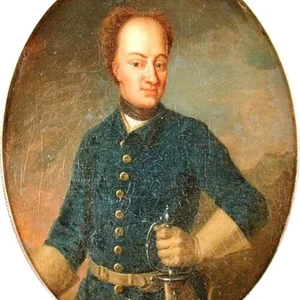
Charles XII of Sweden

Frederick II of Denmark
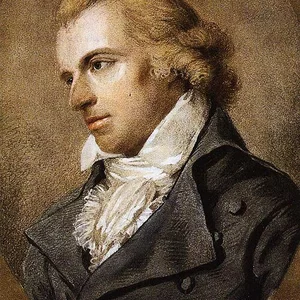
Friedrich Schiller
1759 — 1805
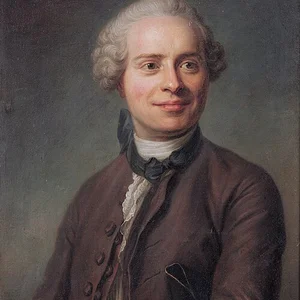
Jean le Rond d'Alembert
1717 — 1783