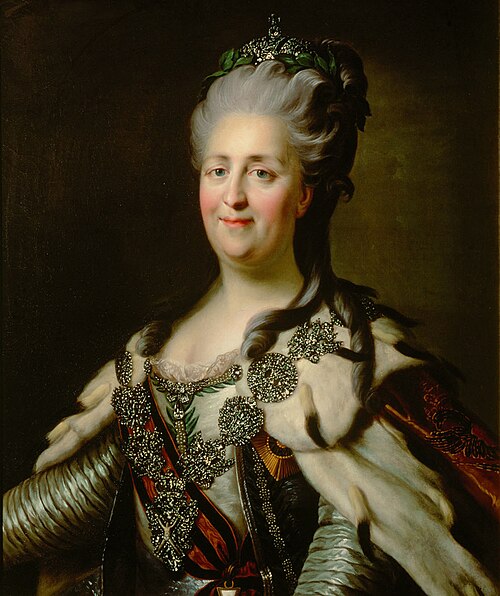
Catherine II(1729 — 1796)
Catherine II of Russia
royaume de Prusse, Empire russe
9 min read
Empress of Russia from 1762 to 1796, Catherine II is one of the most influential rulers in European history. Inspired by Enlightenment philosophers, she modernized Russian administration and significantly expanded the territory of the Empire.
Famous Quotes
« The more I enlighten my contemporaries, the more good servants I prepare for myself. »
« One must govern in such a way that the people believe they are governing themselves. »
Key Facts
- 1762: Seizes power following a coup against her husband Peter III
- 1767: Writes the Instruction (Nakaz), a text inspired by Enlightenment philosophers to reform justice
- 1773-1775: Suppresses the Pugachev Revolt, a major peasant uprising
- 1783: Annexation of Crimea, expanding the Russian Empire southward
- 1796: Death after 34 years of reign, leaving Russia as a major European power
Works & Achievements
A political treatise of 655 articles personally written by Catherine, inspired by Montesquieu and Beccaria. It aimed to modernize Russian law and abolish torture, but its ambitious conclusions were never fully translated into legislation.
Catherine had the Small Hermitage built to house her first art acquisitions. Today one of the largest museums in the world, it holds more than three million objects from her collections and those of her successors.
Following the Pugachev Revolt, Catherine reorganized the Empire into fifty governorates (*guberniyas*) led by governors appointed by the central government. This reform strengthened state authority and permanently modernized local administration.
A foundational document guaranteeing Russian nobles collective rights: exemption from compulsory service, inviolability of property, and the right to travel abroad. This charter shaped Russian society for more than a century.
Through two victorious wars against the Ottomans and the annexation of Crimea, Catherine extended Russia's borders to the Black Sea and opened new commercial ports, considerably strengthening Russian power.
To populate and develop the conquered territories in the south, Catherine ordered the founding of dozens of new cities, including Odessa (a commercial port) and Sevastopol (the naval base of the Black Sea Fleet).
Anecdotes
Born Sophie d'Anhalt-Zerbst in 1729, Catherine was a modest German princess when she was chosen to marry the future Tsar Peter III. She learned Russian with such dedication that she would study until exhaustion late into the night, falling ill from the cold in her freezing palace bedroom. This determination to fit in earned her the admiration of the Russian people, who quickly came to see her as one of their own.
In June 1762, Catherine overthrew her own husband, the unpopular Peter III, through a carefully planned coup carried out with her trusted officers. She mounted a horse in an imperial guard's uniform and placed herself at the head of the regiments that marched on Saint Petersburg. This image of a woman commanding thousands of soldiers made a striking impression on contemporaries and the foreign ambassadors present at court.
A great admirer of the Enlightenment, Catherine invited Denis Diderot to Saint Petersburg in 1773. When she learned that the encyclopedist was in financial difficulty, she bought his library from him for 15,000 livres, but allowed him to keep using it until his death by appointing him her “librarian.” Voltaire, whom she called “the patriarch of Ferney,” wrote her more than 150 letters and showered her with praise across all of Europe.
In 1768, Catherine had herself inoculated against smallpox by the English physician Thomas Dimsdale, becoming the first high-ranking figure in Russia to receive the treatment. To encourage her subjects to follow her example, she publicly announced her decision and organized a grand celebration in the physician's honor. This pro-scientific gesture reflects her genuine commitment to the ideas of the Enlightenment.
A passionate collector, Catherine acquired more than 4,000 paintings, hundreds of sculptures, and countless books over just a few decades. To house her treasures, she had the Small Hermitage built adjacent to the Winter Palace — the origin of what would become the Hermitage Museum, today one of the largest museums in the world. She liked to say that she collected not out of a taste for luxury, but to feed her “intellectual gluttony.”
Primary Sources
Liberty is the right to do whatever the laws permit; and if a citizen could do what the laws forbid, he would no longer have liberty, because all others would equally possess that same power.
I told myself: it is up to you alone to make your happiness. Have good health, a good nature, and frankness. Be just in all things, so as to deserve the esteem and love of those with whom you live.
You taught me to love tolerance, humanity, and letters. When I read you, it seemed to me that I became better than I was.
We have resolved to take the peninsula of Crimea, the island of Taman, and the entire bank of the Kuban under our empire, so as to ensure forever the security of our southern borders.
Key Places
Catherine's birthplace, then part of the Kingdom of Prussia. It was in this port city that the future empress spent her childhood in a noble but modest family, before being chosen to marry the heir to the Russian throne.
The official residence of Russia's emperors, it was from this Baroque palace that Catherine governed the Empire for more than thirty years. She received philosophers and ambassadors there, and installed her first art collections in the neighboring Hermitage building.
Catherine's favorite summer residence, located 25 km from Saint Petersburg. She had the Catherine Palace expanded and magnificent English-style gardens laid out there, and welcomed Diderot during his visit in 1773–1774.
It was in this cathedral, the spiritual heart of Russia, that Catherine was crowned empress on 22 September 1762. The ceremony of extraordinary pomp affirmed her legitimacy in the eyes of the Orthodox Church and the Russian people.
Formerly held by the Tatar khanate under Ottoman suzerainty, Crimea was annexed by Catherine in 1783 after years of diplomatic and military pressure. This territory gave Russia vital access to the Black Sea, a strategic ambition of several tsars.