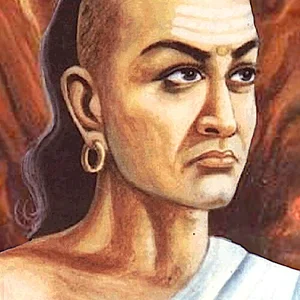

An Indian philosopher, economist, and political strategist of the 4th century BCE, Chanakya served as advisor to Chandragupta Maurya, founder of the Maurya Empire. Often called the "Indian Machiavelli," he authored the Arthashastra, a foundational treatise on politics and economics.
Chanakya(374 av. J.-C. — 282 av. J.-C.)
Chanakya
6 min read
Frequently asked questions
Famous Quotes
« Before you start some work, always ask yourself three questions: Why am I doing it? What might the result be? Will I succeed?»
« Education is the best friend. An educated person is respected everywhere.»
Key Facts
- Born around 374 BCE, probably in Taxila (present-day Pakistan)
- Authored the Arthashastra, a treatise on statecraft, economics, and military strategy
- Played a decisive role in the fall of the Nanda dynasty and the rise of Chandragupta Maurya around 321 BCE
- Taught at the University of Taxila, one of the greatest centers of learning in the ancient world
- Died around 282 BCE, leaving behind a major body of political and economic thought
Works & Achievements
A Sanskrit treatise on politics, economics, and military strategy, rediscovered in 1905; considered one of the greatest texts of political thought from the ancient world.
A collection of maxims and moral precepts on politics, social life, and the conduct of the wise; highly influential in the Indian tradition to this day.
A landmark political achievement: Chanakya masterminded the military and diplomatic overthrow of the Nanda dynasty and the rise of Chandragupta, unifying a large part of the subcontinent.
A diplomatic negotiation resulting in the cession of strategic territories to the Maurya Empire in exchange for war elephants — a masterpiece of Chanakyan diplomacy.
Anecdotes
As a child, Chanakya is said to have been expelled from the court of King Dhana Nanda at Pataliputra after openly criticizing his rule. Humiliated, he vowed to overthrow the Nanda dynasty — and kept his promise by placing Chandragupta Maurya on the throne.
According to tradition, Chanakya constantly tested Chandragupta's loyalty by staging false conspiracies and dangerous scenarios. He believed that only a ruler capable of outwitting the schemes of his own advisor deserved to reign.
The Arthashastra recommends that the king taste all his food in the presence of a trusted minister, and that his meals be prepared according to a strict protocol to prevent poisoning. Chanakya himself had survived several assassination attempts through extreme vigilance.
Tradition holds that Chanakya lived in a modest brahmin hut despite his immense power at the Mauryan court. He always refused wealth and honors, believing that wisdom and personal discipline were the only true safeguards for an advisor.
Primary Sources
The king must always be active in managing the affairs of the state. The prosperity of the kingdom depends on the king's activity; his inactivity is its ruin.
He who is a friend in adversity is the true friend; he who is a husband in difficult times is the true husband.
Chanakya, minister to Chandragupta, accomplished through cunning and strategy what armies alone could never have achieved, overthrowing the power of the Nandas.
The king's inspected advisors are men of great wisdom; they oversee public works, roads, and markets with remarkable rigor.
Key Places
A great university city in northwestern India (present-day Pakistan), where Chanakya studied and taught political science, economics, and military strategy.
Capital of the Maurya Empire, where Chanakya served as Prime Minister to Chandragupta, overseeing the administration of an empire spanning the entire subcontinent.
A fertile region in northeastern India (present-day Bihar), the political and economic heartland of the Maurya Empire, whose conquest Chanakya had planned in order to establish Chandragupta's power.
A crossroads between Central Asia and India, traversed by Alexander the Great; Chanakya made it a strategic axis of Mauryan diplomacy and expansion.
Typical Objects

The traditional writing medium of ancient India, on which Chanakya is said to have composed the Arthashastra, a Sanskrit treatise on politics and economics.

A metal or bamboo tool used to inscribe or write on palm leaves — the everyday instrument of the learned brahmin that Chanakya was.

The Arthashastra gives detailed descriptions of methods for surveying agricultural land and royal roads, tools essential to the administration of the empire.

A source of light used during long nights of intellectual work; tradition describes Chanakya as a man who labored before dawn.

A measuring instrument regulated by the Arthashastra to oversee markets and prevent commercial fraud throughout the Maurya Empire.

The traditional attribute of the ascetic brahmin, symbolizing ritual purity. Despite his political role, Chanakya maintained the lifestyle of a renunciant sage.
School Curriculum
Vocabulary & Tags
Key Vocabulary
Tags
Daily Life
Morning
Chanakya rose before dawn in accordance with Brahminic discipline, performing his ritual ablutions and reciting Vedic prayers. He devoted the early hours of the day to study and the writing of his treatises, before the first royal audiences.
Afternoon
He oversaw the administration of the empire: audiences with ministers, inspection of treasury accounts, and meetings with spies (the 'eyes and ears of the king' described in the Arthashastra). He also trained young Brahmins in the political sciences.
Evening
Chanakya devoted his evenings to strategic reflection and discussions with Chandragupta on affairs of state. By the light of oil lamps, he recorded his recommendations on palm leaves in the simplicity of his Brahmin dwelling.
Food
True to his ascetic way of life, Chanakya followed a simple vegetarian diet: rice, legumes (dal), boiled vegetables, and fruit. He avoided excess in eating, teaching that mastery of the body was the first discipline of the wise.
Clothing
He wore the plain white cotton dhoti of the renunciant Brahmin, without ornament or jewelry. Despite his enormous political influence, he refused the silk garments and adornments reserved for the nobles of the Mauryan court.
Housing
Chanakya lived in a modest hut (āśrama) set apart from the palace, furnished with mats and chests of manuscripts. This deliberate simplicity was as much a political act as a spiritual one, asserting the adviser's independence from royal power.
Historical Timeline
Period Vocabulary
Visual Style
Un esthétique sobre et austère de brahmane savant, contrastant avec la richesse de la cour maurya : lumière ocre des lampes à huile, architecture de pierre et de bois, manuscrits sur feuilles de palme.
Sound Ambience
L'ambiance sonore de la cour de Pataliputra mêle les récitations savantes en sanskrit, les bruits du marché réglementé et les préparatifs militaires d'un empire en construction.
Liens externes & ressources
Références
Œuvres
Arthaśāstra
IVe–IIIe siècle av. J.-C.
Chânakya Nīti (Nītiśāstra)
IVe–IIIe siècle av. J.-C.
Fondation de l'empire Maurya
321 av. J.-C.
Traité avec Séleucos Ier
305 av. J.-C.