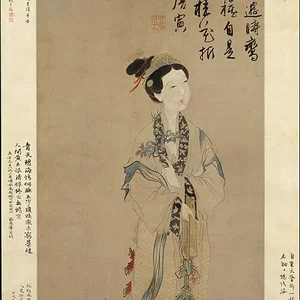

Chang'e is the goddess of the Moon in Chinese mythology. Wife of the divine archer Hou Yi, she swallowed the elixir of immortality and flew to the Moon, where she has resided ever since in her jade palace with the moon rabbit.
Chang'e
Chang'e
9 min read
Frequently asked questions
Key Facts
- Chang'e is mentioned in ancient Chinese texts dating back to at least the 4th century BCE.
- According to the myth, she consumed the elixir of immortality to prevent the tyrant Peng Meng from seizing it.
- Her husband Hou Yi had received this elixir as a reward for shooting down nine of the ten suns that were scorching the Earth.
- Chang'e is celebrated every year during the Mid-Autumn Festival (Zhongqiu Jie), one of the most important Chinese festivals.
- The Chinese space probe Chang'e, launched from 2007 onward, bears her name in tribute to the lunar goddess.
Works & Achievements
The earliest known written text containing the legend of Chang'e (named Heng'e). This philosophical and mythological anthology compiled by Liu An sets down the story of the theft of the elixir in writing for the first time.
A cosmological treatise by astronomer Zhang Heng that places Chang'e within a scholarly vision of the Chinese cosmos, granting her the officially recognized status of a lunar being in learned thought.
A Tang dynasty quatrain, among the most quoted in all of Chinese literature. It captures the melancholy and eternal regret of Chang'e exiled in her palace of ice, far from her husband and the world of the living.
A song-poem from the Song dynasty, composed on a Mid-Autumn night. A meditation on separation and eternity, it evokes Chang'e's palace and remains one of the most memorized works in classical Chinese literature.
A major popular festival celebrated every 15th night of the 8th lunar month in honor of Chang'e. Family reunions, contemplation of the full moon, offerings of mooncakes — this tradition keeps the myth alive throughout East Asia.
A series of lunar probes and rovers bearing the goddess's name, from Chang'e 1 to Chang'e 6. This world-leading program gives extraordinary contemporary resonance to a myth two millennia old.
Anecdotes
Chang'e was the wife of Hou Yi, the divine archer who saved the Earth by shooting down nine of the ten suns that were scorching it simultaneously. As a reward, the Queen Mother of the West (Xi Wang Mu) offered him an immortality elixir — but only enough for one person, condemning the couple to choose who would live forever.
On the night when Peng Meng, Hou Yi's jealous apprentice, tried to seize the elixir by force, Chang'e made a drastic choice: she swallowed the precious potion alone to prevent it from falling into the wrong hands. Her body became so light that she floated involuntarily toward the Moon, condemned to dwell forever in the Palace of Vast Cold, eternally separated from her husband.
In her jade lunar palace, Chang'e shares her solitude with the Jade Rabbit (Yù Tù), a white rabbit that endlessly pounds medicinal herbs in a golden mortar. A woodcutter named Wu Gang is also said to be condemned to eternally chop down a lunar laurel tree that always grows back — thus populating the Moon with punished and melancholic beings.
The Mid-Autumn Festival (Zhōngqiū Jié), celebrated each year on the 15th day of the 8th lunar month when the full moon is at its brightest, is directly linked to Chang'e. Chinese families gather to gaze at the moon and eat mooncakes (yuèbǐng), round pastries symbolizing wholeness and reunion — everything the lonely goddess can no longer know.
The myth of Chang'e has crossed the centuries into the space age: China has named its entire series of lunar probes 'Chang'e' (嫦娥工程). The rover that landed in 2013 is called Yutu, the Jade Rabbit. In 2024, Chang'e 6 returned the first samples from the far side of the Moon — giving a modern scientific echo to the millennia-old myth of the exiled goddess.
Primary Sources
Hou Yi obtained from Xi Wang Mu the medicine of immortality. Heng'e [Chang'e] stole it and fled to the Moon. She then became a lunar being, residing on that celestial body.
Heng'e, wife of Yi the Archer, stole the pill of immortality and fled to the Moon. She now resides there as a celestial being, guardian of that cold celestial body.
云母屏风烛影深,长河渐落晓星沉。嫦娥应悔偷灵药,碧海青天夜夜心。 (The mica screen, the candle and its deep shadow; the Milky Way tilts, the morning star fades. Chang'e must regret having stolen the elixir — blue-green sea, azure sky, night after night, this solitary heart.)
我欲乘风归去,又恐琼楼玉宇,高处不胜寒。 (I would ride the wind to return home, yet I fear the jade towers, so high, would be too cold to bear.) — a melancholic evocation of Chang'e's lunar palace.
Description of Xi Wang Mu and her domain on Mount Kunlun, guardian of the elixir of immortality — the founding mythological context of the Chang'e narrative and the transmission of the elixir to Hou Yi.
Key Places
Chang'e's eternal dwelling, described as a palace of white jade and crystal bathed in cold, blue light. Chang'e lives there alone with the Jade Rabbit in an icy silence, gazing at the unreachable Earth.
A mythical mountain in Taoist cosmology and home of Xi Wang Mu, guardian of the elixir of immortality. It is here that Hou Yi came to seek the medicine that would forever alter Chang'e's fate.
The home Chang'e shared with her husband before her lunar exile, a symbol of the world of the living she can no longer return to. Its loss embodies the central longing at the heart of the myth.
An imperial temple built in 1530 under the Ming dynasty, where the Emperor of China came each autumn to pay tribute to the Moon and Chang'e. One of the few historically attested sites of Chinese lunar worship.
Typical Objects

Sacred drink offered by Xi Wang Mu to Hou Yi. Chang'e swallowed it whole to protect him from the apprentice Peng Meng, triggering her flight to the Moon — the central and tragic object of her entire destiny.

Chang'e's eternal companion on the Moon, a white rabbit that tirelessly pounds medicinal herbs in a golden mortar. Across East Asia, its silhouette is recognized in the markings of the full moon.

A giant tree growing in the lunar palace, which Wu Gang is condemned to chop down forever without ever succeeding. The cassia tree symbolizes cyclical rebirth and the unchanging time of exile.

Round pastry filled with lotus paste or red bean paste, eaten during the Mid-Autumn Festival in memory of Chang'e. Its circular shape evokes the full moon and the family unity the goddess has lost.

Chang'e's divine garment, made from celestial birds' feathers and silver silk, allowing her to soar through the heavenly spheres. The famous Tang court melody 'Nícháng Yǔyī' drew direct inspiration from it.

Chinese ritual object associated with the Moon and Chang'e, often decorated with rabbits and astral motifs. These mirrors served as offerings during the Mid-Autumn Festival and as protective amulets connected to the goddess.
School Curriculum
Vocabulary & Tags
Key Vocabulary
Tags
Lieu
Daily Life
Morning
At moonrise — which for Chang'e is an inverted dawn — the goddess gazes from the jade terraces of her palace at the Earth slowly turning in the darkness. She tends the Jade Rabbit and collects the crystal dew that forms on the precious stones of the palace, the first nourishment of the celestial day.
Afternoon
Chang'e spends her long hours in the gardens of the Palace of Great Cold, gathering osmanthus blossoms (桂花) whose fragrance fills the frozen air. She plays the jade flute or weaves fabrics of silver silk, in a silence broken only by the steady rhythmic pounding of the Jade Rabbit's pestle.
Evening
When the full moon illuminates the Earth, Chang'e dances alone in the great hall of the palace, dressed in her flowing feathered robe. It is at this moment that she is most visible from the ground below and that she hears, it is said, the prayers of mortals who dedicate offerings of round moon cakes to her.
Food
As an immortal, Chang'e does not eat as humans do. She consumes celestial elixirs, moonlit dew distilled upon jade, and peaches of immortality grown in the divine gardens. The moon cakes (月饼) that humans offer her during the Mid-Autumn Festival are an earthly echo of this ethereal diet.
Clothing
Chang'e is depicted wearing long robes of white or silver silk, embroidered with clouds and lunar blossoms. Her most celebrated garment is the Nícháng Yǔyī, the “Feathered Robe and Rainbow Skirt”, a diaphanous tunic that allows her to fly and ripples around her like an icy mist.
Housing
The Palace of Great Cold (广寒宫) is described in classical texts as a dwelling built entirely of white jade, rock crystal, and pure silver, bathed in a cold, pale blue light. Its gardens are filled with osmanthus trees; its halls resound with the eternal silence of exile.
Historical Timeline
Period Vocabulary
Liens externes & ressources
Références
Œuvres
Huainanzi (淮南子) — Chapitre Lan Ming Xun
vers 139 av. J.-C.
Lingxian (灵宪), Zhang Heng
vers 120 ap. J.-C.
Poème 'Chang'e' (嫦娥), Li Shangyin
vers 850 ap. J.-C.
Shui Diao Ge Tou (水调歌头), Su Shi
1076 ap. J.-C.
Fête de la Mi-Automne (中秋节) — tradition rituelle vivante
attestée depuis la dynastie Tang (618–907 ap. J.-C.)
Programme spatial Chang'e (嫦娥工程), Agence spatiale nationale chinoise
2007 — en cours