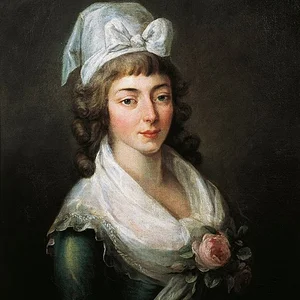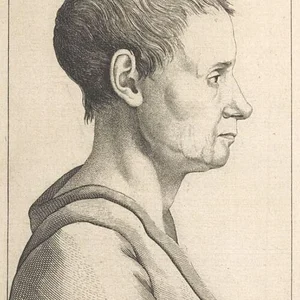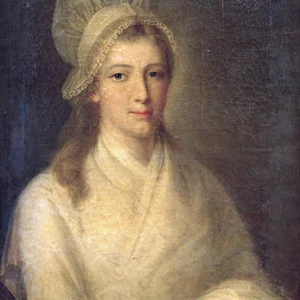

A Norman Girondin activist, Charlotte Corday assassinated Jean-Paul Marat in his bathtub on July 13, 1793. Convinced she was putting an end to the Terror, she was guillotined four days later at the age of 24.
Charlotte Corday(1768 — 1793)
Charlotte Corday
France
8 min read
Frequently asked questions
Famous Quotes
« I killed one man to save a hundred thousand.»
« I knew I was a republican long before the Revolution.»
Key Facts
- Born on July 27, 1768, in Saint-Saturnin-des-Ligneries (Normandy)
- A Girondin sympathizer, opposed to the Montagnards and the Terror
- Assassinated Jean-Paul Marat in his bathtub in Paris on July 13, 1793
- Tried and sentenced to death by the Revolutionary Tribunal
- Guillotined on July 17, 1793, at the age of 24, on the Place de la Révolution
Works & Achievements
A political text written by Charlotte Corday before her departure for Paris, in which she justifies her forthcoming act as a civic deed to save the Republic from the excesses of the Terror. Found among her belongings at the time of her arrest, this document is the principal testimony to her political thinking.
A deeply moving letter written from her prison cell between the 13th and 16th of July, in which she asks her father's forgiveness while affirming the righteousness of her convictions. This document reveals her clarity of mind and composure in the face of a death she knew to be certain.
At her trial, which lasted only a few hours, Charlotte Corday defended her act alone, rejecting any suggestion of accomplices and claiming full individual responsibility. This oral testimony, transcribed in the judicial archives, struck contemporaries with its clarity and coherence.
A letter addressed to the Girondin deputy requesting a letter of introduction for Paris — the first concrete step in carrying out her plan. This letter proves that her act was premeditated several weeks in advance.
Anecdotes
On the morning of July 13, 1793, Charlotte Corday bought an ordinary kitchen knife at the Palais-Royal market in Paris for two francs. She had only arrived in the capital two days earlier from Caen, carrying with her a letter of introduction for a Girondin deputy. No one suspected her intentions.
To gain entry to Marat's home, Corday claimed to have information about a list of Girondin traitors hiding in Normandy. Marat, suffering from a severe skin condition, was working in his medicinal bathtub — a special arrangement that allowed him to continue writing his revolutionary newspaper despite the pain. It was in this position that she stabbed him in the heart.
At her trial before the Revolutionary Tribunal on July 17, 1793, Charlotte Corday maintained a remarkable composure that astonished those present. She refused to implicate any accomplice, proudly declaring that she had acted alone and with full awareness of what she was doing. She was just 24 years old when she was guillotined that same day.
The painter Jacques-Louis David, then a member of the Convention, visited Marat's bedside just hours after the assassination. From this tragic scene was born his masterpiece *The Death of Marat*, painted in a matter of weeks, which transformed the victim into a martyr of the Revolution. Charlotte Corday, the killer, vanishes from the painting — only the letter she had handed him remains visible.
Before leaving Caen for Paris, Charlotte Corday wrote a farewell letter to her father, asking his forgiveness for the pain she was about to cause him. She also wrote a political declaration titled *Address to the French People, Friends of Law and Peace*, which she intended to distribute after the act, explaining her Girondin motives. This document was found on her when she was arrested immediately afterward.
Primary Sources
Forgive me, dear Father, for having disposed of my life without your permission. I have avenged many innocent victims, and prevented many more disasters. The people, once disillusioned, will rejoice at being delivered from a tyrant.
I alone conceived and executed this plan. I needed no one's help to carry out a well-made resolution. I knew that Marat was a villain; I killed one man to save a hundred thousand.
How many more innocents will perish if you do not rise up! Peaceful citizens, if you love the law and your homeland, know that the time has come to act against those who would plunge France into civil war and despotism.
I thank you, citizen, for the letter you gave me for Duperret. I am leaving for Paris with the hope of rendering my homeland a signal service. I count on your discretion.
Key Places
Birthplace of Charlotte Corday on July 27, 1768, born into a modest Norman noble family descended from the playwright Pierre Corneille. She grew up in a rural setting steeped in aristocratic and religious values.
Charlotte Corday was a boarder here from around 1782 to 1791, receiving a careful religious and literary education. It was in the abbey's library that she discovered Plutarch, Rousseau, and the great Enlightenment authors who shaped her convictions.
The city where Charlotte Corday was living in 1793 during the Girondin federalist uprising against Paris. It was through her contact with Girondin deputies who had taken refuge in Caen that she hardened her resolve to act against Marat.
The home address of Jean-Paul Marat, where Charlotte Corday stabbed him on July 13, 1793. She had to insist twice before being admitted, claiming to have information about Girondin traitors in Normandy.
The site where the guillotine stood during the Terror, and where Charlotte Corday was executed on July 17, 1793 at the age of 24 — just four days after the assassination of Marat. Thousands of people attended these public executions.
Typical Objects

On 13 July 1793, Charlotte Corday purchased this ordinary knife at the Palais-Royal market for two francs. It was the weapon she used to stab Marat: its simplicity stands in stark contrast to the political significance of the act.

The Girondist deputy Barbaroux gave her this letter addressed to deputy Duperret in Paris, providing her with a contact in the capital. This letter of recommendation opened the doors of the Parisian revolutionary world to her.

Corday was an educated woman, deeply shaped by Enlightenment ideals and in particular by Plutarch's writings on great men. She wrote several letters before and after her act, including a political address and a farewell letter to her father.

On the day of the assassination, Charlotte Corday was wearing a green and brown striped dress — the modest, understated outfit of a young bourgeois provincial woman. The garment was described in precise detail in the arrest records.

Marat suffered from a severe skin condition (probably eczema or psoriasis) that forced him to work submerged in a bathtub filled with medicinal water. It is this ordinary household object that Jacques-Louis David immortalized in his painting, turning it into a symbol of a revolutionary martyr caught in his most private moment.

This hugely popular revolutionary newspaper, written by Marat himself, regularly called for the deaths of the Revolution's enemies. Charlotte Corday read it and saw it as the primary engine of the Terror she was determined to stop.
School Curriculum
Vocabulary & Tags
Key Vocabulary
Daily Life
Morning
In 1793 in Caen, Charlotte Corday rose early like most bourgeois women of the provinces. She often attended morning Mass — her education at the abbey had instilled in her a sincere piety — then devoted her mornings to reading, particularly the works of Plutarch and the Enlightenment philosophers that shaped her republican convictions.
Afternoon
In the afternoons, she would visit the cafés and salons of Caen where Girondin refugees driven from Paris gathered to debate. It was during these lively discussions that she heard accounts of the violence of Marat and the Montagnards, strengthening her resolve to act. She also walked the streets of Caen, a city still relatively peaceful compared to Paris.
Evening
Evenings were spent with family or close friends, reading, corresponding, or listening to political news read aloud. Revolutionary newspapers such as Marat's L'Ami du peuple circulated even in the provinces: it was by reading them that Corday grasped the full extent of the Terror.
Food
Like the majority of French people of modest means in 1793, Charlotte Corday lived mainly on bread, vegetables, and milk. The war and revolutionary requisitions created frequent food shortages, and meat remained an occasional item for the Norman middle classes.
Clothing
As a young woman of impoverished minor nobility, Corday wore simple linen or wool dresses in muted colors — striped or checked — without the adornments of the great aristocrats. Her outfit on the day of the assassination, a green and brown striped dress with a bonnet with ribbons, is described in precise detail in the judicial archives.
Housing
After the abbey's closure (convents were dissolved by the Revolution), Charlotte Corday lived with a friend, Madame le Bretteur, in a bourgeois boarding house in Caen. Her room, simply furnished with a bed, a table, and a few books, reflected the modest economic circumstances of her impoverished noble family.
Historical Timeline
Period Vocabulary
Liens externes & ressources
Références
Œuvres
Adresse aux Français amis des lois et de la paix
Juillet 1793
Lettre d'adieu à son père (Charles-Alexis de Corday d'Armont)
13 juillet 1793
Déclaration devant le Tribunal révolutionnaire
17 juillet 1793
Lettre au conventionnel Barbaroux
Juin 1793