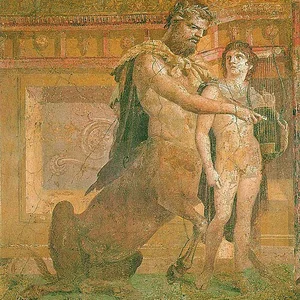

Chiron is a centaur from Greek mythology, son of Cronus and the nymph Philyra. Renowned for his wisdom, he served as tutor to many Greek heroes, including Achilles, Jason, and Asclepius. He excelled in medicine, music, hunting, and philosophy.
Chiron
Chiron
9 min read
Frequently asked questions
Key Facts
- Son of Cronus and the nymph Philyra, born a centaur unlike Cronus's other children
- Tutor of Achilles, whom he taught music, hunting, medicine, and the arts of war
- Teacher of Asclepius, god of medicine, to whom he passed on his medical knowledge
- Accidentally wounded by one of Heracles's poisoned arrows, he chose to give up his immortality to end his suffering
- Zeus placed him among the stars as the constellation Centaurus or Sagittarius
Works & Achievements
Chiron raised Achilles from childhood on Mount Pelion, teaching him medicine, music, hunting, and the art of war. Without Chiron, the greatest hero of the Trojan War — celebrated by Homer in the Iliad — would never have existed.
Chiron passed on the full breadth of his medical and botanical knowledge to Asclepius, shaping him into the future god of medicine. This legacy came to symbolize the entire medical and pharmaceutical tradition of ancient Greece.
Chiron took Jason under his wing for twenty years and forged him into the leader capable of heading the Argonauts' expedition in quest of the Golden Fleece. He taught him wisdom, courage, and diplomacy — the virtues of the heroic leader.
Moral maxims and precepts attributed to Chiron circulated in antiquity under this title, some of them incorporated into the works of Hesiod. These texts distilled the wisdom the centaur was said to impart to his heroic pupils.
By voluntarily surrendering his immortality to free Prometheus from his eternal torment, Chiron performed an act of absolute selflessness. This mythological deed symbolizes the triumph of compassion and wisdom over the instinct for self-preservation.
Anecdotes
Chiron was no ordinary centaur: born of Cronus and the nymph Philyra, he had a character radically different from other centaurs, who were notorious for their savagery and their immoderate love of wine. Where his kind fought and pillaged, Chiron meditated, healed, and taught, earning the epithet 'the most just of centaurs' in ancient Greek texts.
Chiron raised young Achilles after his father Peleus entrusted the child to him on Mount Pelion. In his cave, he taught him to play the lyre, to hunt, to practice medicine, and the art of war. According to some traditions, he fed the child lion and boar marrow to forge in him an indomitable courage — a uniquely holistic education in Greek mythology.
Despite his immortality, Chiron fell victim to a terrible accident: an arrow from Heracles, poisoned with the blood of the Lernaean Hydra, accidentally wounded him in the thigh during an encounter on Pelion. The pain was so excruciating and impossible to cure — even for the greatest healer in the mythological world — that he begged Zeus to strip him of his immortality so he could finally die in peace.
To relieve Chiron's suffering, Zeus agreed to an extraordinary exchange: the centaur gave up his immortality to Prometheus, who had been chained and tortured for centuries for giving fire to humanity. Chiron died, freeing the Titan, and Zeus, to honor his wisdom and sacrifice, placed him among the stars in the form of the constellation Centaurus.
Among the many heroes Chiron trained, Asclepius became under his tutelage the god of medicine. Chiron taught him medicinal plants, remedies, and surgery with such excellence that Asclepius eventually raised the dead — which angered Zeus to the point of striking him down with a thunderbolt. Chiron's medical legacy thus lived on throughout the entire ancient Greek medical tradition.
Primary Sources
Patroclus led Eurypylus out of the crowd [...] He cut out the sharp arrow, washed the dark wound with warm water and applied a bitter root, a root that Chiron had once given to Achilles, who had passed it on to his friend.
Jason, raised by Chiron on the heights of Pelion, returned from the Centaur's cave after twenty years, unstained by any falsehood, schooled in justice and in the arts of war.
Philyra bore great Chiron, most just and wise of all, of double nature, half man and half horse — a gift of Cronus, who had transformed himself into a stallion to unite with her in secret.
Chiron, son of Cronus and Philyra, lived on Mount Pelion in Thessaly. He took in Achilles, son of Peleus, and taught him hunting, horsemanship, medicine, music, and the arts of war.
Chiron came down to the seashore and, in the waves, dipped his broad feet, then waved his hand in farewell to the distant Argonauts, wishing his pupil Jason a safe return.
Key Places
The cave on Mount Pelion was both the home and the school of Chiron. This forested mountain in Thessaly, rich in medicinal plants, welcomed generations of Greek heroes who came to be trained by the wise centaur.
A region of ancient Greece associated with centaurs and primal myths. Thessaly was the birthplace of the heroes trained by Chiron, most notably Achilles (born in Phthia) and Jason (born in Iolcos).
The seat of the Olympian gods, it was here that Zeus deliberated and decided to grant Chiron catasterism after his death — raising him to the stars as a reward for his wisdom and self-sacrifice.
After his death, Zeus transformed Chiron into a constellation. Centaurus is one of the largest constellations in the southern sky, preserving for eternity the memory of the wisest of all centaurs.
Typical Objects

Chiron was a legendary archer, a symbol of his mastery of hunting and the martial arts. He taught this skill to Achilles and many other heroes, elevating archery into a discipline that was as much spiritual as it was technical.

Mount Pelion was renowned in antiquity for its plants with exceptional therapeutic properties, which Chiron knew better than anyone. He passed this botanical knowledge on to Asclepius, symbolically laying the foundations of Greek pharmacopoeia.

Chiron taught music to his pupils as a discipline of both soul and body. The lyre he played in his cave symbolized the union of intellectual rigor and artistic sensitivity — two qualities indispensable to the accomplished hero.

Chiron gave Peleus, and later Achilles, a spear fashioned from an ash tree on Mount Pelion — the hero's emblematic weapon in the Iliad. This object symbolizes the unbreakable bond between the master and his most celebrated pupil.

An indispensable tool for preparing remedies, Chiron's mortar represents his role as healer and pioneering pharmacologist. He used it to grind the medicinal plants gathered on the slopes of Pelion.

One of Heracles' arrows, dipped in the venom of the Lernaean Hydra, accidentally wounded Chiron, inflicting the immortal centaur with unbearable and incurable pain. This fatal object became the symbol of the wise centaur's tragic fate and of the limits of all knowledge in the face of suffering.
School Curriculum
Vocabulary & Tags
Key Vocabulary
Daily Life
Morning
Chiron wakes at dawn in his cave on Mount Pelion and gathers the first medicinal herbs while they are still covered in dew — the moment when their active compounds are most concentrated, according to Greek tradition. He begins each day by observing the sky and the stars, as astronomy and meteorology are integral parts of the knowledge he imparts to his students.
Afternoon
The afternoon is devoted to practical instruction: Chiron leads his students into the woods for hunting exercises, footraces, and nature observation. He teaches them botany by naming each plant and explaining its medicinal uses, then trains alongside them in archery and javelin throwing on the rocky slopes of Pelion.
Evening
In the evening, gathered around the fire inside the cave, Chiron plays the lyre and teaches music and poetry. These evenings also serve as occasions for philosophical discussion on justice, courage, and temperance — the core values he seeks to instill in his students, shaping them not merely into warriors, but into truly virtuous heroes.
Food
Chiron subsisted mainly on the fruits of the hunt — deer, boar, and hares caught on Pelion — along with foraged fruits, berries, and wild grains. Unlike the wild centaurs, who were notorious for their immoderate appetite for raw meat and wine, Chiron cooked his food and drank in moderation, embodying the virtue of temperance that he preached.
Clothing
As a centaur, Chiron had no need of clothing for his equine half. His human torso was depicted bare in Greek iconography, or sometimes draped in a simple chlamys (a short cloak pinned at the shoulder) during his mountain outings. He carried a quiver on his back and sometimes wore a laurel wreath, the symbol of wisdom.
Housing
The famous cave on Mount Pelion served as Chiron's home, laboratory, and school all in one. This natural grotto, lined with animal hides and bundles of dried herbs hanging from the walls, held his medical instruments, his lyre, his weapons, and stores of medicinal plants. Open to any hero seeking knowledge, it represented the first model of a school in Greek mythology.
Historical Timeline
Period Vocabulary
Visual Style
Style inspiré de la céramique grecque antique à figures rouges, avec des teintes ocre, vert olive et terre cuite, représentant Chiron dans sa caverne du mont Pélion entourée de plantes médicinales, d'instruments de musique et de jeunes héros en apprentissage.
Sound Ambience
Atmosphère montagnarde mystique du mont Pélion, entre chants d'oiseaux, frémissement des forêts thessaliennes et musique de lyre — l'univers sonore de la caverne-école du sage centaure, berceau des héros grecs.
Liens externes & ressources
Références
Œuvres
Formation d'Achille
Temps mythiques
Formation d'Asclépios
Temps mythiques
Formation de Jason
Temps mythiques
Préceptes de Chiron (Cheiron Hypothekai)
VIIe-VIe siècle av. J.-C. (attribution ancienne)
Sacrifice de l'immortalité pour Prométhée
Temps mythiques