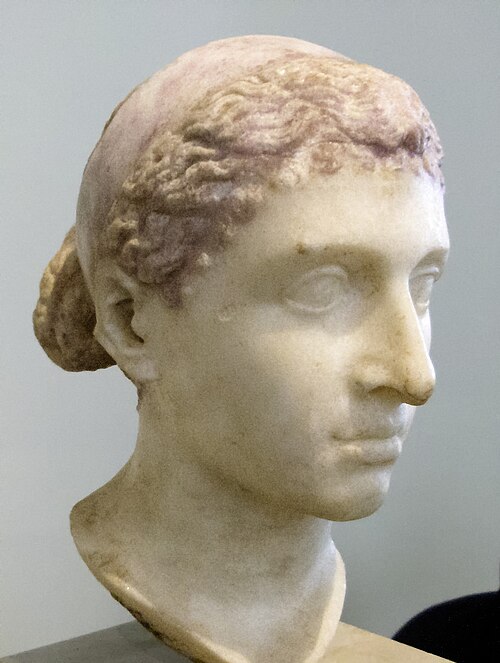
Cleopatra VII(68 av. J.-C. — 29 av. J.-C.)
Cleopatra
royaume ptolémaïque
8 min read
Last queen of the Ptolemaic dynasty of Egypt, she reigned from 51 to 30 BC. Allied with Julius Caesar and then Mark Antony, she embodied Egypt's resistance against Roman power before taking her own life during Octavian's conquest.
Frequently asked questions
Key Facts
- 51 BC: ascends the throne of Egypt at age 18, alongside her brother Ptolemy XIII
- 48 BC: meets Julius Caesar in Alexandria and becomes his ally
- 41 BC: meets Mark Antony in Tarsus; political and romantic union
- 31 BC: naval defeat at Actium against Octavian
- 30 BC: death of Cleopatra; Egypt becomes a Roman province
Works & Achievements
According to several ancient sources, Cleopatra reportedly wrote texts on medicine, poisons, and cosmetics. These writings, now lost, attest to her advanced scientific training at the Mouseion of Alexandria.
Cleopatra stabilized the Egyptian currency, reorganized trade with the East, and developed caravan routes to India and Arabia, reinforcing the kingdom's prosperity despite Roman pressure.
During this grand ceremony organized with Mark Antony, Cleopatra was proclaimed “Queen of Kings” and “New Isis.” She obtained sovereignty over significant eastern territories, manifesting her ambition to reconstitute an independent Egyptian empire.
Cleopatra had numerous temples built and embellished across Egypt, notably at Dendera where her portrait as a goddess is carved on the facade, and at Philae. These constructions aimed to assert her divine nature before the Egyptian population.
Cleopatra's great political achievement was maintaining Egypt's independence by successively allying herself with the two most powerful men in Rome. This diplomacy, unique in the ancient world, delayed the annexation of Egypt by nearly twenty years.
Anecdotes
To meet Julius Caesar secretly in 48 BC while she was in exile, Cleopatra had herself concealed inside a cloth sack (some sources say a carpet) and delivered to the royal palace in Alexandria. This daring entrance impressed the Roman general, and their political — then romantic — alliance changed the fate of Egypt.
Cleopatra was a woman of exceptional learning: according to the historian Plutarch, she spoke at least nine languages, including ancient Egyptian, Greek, Aramaic, Hebrew, and Ethiopian. She was the first ruler of the Ptolemaic dynasty to learn the language of her own Egyptian subjects, which earned her a popular devotion her predecessors had never known.
The legend of the pearl banquet, recorded by Pliny the Elder, tells that Cleopatra wagered with Mark Antony that she could provide a banquet worth ten million sesterces. She removed one of her enormous pearl earrings, dissolved it in vinegar, and drank the solution. Antony, impressed, conceded that she had won the wager.
At their first meeting in Tarsus in 41 BC, Cleopatra made her entrance on the river Cydnus aboard a gilded galley with purple sails, surrounded by servants dressed as Cupids and female musicians. She herself was dressed as the goddess Isis. This dazzling political and symbolic spectacle left a lasting impression on Mark Antony and the local population.
After the defeat at Actium in 31 BC and the death of Mark Antony, Cleopatra attempted to negotiate with Octavian to preserve the throne for her children. Refusing to be paraded as a captive in a Roman triumph, she took her own life in August 30 BC. Her death marked the end of independent Egypt and of pharaonic civilization as a political power.
Primary Sources
She came aboard a galley whose stern was of gold, the sails of purple, and the oars of silver, which kept stroke to the music of flutes... She was reclining under a canopy spangled with gold, arrayed like Venus in a painting.
Cleopatra, after trying by every means to win Octavian's affection and failing, had no desire to be led in triumph and chose instead to die as a queen.
I detest the queen. [...] Her arrogance, when she was living in Caesar's gardens beyond the Tiber, still makes me shudder at the memory.
There was only one pearl in the world, and it carried off the victory. Cleopatra, who had at her disposal the wealth of entire kingdoms amassed over centuries, dissolved it in vinegar and drank it.
Apollodorus the Sicilian swam from the harbour with some bedding rolled up in a mattress cloth; he had tied this bundle with a strap and was carrying it over his shoulder when he entered Caesar's quarters.
Key Places
Capital of the Ptolemaic kingdom and home to the famous Mouseion and the Great Library. Cleopatra was born here, ruled here, and died here; it was one of the greatest metropolises of the ancient world.
Cleopatra stayed in Rome between 46 and 44 BC as Caesar's guest, at his villa across the Tiber. This political sojourn gave her an inside view of how Roman power operated.
City in Cilicia where the famous first meeting between Cleopatra and Mark Antony took place in 41 BC. This diplomatic encounter, staged as a divine apparition, sealed their political and personal alliance.
A promontory in northwestern Greece where, on September 2, 31 BC, the decisive naval battle was fought between the fleets of Antony and Cleopatra and that of Octavian. Their defeat sealed the fate of Ptolemaic Egypt.
An island in the Nile housing the great temple dedicated to Isis, the goddess with whom Cleopatra officially identified herself. She had hieroglyphic inscriptions carved there and conducted religious ceremonies to reinforce her divine legitimacy.