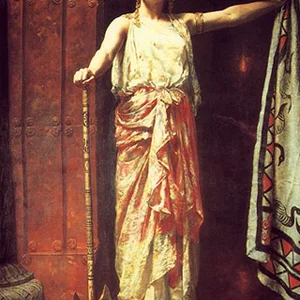

A major figure in Greek mythology, Clytemnestra is the wife of King Agamemnon of Mycenae. She murders him upon his return from the Trojan War to avenge the sacrifice of their daughter Iphigenia. She is the central character of Aeschylus's Oresteia (458 BCE).
Clytemnestra
Clytemnestra
8 min read
Frequently asked questions
Key Facts
- Wife of Agamemnon, king of Mycenae, and mother of Iphigenia, Orestes, Electra, and Chrysothemis
- Takes Aegisthus as her lover during the Trojan War (c. 1200 BCE in mythological tradition)
- Murders Agamemnon upon his return from Troy to avenge the sacrifice of Iphigenia at Aulis
- Is killed by her own son Orestes, avenging his father, which triggers the pursuit of the Erinyes
- Protagonist of Aeschylus's Oresteia (trilogy performed in 458 BCE), the first complete trilogy preserved in Western literature
Works & Achievements
The first complete set of Greek tragedies to survive intact. Clytemnestra is the dominant figure of the first play, portrayed simultaneously as a cold-blooded killer and the victim of a genuine injustice.
A tragedy centered on Agamemnon's daughter and her hatred of Clytemnestra. The mother is portrayed here without remorse or complexity, a pure villain whose actions justify the revenge sought by Electra and Orestes.
A more psychological and realistic retelling of the myth, questioning whether Orestes' revenge is truly justified. Euripides gives Clytemnestra a more human dimension, making her almost understandable.
A posthumous tragedy exploring the foundational events that set the cycle of revenge in motion. In it, we see Clytemnestra desperately trying to protect her daughter before the sacrifice, making her future rage entirely understandable.
The murder of Agamemnon is referenced several times as the ultimate example of marital betrayal, serving as a foil to Odysseus's homecoming and Penelope's faithfulness.
Anecdotes
When the Greek fleet was stranded at Aulis by contrary winds, the seer Calchas revealed that only the sacrifice of Iphigenia, Agamemnon's eldest daughter, would appease the goddess Artemis. Agamemnon lured his daughter to Aulis under the pretense of marrying her to Achilles, before sacrificing her on the altar. This ultimate betrayal planted in Clytemnestra's heart an implacable hatred that would last ten years.
During the ten years of the siege of Troy, Clytemnestra ruled Mycenae alone and took Aegisthus — son of Thyestes and hereditary enemy of Agamemnon's house — as her lover. This affair was not merely a marital betrayal: it was part of the long chain of vendettas that had torn the family of the Atreids apart for generations.
Upon Agamemnon's return, Clytemnestra received him with lavish hospitality and persuaded him to walk upon purple tapestries — cloth reserved for the gods — to enter the palace. This theatrical gesture, a symbol of hubris, was a calculated performance: she was preparing her revenge while letting Agamemnon condemn himself in the eyes of the gods.
In the palace bathhouse, Clytemnestra trapped Agamemnon in a net or a sleeveless robe that prevented him from defending himself, then struck him three times with a double-headed axe according to Aeschylus. She also killed Cassandra, the Trojan prophetess brought back as a captive, showing no mercy to the slave who had foretold her own death.
Orestes, Clytemnestra's son, was compelled by Apollo's oracle to avenge his father by killing his own mother. After this act of matricide, he was pursued by the Erinyes — avenging deities bound to crimes of blood — until Athena established a tribunal on the Areopagus in Athens to judge him. His acquittal symbolically brought an end to the endless cycle of vengeance consuming the Atreids.
Primary Sources
I struck him twice; twice he cried out, then his limbs gave way beneath him. As he fell, I dealt him a third blow, a votive offering to the Zeus of the underworld, savior of the dead.
He, upon returning home, was slain by Aegisthus and the treacherous Clytemnestra. So Agamemnon perished under a pitiful fate, far from his homeland.
She lives in luxury with the accursed Aegisthus, as though she had done something noble, defiling her father's hearth without shame or remorse.
You took my daughter from me and sacrificed her. Tell me now: in return for what service did you kill your own child? For the Greeks? They had no right to demand it.
Clytemnestra in turn met her end when Orestes, at first a fugitive, returned to slay his mother and Aegisthus with the sword of vengeance.
Key Places
Royal citadel perched in the Argolid, home to Agamemnon and Clytemnestra. It is in its baths that the murder takes place, making the palace the central stage for the entire family vendetta.
Boeotian port where the Greek fleet gathered before setting sail for Troy. It is here that Iphigenia was sacrificed — the founding act of Clytemnestra's hatred toward Agamemnon.
City besieged for ten years by the Greeks, keeping Agamemnon far from Mycenae. Its fall triggers the king's fateful return and the inexorable fulfillment of vengeance.
The oracle of Apollo who commands Orestes to avenge his father by killing Clytemnestra. The sanctuary later shelters the fugitive son as he flees, pursued by the Erinyes.
Rocky hill in Athens where Athena establishes the first human tribunal to judge Orestes for matricide. His acquittal there symbolically brings the cycle of Atreid vengeance to an end.
Typical Objects
A double-bladed bronze weapon that Clytemnestra uses to strike Agamemnon in his bath, according to Aeschylus. It has become the symbol of her act of vengeance and of feminine power overturning that of the warrior.
A garment-trap in which Clytemnestra entangles Agamemnon during his bath, immobilizing him before striking. This net symbolizes feminine cunning triumphing over the brute force of the soldier.
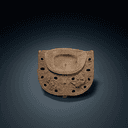
Precious scarlet cloths that Clytemnestra has spread on the ground for Agamemnon to walk upon upon his return. This theatrical gesture pushes him toward hubris while concealing the queen's murderous intentions beneath an outward show of homage.
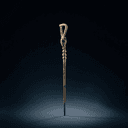
The emblem of royal power that Clytemnestra wields during the ten years of her sole rule over the kingdom. It symbolizes sovereignty assumed by a woman in a world of absent kings.
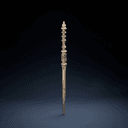
In Aeschylus's Agamemnon, a relay of signal fires runs from Troy to Mycenae to announce the Greek victory. Clytemnestra watches these flames from the battlements and immediately sets her plan of revenge in motion.
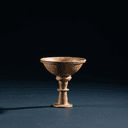
A bronze or terracotta vessel used for offerings to the gods and the dead. In The Libation Bearers, Electra pours libations on Agamemnon's tomb — a mirror image of Clytemnestra's ritual hypocrisy, as the queen also offers libations to lull suspicion.
School Curriculum
Vocabulary & Tags
Key Vocabulary
Tags
Daily Life
Morning
At dawn, Clytemnestra presides over offering rituals in the megaron, burning incense and pouring wine to the Olympian gods. She receives reports from the stewards overseeing the granaries, herds, and palace workshops, exercising absolute authority in the king's absence.
Afternoon
In the afternoon, she holds court in the throne room to arbitrate disputes between nobles and peasants of the Argolid. Alongside Aegisthus, she oversees the palace guards and ensures the loyalty of the military household.
Evening
In the evening, Clytemnestra presides over banquets in the torch-lit megaron, where bards sing of heroes' exploits. As night falls, she watches from the ramparts for signal fires that might announce Agamemnon's return from Troy.
Food
The Mycenaean royal table brings together barley and wheat bread, lamb and beef roasted on the spit, goat cheese, figs, olives, and wine mixed with water. Official meals are accompanied by libations poured in honor of the gods and ancestors.
Clothing
Clytemnestra wears long woolen robes dyed in murex purple or saffron, fastened with golden fibulae. A diadem crowns her pinned-up hair, and necklaces of lapis lazuli or amber mark her rank as basileia.
Housing
The palace of Mycenae is an imposing citadel of Cyclopean stones dominating the plain of the Argolid, accessible through the famous Lion Gate. The heart of palace life is the megaron — a great hall with a central hearth — flanked by bathrooms, storerooms, and apartments adorned with frescoes of processions and hunts.
Historical Timeline
Period Vocabulary
Visual Style
Style mycénien sombre et monumental : pourpre royal, noir obsidienne, or terni et rouge sang, alliant exactitude archéologique et intensité dramatique de la céramique attique à figures rouges.
Sound Ambience
Ambiance nocturne et oppressante du palais mycénien : torches crépitantes, eau, murmures féminins, vent sur les remparts et silence pesant après le crime.
Liens externes & ressources
Références
Œuvres
Orestie — Eschyle (Agamemnon, Les Choéphores, Les Euménides)
458 av. J.-C.
Électre — Sophocle
~410 av. J.-C.
Électre — Euripide
~413 av. J.-C.
Iphigénie à Aulis — Euripide
~405 av. J.-C.
Odyssée — Homère (chants III, IV, XI)
VIIIe siècle av. J.-C.