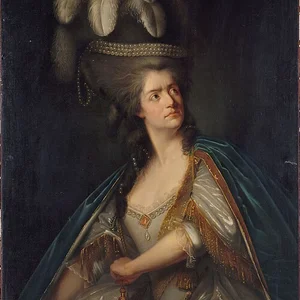

Wife of Heracles and princess of Calydon, Deianira is a tragic figure in Greek mythology. Deceived by the centaur Nessus, she gives her husband a tunic soaked in poison, believing it to be a love potion, thereby causing his death.
Deianira
Deianira
8 min read
Frequently asked questions
Key Facts
- Daughter of Oeneus, king of Calydon, she is coveted by the river god Achelous
- Heracles wins her in combat against Achelous and takes her as his wife
- The centaur Nessus, as he lies dying, gives her his blood as a supposed love potion
- She sends Heracles the tunic soaked in Nessus's blood, which is in fact a deadly poison
- Upon learning of Heracles' death, she takes her own life in despair, according to Sophocles
Works & Achievements
A Greek tragedy in which Deianira is the main protagonist; she expresses her jealousy, love, and despair before sending the fatal robe to Heracles.
A fictional letter from Deianira to Heracles in which she laments his infidelity with Iole; a poignant text that explores her perspective as a deceived and innocent wife.
A Latin account of the episode of the poisoned robe and the death of Heracles, weaving Deianira's perspective into Ovid's grand mythological tapestry.
A Latin tragedy retelling the myth of the robe of Nessus; Deianira is portrayed as a tragic figure consumed by guilt and despair.
A mythographic compilation that gives a detailed account of the marriage of Deianira and Heracles, the episode of the centaur Nessus, and the hero's death.
Anecdotes
Deianira nearly married the river-god Achelous, who transformed himself successively into a serpent and a bull to win her over. Heracles fought him and wrenched off one of his horns, ending the contest — that horn became the legendary Horn of Plenty. It was thus that Deianira was given in marriage to the greatest of Greek heroes.
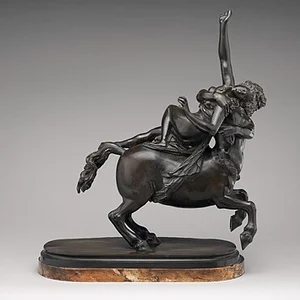
While crossing the river Evenus, the centaur Nessus offered to carry Deianira on his back while Heracles swam across. Along the way, Nessus attempted to assault her; Heracles struck him down with an arrow dipped in the venom of the Hydra of Lerna. As he lay dying, the centaur treacherously advised Deianira to collect his blood as a love potion to keep Heracles faithful.
Years later, Heracles returned victorious from Oechalia with Iole, the defeated king's daughter, as his captive. Fearing she was losing her husband's love, Deianira sent him a tunic soaked in Nessus's blood, convinced it was a charm to ensure his faithfulness. The poison clung to Heracles's skin and caused him such unbearable agony that he chose to die on a funeral pyre on Mount Oeta.
The tragedy of Deianira embodies the Greek theme of involuntary error: she had no murderous intent whatsoever. The moment she understood what her act had brought about, she took her own life. The Greeks saw in her fate the example of a loving woman destroyed by jealousy and the cunning of a dead enemy.
Deianira is one of the rare mythological women whom Sophocles made the true heroine of a tragedy, The Women of Trachis. Unlike other heroes' wives confined to secondary roles, she is the central figure of the play, and her inner voice, her doubts, and her grief fill every moment of it.
Primary Sources
"I know well that the beauty of the young girl has caught Heracles' eyes, while I, Deianira, am cast aside, like an old companion no one looks at anymore."
"It was not I who gave you death, Heracles — it was love; that blind tenderness which led me to my own ruin and yours."
"Nessus, mortally wounded by Heracles' arrow, told Deianira to collect the blood flowing from his wound, for it would serve as a charm to preserve her husband's love."
"The tunic soaked in the Hydra's venom clung to Heracles' limbs; whenever he tried to tear it off, his flesh came away with it."
"O Deianira, how guilty was your hand! Unknowing of the harm it caused, it sent death in the guise of a love too ardent."
Key Places
Mythical city of Aetolia, birthplace of Deianira and kingdom of her father Oeneus. The site of the famous Calydonian Boar Hunt and the first meeting between Deianira and Heracles.
The river where the centaur Nessus attempted to abduct Deianira and passed on what he claimed was a love potion — in truth a deadly poison. A pivotal location in the entire tragedy of Deianira.
A city in Thessaly where Deianira stayed with her children during Heracles' long absences. The principal setting of Sophocles' The Women of Trachis.
The mountain where Heracles, consumed by the agony of Nessus' poisoned robe, had his own funeral pyre built. Both the site of his tragic death and of his divine apotheosis.
The city whose kingdom Heracles sacked in order to take Iole captive; his triumphant return with her sparked Deianira's jealousy and set the final tragedy in motion.
Liens externes & ressources
Références
Œuvres
Les Trachiniennes — Sophocle
vers 450-430 av. J.-C.
Héroides, Lettre IX — Ovide
vers 20 av. J.-C.
Métamorphoses, Livre IX — Ovide
vers 8 ap. J.-C.
Hercule sur l'Oeta — Sénèque
Ier siècle ap. J.-C.
Bibliothèque — Apollodore
IIe siècle ap. J.-C.