
A protective spirit of the home in Slavic mythology, the Domovoi watches over the household and its inhabitants. A tutelary being of the polytheistic Slavic tradition, he embodies the bond between the living and their ancestors. He persists in popular folklore after Christianization.
Domovoi
domovoy
8 min read
Frequently asked questions
Key Facts
- The Domovoi is attested in Slavic ethnographic sources from the Middle Ages, but his roots go back to pre-Christian Slavic religion (before 988 for Kievan Rus).
- He traditionally resides under the threshold, behind the stove, or in the cellar — symbolic places of the hearth.
- Depicted as a family ancestor in the form of a small old man, he ensures the protection of the home in exchange for offerings (bread, salt, porridge).
- The Christianization of Kievan Rus (988) did not eliminate the cult of the Domovoi: he remained part of Russian, Belarusian, and Ukrainian popular folklore into the modern era.
- The Domovoi illustrates Slavic religious syncretism: integrated into local Christian practices while retaining his polytheistic attributes.
Works & Achievements
A monumental three-volume study by Alexander Afanasyev and a foundational academic source on the Domovoi. Afanasyev analyzes the spirit as an ancestral being tied to fire and family continuity.
A collection of Russian folk tales gathered by Afanasyev in which the Domovoi appears as a recurring character, revealing his central place in Slavic popular imagination.
This encyclopedic dictionary provides numerous entries on the Domovoi and its regional variants, offering a valuable ethnographic record of Russian folk beliefs.
The first major chronicle of Kievan Rus', written by the monk Nestor. It mentions ancient Slavic religious practices — including offerings to spirits — in the context of Christianization.
Rulings of the Russian ecclesiastical council explicitly condemning the veneration of household spirits. This document attests to the Domovoi's persistence in popular practice more than five centuries after Christianization.
Anecdotes
The Domovoi was known to braid horses' manes during the night. If a peasant found his horse's mane tangled in the morning, it was a sign that the spirit was unhappy or agitated. Some families left a comb near the stable to appease the spirit and ward off these bad omens.
When a Slavic family had to move, they never left without their Domovoi. A specific ritual involved carrying a pot of embers from the old hearth to the new home, solemnly inviting the spirit to follow. Leaving without him would have exposed the family to bad luck and misfortune in their new dwelling.
The Domovoi was regarded as a protective ancestor rather than a demon. He was often called 'dedouchka' (grandfather) or 'khoziaïn' (master of the house). This veneration reflects the central role of ancestor worship in pre-Christian Slavic spirituality, where the dead continued to watch over their descendants.
To win the Domovoi's favor, Slavic women would leave offerings near the threshold or behind the stove: a piece of bread, some salt, or a bowl of buckwheat porridge. In return, the spirit protected the household from illness, thieves, and malevolent spirits. A neglected Domovoi would grow temperamental and could cause all manner of trouble.
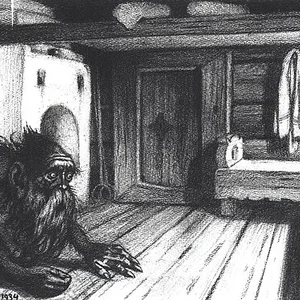
According to Slavic tradition, the Domovoi would sometimes appear as a small, hairy old man, covered in fur like an animal. At night, he could be heard sighing or moaning, and these sounds were interpreted as warnings of imminent danger — fire, illness, or the approaching death of a family member.
Primary Sources
The Domovoi is regarded as the guardian of the home and its inhabitants. He dwells behind the stove or beneath the threshold, and makes himself known to family members through omens and nocturnal apparitions.
Domovoi: spirit of the house, guardian of the hearth; a small, hairy old man who lives beneath the threshold or near the fireplace and protects the home against evil spirits. He is also called *khozyain* or *dedushka*.
The Slavs, before their conversion, paid worship to the spirits of forests, waters, and homes, offering them sacrifices to secure their protection and goodwill.
Some continue to worship idols, to honor the spirits of hearths and fields according to ancient customs, and to bring them offerings of food and drink — practices the Church formally condemns.
Key Places
Capital of medieval Slavic civilization where the cult of domestic spirits such as the Domovoi was practiced both before and after the Christianization of 988. Cradle of the East Slavic traditions.
Important medieval Slavic center renowned for the persistence of its polytheistic folk traditions, where beliefs in the Domovoi and other spirits were well documented by chroniclers.
Typical dwelling of Slavic peasants, built from logs, whose central hearth formed the domain of the Domovoi. The izba served at once as a home, a ritual space, and a place of family memory.
Former Polish capital and center of Western Slavic traditions, where beliefs similar to the Domovoi existed under the names 'skrzat' or 'domowik', attesting to the pan-Slavic spread of these beliefs.
Medieval Slavic republic where animistic practices and the cult of domestic spirits were particularly well documented in medieval ecclesiastical sources that sought to condemn them.
Typical Objects

A massive clay hearth at the center of the Slavic *izba*, the stove was the Domovoi's preferred dwelling. Behind or beneath it, the spirit watched over the warmth and life of the household.

Ritual offerings left near the hearth to honor the Domovoi. Bread and salt symbolized hospitality and abundance in Slavic culture; neglecting them risked angering the spirit.

A magical space of transition between inside and outside, the threshold was one of the Domovoi's dwellings. Slavs avoided quarreling on the threshold so as not to disturb the spirit.

A ritual dish offered to the Domovoi during festivals or when moving house. *Kasha*, a staple food of medieval Slavs, represented the prosperity of the home of which the spirit was guardian.

A tool left intentionally near the stable or hearth to appease the Domovoi. It was believed he used it to groom his fur or the manes of domestic animals during the night.

The central object in the Slavic moving ritual: carrying embers from the old hearth in a pot allowed one to symbolically transport the Domovoi to the new home and ensure the continuity of his protection.
School Curriculum
Vocabulary & Tags
Key Vocabulary
Tags
Daily Life
Morning
At dawn, when the inhabitants of the izba rise, the Domovoi completes his nightly patrol. He has inspected every corner of the house, checked on the animals in the stable, and watched over the family's sleep. The mistress of the house speaks a respectful word to him before lighting the stove fire.
Afternoon
During the day, the Domovoi remains discreet, tucked behind the stove or under the threshold. He observes the household's activities, ensures that domestic chores go smoothly, and may help or hinder household tasks depending on the harmony prevailing in the home.
Evening
At nightfall, the Domovoi resumes his main activity. He guards the door against evil spirits, watches over the hearth's embers to prevent fires, and may make himself known through sounds or sighs to those who stay awake after the family's evening gathering.
Food
The Domovoi is symbolically nourished by the offerings left by the family: bread, salt, buckwheat porridge, and sometimes a small portion of the evening meal placed discreetly near the hearth. These offerings form an implicit pact between the protective spirit and his human hosts.
Clothing
The Domovoi is described in Slavic traditions as covered in thick grey or black fur, resembling a small, shaggy old man. This animal-like appearance distinguishes him from celestial spirits and underscores his chthonic nature, deeply connected to the earth and to the ancestors.
Housing
The Domovoi resides primarily behind or beneath the stove (petch), a massive clay structure occupying a quarter of the main room of the izba. He may also dwell under the threshold or in the corner of honor of the house, always within the walls, never outside.
Historical Timeline
Period Vocabulary
Liens externes & ressources
Références
Œuvres
Visions poétiques des Slaves sur la nature (Poeticheskie vozzreniya slavyan na prirodu)
1866-1869
Contes populaires russes (Narodnye russkie skazki)
1855-1863
Dictionnaire explicatif de la grande langue russe vivante, Vladimir Dal
1863-1866
Chronique des temps passés (Povest Vremennykh Let)
vers 1113
Stoglav (Livre aux cent chapitres)
1551