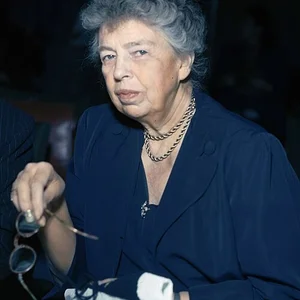

First Lady of the United States (1933–1945), Eleanor Roosevelt established herself as a tireless advocate for civil rights and social justice. She chaired the UN commission that drafted the Universal Declaration of Human Rights (1948).
Eleanor Roosevelt(1884 — 1962)
Eleanor Roosevelt
États-Unis
9 min read
Frequently asked questions
Famous Quotes
« The future belongs to those who believe in the beauty of their dreams.»
« No one can make you feel inferior without your consent.»
Key Facts
- 1933–1945: First Lady of the United States during Franklin D. Roosevelt's presidency
- 1948: Chairs the UN commission tasked with drafting the Universal Declaration of Human Rights
- 1941–1945: Actively supports the inclusion of women and African Americans in the war effort
- 1946–1952: United States delegate to the United Nations General Assembly
- 1962: Dies in New York, leaving a lasting legacy in the defense of civil rights
Works & Achievements
A column published six days a week in more than 90 American newspapers for 27 years. Through this personal and direct writing, Eleanor Roosevelt created an unprecedented connection between the First Lady and the American public.
The first autobiographical volume, in which Eleanor recounts her painful childhood and formative years. The book reveals the woman behind the public figure and traces the roots of her lifelong commitment to social causes.
A landmark 30-article text adopted in Paris, whose drafting Eleanor Roosevelt chaired as head of the UN Commission on Human Rights. It remains the world's foremost reference on fundamental rights.
The second autobiographical volume, focused on the White House years (1933–1945) and her role alongside Franklin Roosevelt during the Great Depression and World War II.
A third autobiography recounting her life after Franklin Roosevelt's death in 1945, including her work at the UN and her travels around the world as an informal ambassador for human rights.
A definitive synthesis of her three volumes of memoirs, published a year before her death. This intellectual testament sets out her life philosophy, grounded in moral courage and a commitment to justice.
Anecdotes
In 1939, the great Black American singer Marian Anderson was denied access to Constitution Hall in Washington by the Daughters of the American Revolution, an organization of which Eleanor Roosevelt was a member. Outraged, Eleanor publicly resigned from the organization and helped arrange a free concert at the Lincoln Memorial, attended by 75,000 people. This courageous act caused a scandal in the still deeply segregated America of the time.
From 1935 onward, Eleanor Roosevelt held a weekly press conference open exclusively to women journalists. At a time when newsrooms employed very few women, this initiative forced several major newspapers to hire female reporters so as not to miss the First Lady's statements. She thus transformed her ceremonial role into a lever for professional advancement.
In 1935, Eleanor Roosevelt began writing a daily column titled “My Day,” which she continued for twenty-seven years with almost no interruption. In it, she recounted her meetings, her travels, and her opinions with a frankness unusual for a First Lady. The column was published in more than 90 newspapers across the United States, allowing her to reach millions of readers every day.
During the negotiations for the Universal Declaration of Human Rights at the United Nations in 1947–1948, Eleanor Roosevelt chaired the proceedings with remarkable tenacity in the face of Soviet delegates who were attempting to block the text. She had to reconcile radically opposing worldviews between capitalist and communist countries, colonizing nations and colonized peoples. On December 10, 1948, when the text was adopted in Paris without a single vote against, the assembly gave her a standing ovation.
As a child, Eleanor Roosevelt endured a painful youth: orphaned at ten, she was often described as ugly and clumsy by her own family. Yet, thanks to a kind teacher in England, she developed a self-confidence that transformed her entirely. This personal experience of suffering and rejection largely explains her exceptional empathy for the most disadvantaged throughout her life.
Primary Sources
No one can make you feel inferior without your consent. I have always felt that a woman's place is wherever she is needed — and that she is needed everywhere.
I had painfully high ideals and a tremendous sense of the must of duty — the English public school tradition which my father had imbibed and passed on to me. I worshipped him and felt that he set for me a standard I must always live up to.
We stand today at the threshold of a great event both in the life of the United Nations and in the life of mankind. This Universal Declaration of Human Rights may well become the international Magna Carta of all men everywhere.
The question of the rights of colored people is one which touches the very roots of our democracy. We cannot speak to the world about human rights while denying them at home.
You gain strength, courage, and confidence by every experience in which you really stop to look fear in the face. You must do the thing you think you cannot do.
Key Places
The Roosevelt family home on the banks of the Hudson River. Eleanor was spiritually reborn here: it was where she learned to assert herself against her mother-in-law Sara, and where she was buried in 1962.
The only property Eleanor ever owned outright, built in 1926. She made it her refuge and headquarters after Franklin's death — a symbol of her independence within a most unconventional marriage.
Her official residence from 1933 to 1945, where Eleanor transformed the role of First Lady into a political platform. She hosted Black civil rights activists, labor organizers, and artists there, breaking the conventions of the era.
It was in this palace that the UN General Assembly adopted the Universal Declaration of Human Rights on December 10, 1948 — a text Eleanor Roosevelt had negotiated and championed for three years.
The site of Marian Anderson's concert on April 9, 1939, organized with Eleanor Roosevelt's decisive support after Constitution Hall refused to host her. The concert drew 75,000 people and became a landmark moment in the civil rights movement.
Typical Objects

Eleanor Roosevelt wrote her daily column 'My Day' on her typewriter, wherever she happened to be. This tool symbolized her commitment to communicating directly with the American people, without any intermediary.

The formal attire of a First Lady included these essential accessories at official ceremonies. Eleanor wore them with a certain stiffness, far preferring the practical outfits she wore on her field inspection trips.

Eleanor kept notebooks in which she recorded her observations during visits to slums, factories, and refugee camps. These notes fed into her speeches, her letters to cabinet members, and her columns.

A tireless traveler, Eleanor crisscrossed the United States and the world to report on the real living conditions of disadvantaged populations. Her suitcases symbolize a First Lady who refused to remain confined to the White House.

The text Eleanor championed for two years at the UN, in English, French, Spanish, Chinese, and Russian. She distributed copies of it wherever she went and considered it her most important achievement.

Eleanor Roosevelt was one of the first First Ladies to use the telephone as a political tool, directly calling cabinet members, labor union leaders, and civil rights activists to advance her causes.
School Curriculum
Vocabulary & Tags
Key Vocabulary
Tags
Daily Life
Morning
Eleanor Roosevelt rose at 7:30 a.m. and invariably began her day by reading several national and local newspapers, pencil in hand to note topics she wanted to address. She would then dictate her column 'My Day' or reply to her mail — she received up to 300 letters a day at the White House, which she made a point of answering personally.
Afternoon
Her afternoons were filled with meetings with charitable organizations, union delegations, or civil rights activists she received at the White House, including Black leaders traditionally excluded from those halls. She also made frequent field visits to factories, schools, and unemployment camps to observe real living conditions firsthand.
Evening
Evenings at the White House were often taken up by official dinners where Eleanor fulfilled her role as hostess, but she seized every free moment to read or talk with her closest aides. She rarely went to bed before midnight, convinced there was always one more letter to write or a speech to prepare.
Food
Eleanor Roosevelt had simple, even austere tastes in food — a sharp contrast with White House protocol. She enjoyed traditional American dishes — scrambled eggs, sandwiches, vegetable soup — and drank a great deal of tea. Her mother-in-law Sara often reproached her for her lack of interest in fine cuisine.
Clothing
In public, Eleanor wore the formal attire her position required — long dresses, hats, gloves — chosen with care but without ostentation, favoring understated colors. In private and on her inspection tours, she dressed very practically, sometimes in trousers, which scandalized the conventions of the time.
Housing
At the White House (1933–1945), Eleanor occupied her own apartments separate from Franklin's, reflecting the independence of their relationship. She made Val-Kill Cottage in Hyde Park her true home: a simple, welcoming house with no permanent domestic staff, where she loved to receive friends and activists in a relaxed atmosphere.
Historical Timeline
Period Vocabulary
Liens externes & ressources
Références
Œuvres
My Day (chronique quotidienne)
1935–1962
This Is My Story (autobiographie, vol. 1)
1937
Déclaration universelle des droits de l'homme (ONU)
10 décembre 1948
This I Remember (autobiographie, vol. 2)
1949
On My Own
1958
The Autobiography of Eleanor Roosevelt
1961