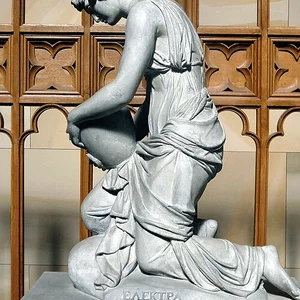

Electra is a heroine of Greek mythology, daughter of Agamemnon and Clytemnestra. After her father is murdered by her mother and her lover Aegisthus, she convinces her brother Orestes to avenge him. Her tragic fate inspired all three of the great Greek tragedians.
Electra
Electra
8 min read
Frequently asked questions
Key Facts
- Daughter of Agamemnon, king of Mycenae, and Clytemnestra
- Her mother and her lover Aegisthus murder Agamemnon upon his return from the Trojan War
- Electra protects her young brother Orestes by sending him far from Mycenae to keep him safe
- She urges Orestes to return and kill Clytemnestra and Aegisthus to avenge their father
- Three major plays are devoted to her: by Aeschylus (The Libation Bearers), Sophocles, and Euripides (both titled Electra)
Works & Achievements
The first major portrayal of Electra in classical tragedy. She appears as the leader of the mourning servants, instilling in Orestes the determination to carry out divine vengeance.
The heroine stands at the absolute center of the play: unyielding, anguished, magnificent. Sophocles makes her a model of filial devotion and moral resistance, never once questioning the legitimacy of vengeance.
A more unsettling and psychologically nuanced version: Electra is a broken woman, married off to a peasant as a form of humiliation. Euripides questions the morality of matricide and paints a far more ambiguous heroine.
An Austrian Expressionist adaptation that transforms Electra into an obsessive, almost monstrous figure consumed by hatred. It would go on to serve as the libretto for Richard Strauss's opera (1909).
An Existentialist rewriting of the myth, performed under the German Occupation. Electra embodies resistance to the guilt imposed by tyrants, yet ultimately surrenders to remorse — in stark contrast to Orestes, who fully embraces his freedom.
A one-act opera based on Hofmannsthal's libretto, widely regarded as a masterpiece of musical Expressionism. It established Electra as a universal figure of vengeance and female suffering.
Anecdotes
The name “Electra” comes from the Greek ἤλεκτρον (êlektron), meaning amber — that golden fossil resin with mysterious properties. Some mythographers see in it an allusion to the solar brilliance of her father Agamemnon, king of kings. Her name thus carries a double meaning: radiance, and the impurity born of bloodshed.
According to several versions of the myth, it was young Electra who snatched her little brother Orestes from the hands of Clytemnestra, entrusting him to a faithful servant to send him into exile in Phocis. Without this act, Orestes would doubtless have been killed by his mother. Electra bore the weight of waiting and resentment alone for years, living in humiliation at the court of her own palace.
The three great Greek tragedians — Aeschylus, Sophocles, and Euripides — each staged Electra, but with very different sensibilities. In Sophocles, she is an implacable heroine who never wavers; in Euripides, she is more unsettling, almost obsessive, and the murder of Clytemnestra is shown in all its horror. This diversity of interpretations reveals the depth of the character.
In the 20th century, psychoanalyst Carl Gustav Jung borrowed Electra’s name to designate the feminine counterpart of the Oedipus complex: the “Electra complex” describes a daughter’s passionate attachment to her father and her rivalry with her mother. This concept shows how far the mythological figure has traveled across the centuries to shape modern psychology.
When Orestes returns to Mycenae incognito, he has his own death announced to lull Aegisthus into complacency. Electra, believing her brother truly dead, falls into utter despair — then recognizes him thanks to a lock of hair left on their father’s tomb. This recognition scene (anagnorisis) is one of the most celebrated in ancient theater.
Primary Sources
Electra: "O Zeus, send up from beneath the earth the avenging arm!" She pours libations on Agamemnon's tomb and calls upon Orestes to carry out the family's vengeance.
Electra: "I am like a stranger in my father's house, dressed in rags, standing before these empty tables." She expresses her reduction to the status of a servant in her own palace.
The Chorus: "Electra, daughter of Agamemnon, I have come to your rustic cottage. A messenger from the mountain told me that a Mycenaean festival is drawing near."
Nestor recounts to Telemachus how Orestes avenged his father Agamemnon by killing Aegisthus, citing the cursed lineage of the Atreides as a grim warning to mortals.
Pindar evokes the fate of Orestes and Electra, the avenging children of Agamemnon, underscoring the unbroken chain of violence that strikes the house of the Atreides.
Key Places
The royal city of the Argolid where Agamemnon once ruled, then Aegisthus after the murder. Electra spends her entire life there as a captive, humiliated in her own palace, waiting for vengeance.
A place of remembrance at the heart of the myth, where Electra comes to pour libations and pray for vengeance. It is before this tomb that the recognition between the two siblings takes place.
A great city of the Argolid closely linked to the legend of the House of Atreus. Some versions of the myth place the royal palace at Argos rather than Mycenae, and tragic playwrights sometimes set the action there.
It is Apollo himself, through the voice of the Pythia, who commands Orestes to avenge his father. Electra is thus indirectly placed under the divine protection of Apollo, guarantor of family justice.
The hill in Athens where Orestes is put on trial by the gods following the matricide, with Athena casting the deciding vote in his favor. This place symbolizes the transition from private justice (family vengeance) to civic justice.
Typical Objects

In Sophocles' play, Orestes hands Electra an urn he claims contains his own ashes. She clasps it to herself weeping, unaware that she is embracing her living brother — one of the most moving recognition scenes in ancient theatre.
Electra regularly pours libations of milk, water, and oil on her father Agamemnon's tomb, an essential funerary rite to appease the soul of the dead and maintain the bond between the living and the dead.

Orestes places a lock of his hair on his father's tomb as a sign of mourning and offering. It is by recognizing this lock that Electra realizes her brother has returned — a recognition token at the very heart of the myth.

Electra has worn mourning clothes since her father's death, refusing to change her garments until vengeance is accomplished. This dark garment symbolizes her silent rebellion against Clytemnestra.

Associated with nocturnal ceremonies honoring the dead and with the Erinyes, the torch evokes the somber atmosphere of funerary rites and the amber glow etymologically embedded in the very name Electra.

The weapon of final retribution, it symbolizes the martial justice that the age reserves for the son — justice Electra cannot carry out herself. She guides Orestes and urges him on, but it is he who wields the blade, reflecting the gendered roles of Greek society.
School Curriculum
Vocabulary & Tags
Key Vocabulary
Daily Life
Morning
At sunrise, Electra goes to her father's tomb to perform the daily funeral rites: pouring libations of milk and water, laying garlands of myrtle, and praying that the gods of the underworld hear her calls for vengeance. These ritual gestures are the heart of her day — her only way of staying connected to the dead.
Afternoon
According to Euripides, Electra is forced into household tasks unworthy of her rank: drawing water from the spring, keeping up a modest home. In Sophocles' palace, she endures the humiliations of her mother and Aegisthus, answering them with defiance at the risk of punishment. She weaves, spins, and waits — but her mind is turned entirely toward Orestes' return.
Evening
In the evening, Electra keeps watch, listening for news that might come from exile. She mourns her father, recalls his former greatness, and tends in her heart the cold flame of resentment. The nights are long in a palace that is hers by blood, yet where she is no more than a watched stranger.
Food
Like any Greek noblewoman of mythological antiquity, she would ordinarily eat barley or wheat bread, olives, sheep's cheese, figs, and dried fish. But in the versions where she has fallen from grace, Euripides shows her reduced to a frugal peasant diet, far removed from the royal banquet that was her birthright.
Clothing
Electra wears dark or worn clothing at all times — a silent provocation aimed at her mother, who reigns adorned with jewels. The peplos (a large draped garment) and chiton (a tunic) of coarse wool replace the purple-dyed fabrics that should by rights have been hers. This conspicuous mourning dress is her only visible act of resistance.
Housing
In the Mycenaean palaces of Greek mythology, Electra lives in a chamber of the royal megaron — a great hall with a central hearth and wooden columns. But according to Euripides, she was forcibly married off to a humble farmer and lives in a modest farmhouse on the outskirts of Argos, a symbol of the downfall engineered by Clytemnestra to prevent her from bearing a high-ranking avenger.
Historical Timeline
Period Vocabulary
Liens externes & ressources
Références
Œuvres
Eschyle — Les Choéphores (partie de l'Orestie)
458 av. J.-C.
Sophocle — Électre
vers 409-410 av. J.-C.
Euripide — Électre
vers 413 av. J.-C.
Jean-Paul Sartre — Les Mouches
1943