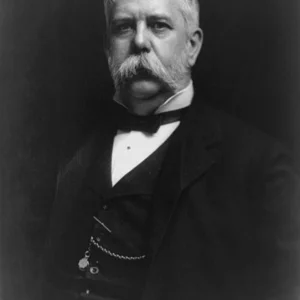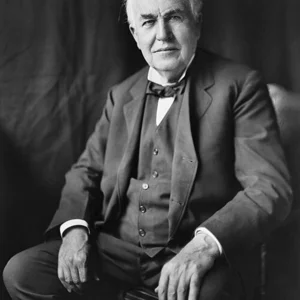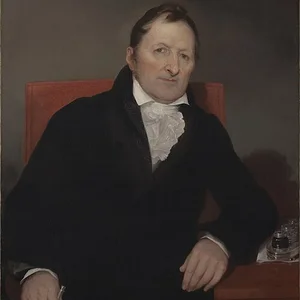

American inventor and industrialist (1765–1825), Eli Whitney is famous for inventing the cotton gin in 1793 and for developing the concept of interchangeable parts in industrial production. His innovations profoundly transformed the American economy and foreshadowed the Industrial Revolution.
Eli Whitney(1765 — 1825)
Eli Whitney
États-Unis
8 min read
Frequently asked questions
Key Facts
- 1793: invention of the cotton gin, which increased ginning productivity fiftyfold
- 1798: government contract to manufacture 10,000 muskets using interchangeable parts
- His cotton gin revived cotton cultivation in the South and unintentionally reinforced the slave system
- His armaments factory in New Haven, Connecticut became a model of rationalized industrial production
- 1825: death in New Haven, leaving a contradictory legacy balancing technical progress against the expansion of slavery
Works & Achievements
A machine that mechanically separated cotton fibers from their seeds, reducing days of labor to a matter of hours. It transformed agriculture across the American South but also contributed to the expansion of slavery.
The first major patent granted in the United States for an agricultural machine. Despite its legal validity, it was massively infringed upon, exposing the weakness of intellectual property law at the time.
An unprecedented government order that pushed Whitney to industrialize his production and refine the concept of interchangeable parts. This contract laid the groundwork for industrial armaments manufacturing in America.
A manufactory built on the banks of the Mill River, designed as an integrated system in which each workstation produced an identical, standardized part. It stands as one of the earliest examples of a factory organized around the principles of mass production.
A landmark event in American industrial history, during which Whitney assembled muskets from a mixed pile of parts, publicly proving the viability of his manufacturing system.
Anecdotes
Eli Whitney invented the cotton gin in 1793 in just a few weeks, while staying at the Mulberry Grove plantation in Georgia. The device could separate cotton fibers from their seeds fifty times faster than by hand. Paradoxically, instead of enriching its inventor, the machine was widely copied by Southern planters, and Whitney spent years in court without ever truly profiting from his discovery.
In 1798, Whitney secured a contract from the U.S. federal government to deliver ten thousand muskets in two years — a colossal challenge at the time. To achieve this, he developed a revolutionary manufacturing system: the parts of each weapon were machined so precisely that they could be swapped between different muskets. This concept, now known as mass production, would go on to transform industry worldwide.
In January 1801, Whitney staged a spectacular demonstration before President John Adams, President-elect Thomas Jefferson, and several members of the U.S. Congress. He disassembled several muskets, mixed their parts together in crates, then assembled new working rifles by drawing pieces at random. The astonished lawmakers were immediately convinced to fund the mass production of armaments.
History's irony is that the cotton gin, designed to simplify labor, instead contributed to the dramatic expansion of slavery in the American South. Before 1793, growing short-staple cotton was barely profitable; after Whitney's invention, cotton output exploded and the demand for enslaved labor tripled in less than twenty years. Whitney himself — a Northerner and an abolitionist at heart — was horrified by this unintended consequence.
Primary Sources
A lady with whom I was staying, observing the great difficulty planters experienced in separating the cotton fibers, asked whether I could invent a machine for that purpose. Within ten days, I had built a working model.
The machine consists of a cylinder fitted with wire teeth which, as it revolves, seizes the cotton fibers and tears them from the seeds, while a rotating brush cleans the teeth and deposits the cotton on the other side.
Eli Whitney undertakes to supply ten thousand infantry muskets, complete and in good serviceable condition, conforming to the models in use in the army of the United States, within a period of twenty-eight months.
I propose to manufacture firearms in such a manner that every part of one musket shall be interchangeable with the corresponding part of any other musket coming out of my workshop. Such a method would allow any weapon to be repaired simply by replacing a single defective part.
Key Places
Eli Whitney's birthplace, where he grew up in a farming family and displayed an early talent for mechanics by making nails and pins in his father's workshop.
The university where Whitney graduated in 1792, at age 27, having worked to pay his way through school. There he gained the scientific foundations that fed his inventive mind.
The estate of General Nathanael Greene's widow, where Whitney was staying in 1793 when he designed and built the first cotton gin after observing the difficulties faced by workers in the fields.
The site of the factory Eli Whitney had built around 1798 on the banks of the Mill River, one of the first manufacturing facilities organized around the principle of interchangeable parts. The neighborhood still bears his name today.
The federal capital where, in 1801, Whitney staged his famous demonstration of interchangeable parts before Congress and Presidents Adams and Jefferson, persuading the government to fund his weapons production.
Typical Objects

A cylinder machine fitted with metal hooks that Whitney invented in 1793 to mechanically separate cotton fibers from their seeds. It represents his most famous invention and transformed the economy of the American South.

A standardized infantry weapon that Whitney mass-produced for the U.S. Army starting in 1798. It was on this weapon that he first applied his system of interchangeable parts on a large scale.

Metal measuring tools that Whitney had made to ensure every musket part leaving his workshop conformed to identical dimensions. These instruments were the technical key to mass production.

A machine tool driven by the waterpower of the Mill River, used at the Whitneyville factory to cut and fit metal parts with a precision unprecedented for the time.

Whitney accumulated a voluminous correspondence with the courts to defend his cotton gin patent. These papers illustrate the difficulties inventors faced in protecting their rights in the early United States.

A common instrument on Southern plantations after 1793, used to weigh bags of cotton fiber cleaned by the gin. A concrete symbol of the new profitability that Whitney's invention brought about.
School Curriculum
Vocabulary & Tags
Key Vocabulary
Tags
Daily Life
Morning
Whitney rose early, before dawn, like most entrepreneurs of his era in New England. He would begin by inspecting his Whitneyville factory, checking that the hydraulic machines powered by the Mill River were running smoothly and ensuring that foremen had assigned each worker to their post.
Afternoon
The afternoon was devoted to office work: drafting letters to federal authorities, negotiating contracts, or preparing legal arguments for his endless patent infringement lawsuits tied to the cotton gin. He personally kept meticulous accounts of his manufactory and oversaw quality control of musket parts.
Evening
In the evenings, Whitney frequently hosted businessmen, army officers, or political officials at his New Haven residence, which also served as his office. He maintained an extensive correspondence with engineers and industrialists on both sides of the Atlantic, always seeking to refine his processes or defend his rights as an inventor.
Food
The diet of a prosperous New England industrialist at the turn of the 19th century relied on local staples: cornbread or wheat bread, salted or smoked meats (pork, beef), seasonal vegetables, and apple cider. Business meals called for greater refinement: imported wines, roasted meats, and sweet pies.
Clothing
Whitney wore the sober, practical attire of New England's Puritan gentry: a dark woolen frock coat, breeches or button-front trousers, a double-breasted waistcoat, a white cravat knotted high at the throat, and a top hat. In the workshop, he pulled on a thick leather apron to protect himself from metal shavings.
Housing
Whitney lived in a two-story brick house in New Haven — modest for a man of his standing, but practical and close to his Whitneyville factory. The home also housed his archives, mechanical models, and technical library, a reflection of a man who never truly separated his private life from his professional work.
Historical Timeline
Period Vocabulary
Liens externes & ressources
Références
Œuvres
L'égreneuse à coton (cotton gin)
1793
Brevet américain n°72X pour l'égreneuse
1794
Contrat de fabrication de 10 000 mousquets pour l'armée américaine
1798
Usine de Whitneyville
1798
Démonstration des pièces interchangeables devant le Congrès
1801