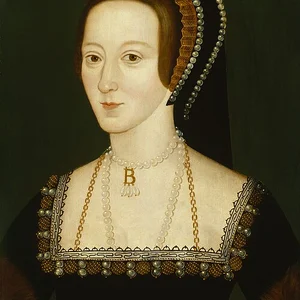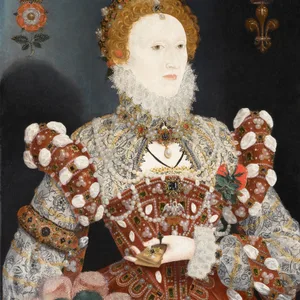

Queen of England and Ireland from 1558 to 1603, daughter of Henry VIII and Anne Boleyn. Her reign, the “Elizabethan era,” marks a golden age of culture and the consolidation of Protestantism in England. She embodies the figure of the “Virgin Queen,” an absolute sovereign who never married any of her suitors.
Elizabeth I
Elizabeth I
8 min read
Frequently asked questions
Famous Quotes
« I have the heart and stomach of a king, and of a king of England too. (Speech at Tilbury, 1588)»
« I am already bound unto a husband, which is the Kingdom of England.»
Key Facts
- 1533: born at Greenwich, daughter of Henry VIII and Anne Boleyn
- 1558: ascends the throne upon the death of Mary I, restores Anglicanism
- 1588: defeat of the Spanish Armada — a major geopolitical turning point
- 1559: Act of Supremacy — Elizabeth becomes Supreme Governor of the Church of England
- 1603: dies without a direct heir, end of the Tudor dynasty
Works & Achievements
These two foundational laws established Elizabeth as Supreme Governor of the Church of England and imposed the use of the Book of Common Prayer. They durably fixed the Protestant religious identity of England.
Elizabeth chose a middle path between Catholicism and radical Puritanism, preserving a degree of national unity. This strategy helped England avoid the religious civil wars that devastated France and the Netherlands.
Under her supreme command, the English navy and fierce storms repelled Philip II of Spain’s fleet. This event established England as a maritime power and marked the beginning of Spain’s decline.
Elizabeth granted this trading company a monopoly on commerce with Asia. This foundation laid the groundwork for British commercial and colonial expansion over the centuries to come.
Elizabeth established a royal acting company (the Queen’s Men) and extended her patronage to playwrights, including Shakespeare. Her support contributed to the flourishing of English dramatic literature, considered among the greatest in history.
Her last great address to the Commons, in which she declared that her greatest happiness was to reign over subjects who loved her. This text is regarded as a masterpiece of political rhetoric and a statement on the nature of royal power.
Anecdotes
In 1588, as the mighty Spanish Armada threatened to invade England, Elizabeth I went in person to the military camp at Tilbury to address her soldiers. Clad in silver armour over a white dress, she delivered one of the most famous speeches in history: “I have the heart and stomach of a king, and of a king of England.” This legendary appearance galvanized the troops and remained etched in the collective English memory.
At thirty, Elizabeth contracted smallpox, a disease often fatal at the time, which left her face scarred. To conceal the marks, she adopted heavy makeup based on ceruse (a lead compound) that gave her an artificially ivory complexion. She also wore red wigs — her natural colour — and multiplied her extravagant hairstyles, thereby setting the canons of Elizabethan beauty for the entire court.
Elizabeth I spoke six languages fluently: English, Latin, Greek, French, Italian, and Spanish. Educated by the finest humanists of her day, including Roger Ascham, she translated classical texts for practice and wrote her own speeches. This mastery of rhetoric allowed her to negotiate directly with foreign ambassadors, without intermediaries — something that deeply impressed all who dealt with her.
Throughout her reign, many suitors — kings, archdukes, princes — sought her hand. Elizabeth turned them all away with remarkable diplomatic skill, keeping their hopes alive without ever committing herself. This strategy of the perpetually deferred marriage allowed her to preserve a precious bargaining chip in foreign policy and never share her power. She was thus nicknamed the “Virgin Queen,” an identity she cultivated as a deliberate political myth.
Elizabeth was passionate about music and dance. She played the virginal (a forerunner of the harpsichord) with widely recognized skill and participated in court dances well into old age. Her reign saw the flourishing of a brilliant English musical culture, with composers such as William Byrd. She also patronized the theatre: the company that performed Shakespeare’s plays was first known as the “Lord Chamberlain’s Men,” supported by royal favour.
Primary Sources
I know I have the body of a weak and feeble woman, but I have the heart and stomach of a king, and of a king of England too ; and think foul scorn that Parma or Spain, or any prince of Europe, should dare to invade the borders of my realm.
Though God hath raised me high, yet this I count the glory of my crown : that I have reigned with your loves. And though you have had, and may have, many princes more mighty and wise sitting in this seat, yet you never had, nor shall have, any that will be more careful and loving.
I do give you most humble thanks that you have vouchsafed to send unto me not only your sweet letters, but also your princely gift.
I am already bound unto a husband, which is the Kingdom of England, and that may suffice you.
I have already joined myself in marriage to a husband, namely the kingdom of England. And do not upbraid me with miserable lack of children, for every one of you, and as many as are Englishmen, are children and kinsmen to me.
Key Places
Birthplace of Elizabeth I on September 7, 1533. This royal palace on the banks of the Thames was one of the favorite residences of the Tudor dynasty.
Elizabeth was imprisoned here in 1554 by her half-sister Mary I, suspected of supporting a Protestant rebellion. She came close to losing her life before being released and ascending to the throne.
Site of Elizabeth I's coronation on January 15, 1559, and her burial in 1603. This landmark is the symbolic heart of the English monarchy.
Elizabeth's childhood and adolescent home, where she received her humanist education. It was here that she learned of her accession to the throne in 1558.
The site where Elizabeth delivered her legendary speech to English troops in August 1588, as the Spanish Armada threatened to invade England.