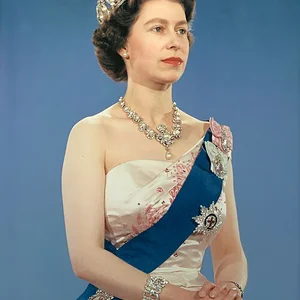

Queen of the United Kingdom from 1952 to 2022, Elizabeth II was the longest-reigning monarch in British history. She embodied the stability of constitutional monarchy through decolonisation, the Cold War, and globalisation.
Elizabeth II(1926 — 2022)
Elizabeth II
Royaume-Uni
9 min read
Frequently asked questions
Famous Quotes
« I declare before you all that my whole life, whether it be long or short, shall be devoted to your service and the service of our great imperial family to which we all belong. (1947)»
« Grief is the price we pay for love. (2001, following the September 11 attacks)»
Key Facts
- 1952: Accession to the throne at age 25 following the death of her father, George VI
- 1953: Coronation at Westminster Abbey — the first royal event broadcast live on television
- 1965: First official visit by a British monarch to West Germany since the Second World War
- 1997: Public address following the death of Diana, Princess of Wales, a moment of crisis for the monarchy
- 2022: Died on 8 September after 70 years on the throne; Platinum Jubilee celebrated in June
Works & Achievements
Every year on 25 December, Elizabeth II delivered a televised address broadcast throughout the Commonwealth, conveying a message of peace and resilience. Watched by tens of millions of people, these speeches stand as a unique record of 70 years of world history.
The Queen transformed the Commonwealth into a voluntary organisation of 56 independent nations, sustaining ties of cooperation in the wake of decolonisation. Her role as Head of the Commonwealth — purely symbolic yet diplomatically influential — was one of her most significant contributions to international peace.
The first visit by a British monarch to Ireland since independence in 1922, this trip marked a decisive milestone in Anglo-Irish reconciliation. The Queen's symbolic gestures — bowing before the memorial to Irish patriots, speaking words in Gaelic — were widely hailed as a courageous act of diplomacy.
Elizabeth II addressed Members of the European Parliament in a formal sitting, affirming Britain's commitment to cooperation with its European partners. Delivered in both English and French, the speech remains one of the rare instances of a royal address to an international parliamentary assembly.
Elizabeth II became the first British monarch to celebrate 70 years on the throne, with national celebrations held from 2 to 5 June 2022. Taking place just weeks before her death, the event was a testament to the public's deep affection for a sovereign who had witnessed seven decades of global change.
Anecdotes
During the Second World War, Princess Elizabeth refused to be evacuated abroad with her sister Margaret. In 1945, at the age of 18, she enlisted in the Women's Auxiliary Territorial Service, learning to drive and maintain military vehicles — an unprecedented decision for an heir to the throne.
The coronation of Elizabeth II on 2 June 1953 at Westminster Abbey was the first to be broadcast live on television. Despite the reservations of some advisers who felt the camera was too intrusive for a sacred rite, the Queen insisted that her subjects should be able to witness it. More than 27 million Britons watched the ceremony.
In 1992, following the fire at Windsor Castle, the divorce of three of her children, and a series of scandals, Elizabeth II delivered a speech that became famous when she described that year as an "annus horribilis" — a Latin phrase meaning "horrible year." This moment of unexpected candour moved the public deeply.
Elizabeth II was well known for her love of racehorses and Corgis. She owned more than 30 Corgis over the course of her life, a breed she had cherished since the age of 7. Her dogs accompanied her at her various residences and became one of the most recognisable symbols of the Queen herself.
In May 2011, Elizabeth II made a historic visit to the Republic of Ireland — the first visit by a British monarch since Irish independence in 1922. By speaking a few words in Irish and bowing before the memorial to Irish freedom fighters, she made a powerful gesture of reconciliation between two nations long shaped by a difficult shared history.
Primary Sources
Will you solemnly promise and swear to govern the Peoples of the United Kingdom of Great Britain and Northern Ireland... according to their respective laws and customs?
I cannot lead you into battle. I do not give you laws or administer justice, but I can do something else — I can give my heart and my devotion to these old islands and to all the peoples of our brotherhood of nations.
1992 is not a year on which I shall look back with undiluted pleasure. In the words of one of my more sympathetic correspondents, it has turned out to be an annus horribilis.
Since last Sunday's dreadful news, we have seen, throughout Britain and around the world, an overwhelming expression of sadness at Diana's death… I admired and respected her for her energy and commitment to others.
A Uachtaráin agus a chairde… With the benefit of historical hindsight we can all see things which we would wish had been done differently or not at all.
Key Places
The sovereign's official residence in London and a symbol of the British monarchy. It is here that audiences and state receptions take place, and where the royal family appears on the balcony during major national ceremonies.
The oldest continuously inhabited royal castle in the world, Windsor was Queen Elizabeth II's preferred weekend residence. It was here that she passed away on 8 September 2022, and she now rests in St George's Chapel within the castle grounds.
The royal family's traditional summer retreat in Scotland, acquired by the Crown under Queen Victoria. Elizabeth II spent every autumn there, enjoyed hiking in the surrounding countryside, and received her Prime Ministers in an informal residential setting.
A central landmark of the English monarchy, Westminster Abbey hosted the coronation of Elizabeth II in 1953, the wedding of Prince Charles in 1981, and the funeral of Diana in 1997. The Queen was also celebrated there during her successive jubilees.
The royal family's private country home where Elizabeth II traditionally spent Christmas and the New Year, away from official duties. It was from Sandringham that she recorded her early Christmas broadcasts on the radio.
Typical Objects

A solid gold crown used solely for the coronation of Elizabeth II in 1953, it symbolises the continuity of the British monarchy since the Middle Ages. The Queen wore it only once, yet it stands on display at the Tower of London among the Crown Jewels.

Elizabeth II carried a handbag by British brand Launer on a daily basis, making it one of her most recognisable visual signatures. It is said she used it to send subtle signals to her aides during official engagements.

These red leather briefcases contain the government documents the Queen was required to read and approve every day, including weekends. Elizabeth II devoted several hours daily to this official correspondence, even while staying at Balmoral.

A passionate equestrian since childhood, the Queen owned and bred thoroughbred racehorses at Sandringham and Newmarket. She won numerous races at major British meetings and knew each of her animals personally.

The Queen raised more than 30 corgis over her lifetime, turning the breed into one globally associated with her image. These sturdy, lively Welsh dogs sometimes slept in her bedroom and accompanied the sovereign on her walks.

At every race meeting, most notably Royal Ascot, the Queen used her binoculars to follow each race with keen attention. This intimate detail reveals the passionate woman behind the royal protocol.

Elizabeth II consistently chose bold, bright colours and hats that matched her suits so she could be spotted easily in crowds during public engagements. This colourful style — often criticised or gently mocked — was in fact a deliberate and practical choice.
School Curriculum
Vocabulary & Tags
Key Vocabulary
Tags
Daily Life
Morning
The Queen rose early, around 7:30 a.m., and had breakfast alone with her corgis while listening to BBC Radio 4. She then turned to the red boxes containing government reports and diplomatic dispatches that a courier delivered each morning, including Saturdays.
Afternoon
Afternoons were devoted to official engagements: a weekly audience with the Prime Minister, investitures, state visits, and opening ceremonies. The Queen also set aside time for personal correspondence, personally replying to letters from ordinary members of the public.
Evening
State dinners followed strict protocol; in private with Prince Philip, the Queen appreciated the relative informality. She watched the television news, kept up with current affairs, and sometimes prepared her speeches with her advisers. She retired early, rarely after 11 p.m.
Food
Elizabeth II ate frugally and healthily: few starches, plenty of vegetables, smoked salmon, game from Balmoral, and dark chocolate, of which she was particularly fond. She had a special liking for chocolate cake and traditional British fare such as venison in season.
Clothing
The Queen wore brightly coloured suits — yellow, turquoise, coral — carefully coordinated with matching hat, handbag, and white gloves, so she could be easily spotted in crowds. Her outfits were entrusted to British designers such as Hardy Amies and later Angela Kelly; at Balmoral she often dressed in Scottish wool.
Housing
Elizabeth II divided her time between four main residences according to the royal calendar: Buckingham Palace (official residence, London), Windsor Castle (weekends), Sandringham (Christmas and New Year, Norfolk), and Balmoral (summer, Scotland). Each palace had its own atmosphere, balancing ceremonial grandeur with a degree of family intimacy.
Historical Timeline
Period Vocabulary
Visual Style
Style majestueux mêlant la grandeur des cérémonies royales britanniques et les tons vifs caractéristiques de la reine, entre portraits officiels solennels et paysages verdoyants d'Écosse.
Sound Ambience
Un mélange de solennité et d'intimité : les fanfares royales et les foules en liesse côtoient le silence des résidences privées, entre crachotements de radio BBC et bruits de sabots sur les pavés londoniens.
Liens externes & ressources
Références
Œuvres
Discours de Noël annuels (Royal Christmas Message)
1952–2021
Visite historique en République d'Irlande
Mai 2011
Jubilé de platine — 70 ans de règne
Juin 2022