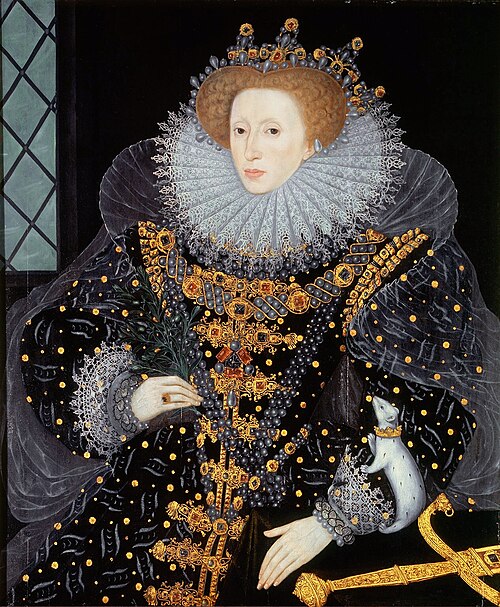
Elizabeth I
Elizabeth I
1533 — 1603
royaume d'Angleterre
Daughter of Henry VIII and Anne Boleyn, Elizabeth I reigned over England and Ireland from 1558 to 1603. Her reign, known as the "Elizabethan Era", was marked by the rise of English power and a remarkable cultural flourishing.
Famous Quotes
« I have the body of a weak and feeble woman, but I have the heart and stomach of a king. »
« I have but one mistress and no master. »
Key Facts
- 1533: born at Greenwich, daughter of Henry VIII and Anne Boleyn
- 1558: accession to the throne of England following the reign of her half-sister Mary I
- 1559: Act of Supremacy — establishment of the Church of England, of which she became the head
- 1588: defeat of the Spanish Armada of Philip II, asserting English naval power
- 1603: death at Richmond, end of the Tudor dynasty, after a 45-year reign
Works & Achievements
These two landmark laws established Elizabeth as Supreme Governor of the Church of England and required the use of the Book of Common Prayer. Together they formed the 'Elizabethan Settlement,' which defined Anglicanism as it still exists today.
Adopted during her reign, these articles of faith set out the Protestant doctrine of the Church of England, positioned between Roman Catholicism and radical Calvinism. They form the theological cornerstone of the Elizabethan religious compromise.
Elizabeth granted a royal charter to the East India Company, laying the foundations for British commercial and colonial expansion across Asia. This decision would have major geopolitical consequences for three centuries.
Delivered before the House of Commons two years before her death, this speech expressed Elizabeth's love for her people and her vision of royal power rooted in the consent of the governed. It was immediately printed and circulated as a political testament.
Under Elizabeth's protection and patronage, English theatre entered its golden age with Christopher Marlowe, William Shakespeare, and Ben Jonson. The Queen attended performances frequently, and her favored acting companies bore the honorary title of 'Queen's Men.'
Elizabeth secretly backed Drake's expedition — the second circumnavigation of the globe in history after Magellan's — allowing him to raid Spanish colonies in the Pacific. By knighting him aboard his own ship, she boldly asserted English naval power against Spain.
Anecdotes
At her coronation in 1559, Elizabeth refused to allow the Bishop of London to elevate the host during Mass, signaling from the very start of her reign her break with Roman Catholicism. This seemingly minor gesture foreshadowed the Act of Supremacy she would have passed to establish herself as Supreme Governor of the Church of England.
Elizabeth wielded the art of marriage negotiation as a formidable diplomatic weapon. For years she kept marriage talks alive with European princes — Philip II of Spain, Archduke Charles of Austria, the Duke of Anjou — without ever reaching a conclusion, thereby maintaining a balance between continental powers while preserving her own independence. She once declared: "I am already married to England."
In 1588, when the Spanish Armada threatened the English coast, Elizabeth rode out to meet her troops at Tilbury, clad in a silver breastplate. There she delivered one of the most celebrated speeches in history: "I know I have the body of a weak and feeble woman, but I have the heart and stomach of a king." The speech galvanized her soldiers and has remained etched in the collective memory of the British people.
A gifted polyglot, Elizabeth was fluent in Latin, Greek, French, Italian, and Spanish. She used this command of languages to unsettle foreign ambassadors by responding to them in their own tongue, thereby stripping them of any diplomatic advantage gained through translation.
The queen carefully cultivated her image as the "Virgin Queen," turning her unmarried status into an instrument of state policy. She commissioned numerous official portraits in which she appeared surrounded by symbols of purity and power — the moon, pearls, ermine — constructing one of the earliest systematic programs of visual propaganda in European history.
Primary Sources
I know I have the body but of a weak and feeble woman; but I have the heart and stomach of a king, and of a king of England too, and think foul scorn that Parma or Spain, or any prince of Europe, should dare to invade the borders of my realm.
Be it enacted by the authority of this present Parliament, that the Queen's highness is the only supreme governor of this realm… as well in all spiritual or ecclesiastical things or causes, as temporal.
And in the end, this shall be for me sufficient, that a marble stone shall declare that a queen, having reigned such a time, lived and died a virgin.
You have in various ways and manners attempted to take my life and to bring my kingdom to destruction by bloodshed. I have never proceeded so harshly against you, but have, on the contrary, protected and maintained you like myself.
Though God hath raised me high, yet this I count the glory of my crown, that I have reigned with your loves. This makes me that I do not so much rejoice that God hath made me to be a Queen, as to be a Queen over so thankful a people.
Key Places
Elizabeth I's birthplace in 1533, this palace on the Thames was one of her favourite residences. It was here that she learned she was to become queen upon the death of Mary I in 1558.
Elizabeth was imprisoned here in 1554 during the reign of her half-sister Mary I, suspected of involvement in a Protestant plot. She had also been brought there as a child following the execution of her mother, Anne Boleyn.
The principal seat of government during her reign, Elizabeth held her court here, received foreign ambassadors, and ruled England from its halls. It was here that she died in March 1603.
A royal residence regularly used by Elizabeth, particularly for ceremonies of the Order of the Garter, of which she was Sovereign Head. The castle embodied the continuity of the English monarchy.
It was at this military encampment on the banks of the Thames that Elizabeth delivered her legendary speech to the troops assembled to repel the Spanish Armada in August 1588.
The site of Elizabeth's coronation on 15 January 1559 and her burial following her death in 1603. Her white marble tomb, facing that of Mary I, remains visible today in the Henry VII Lady Chapel.
Gallery

Portrait of Elizabeth I of England, the Armada Portrait
Wikimedia Commons, Public domain — Formerly attributed to George Gower

Queen Elizabeth I (copy after an original of c.1559) title QS:P1476,en:"Queen Elizabeth I (copy after an original of c.1559) "label QS:Len,"Queen Elizabeth I (copy after an original of c.1559) "label
Wikimedia Commons, Public domain — After Levina Teerlinc

Portrait of a Woman title QS:P1476,en:"Portrait of a Woman "label QS:Len,"Portrait of a Woman "label QS:Lfr,"Portrait de femme"
Wikimedia Commons, CC0 — Unidentified painter

Portrait of Queen Elizabeth Ilabel QS:Len,"Portrait of Queen Elizabeth I"
Wikimedia Commons, Public domain — Workshop of Steven van der Meulen

The Hampden Portraitlabel QS:Len,"The Hampden Portrait"
Wikimedia Commons, CC BY-SA 4.0 — George Gower / Steven van der Meulen

Rastrelli Pierre le Grand
Wikimedia Commons, Public domain — Bartolomeo Carlo Rastrelli

Elizabeth I
Wikimedia Commons, CC0 — Wedgwood and Bentley

Bust of Elizabeth I, Charter Walk, Haslemere
Wikimedia Commons, CC0 — Mertbiol

Elizabeth I tomb effigy, Westminster Abbey
Wikimedia Commons, CC BY-SA 4.0 — Arcaist