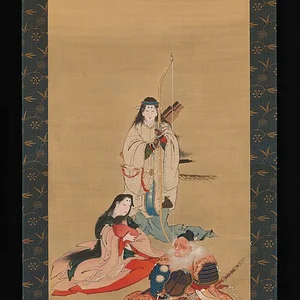

A legendary empress of Japan, Jingū is said to have reigned in the 3rd century according to Japanese chronicles. Tradition credits her with a military campaign against the Korean peninsula, carried out while she was pregnant. Her historical existence is unattested and she belongs to Japan's founding mythology.
Frequently asked questions
Key Facts
- Mentioned in the Kojiki (712) and the Nihon Shoki (720), Japan's earliest written chronicles
- Tradition attributes to her a military expedition to Korea (Silla), conducted while she was carrying the child who would become Emperor Ōjin
- She is said to have served as regent for approximately 69 years according to mythological sources
- Her historical existence is disputed by modern historians; she belongs to the legendary cycle of Japan's origins
- She is associated with Shinto worship and venerated at several shrines, including Sumiyoshi Taisha
Works & Achievements
According to the Nihon Shoki, Jingū is said to have ruled Japan as regent for sixty-nine years after the death of her husband. This regency is presented as an example of exceptional female governance in Japan's legendary history.
Jingū's legendary military campaign against the Korean kingdoms of Silla, Baekje, and Goguryeo is depicted in the chronicles as a victory without battle, with the kings submitting to her fleet. This episode shaped Japan's view of its relationship with Korea for centuries.
Several major Japanese shrines, including Sumiyoshi and Kashii, attribute their founding or divine protection to her. Her religious role is presented as inseparable from her political role in the Shinto tradition.
Tradition credits Jingū with establishing the first formal relations between Japan and the kingdoms of the Korean Peninsula, through the exchange of envoys and tribute. These ties led to the introduction of advanced continental techniques into Japan.
Anecdotes
According to the Kojiki and Nihon Shoki, Jingū received a divine revelation commanding her to lead a military expedition to Korea. The gods promised her victory on the condition that she depart without delay. This prophetic dimension makes her a figure at the crossroads of politics and the sacred in Japanese tradition.
Tradition holds that Jingū was pregnant during her Korean campaign. To delay the birth of her child until her victorious return, she is said to have pressed a cold stone against her belly, symbolizing her determination. Her son, the future Emperor Ōjin, was born upon her return to Japan, associated from birth with divine power.
The chronicles present Jingū as an exceptional regent: following the death of her husband Emperor Chūai, she reportedly governed Japan alone for nearly seventy years, according to traditional calculations. This legendary longevity reflects the symbolic importance granted to her in Japanese collective memory.
The Sumiyoshi Grand Shrine (Osaka) is closely associated with her: according to legend, the Sumiyoshi gods — protective deities of the sea and navigation — guided her during her crossing to the Korean Peninsula. These deities remain among the most venerated in Japan and symbolize the protection of sailors.
Jingū appears on Japanese one-yen banknotes issued between 1881 and 1899, making her the first woman to appear on modern Japanese currency. This choice reflects her status as a national symbol, even though her historical existence remains a matter of debate among contemporary historians.
Primary Sources
The account of Empress Jingū's campaign is recorded in the Kojiki, Japan's first great chronicle. She is presented there as guided by the Sumiyoshi deities, crossing the sea to the land of Silla, whose king submitted without battle.
The Nihon Shoki devotes several chapters to Jingū, describing in detail her regency, her expedition to Korea, and the divine oracles said to have guided her. It is the most fully developed written source on this legendary figure.
Japan's oldest poetry anthology contains poems evoking the maritime exploits and symbolic power associated with the figure of Jingū, enshrining her memory within the Japanese lyric tradition.
This religious text connected to the Sumiyoshi Shrine in Osaka traces the role of the Sumiyoshi deities in the protection they granted Jingū during her maritime expedition, highlighting the link between the worship of these gods and the memory of the empress.
Key Places
One of the oldest Shinto shrines in Japan, closely associated with Jingū according to tradition. The Sumiyoshi gods — patron deities of seafaring — are said to have guided her during her naval expedition to Korea.
A shrine traditionally said to have been founded on the spot where Jingū established her camp before the expedition to Korea. It preserves the legendary stones she is said to have used to delay her childbirth.
The stretch of sea separating the Japanese archipelago from the Korean Peninsula, and the legendary setting of Jingū's military crossing. This strait, roughly 180 km wide, lies at the heart of the Japanese founding tradition associated with her.
The heartland of ancient Japan and the cradle of Yamato civilization, of which Jingū is presented as a founding figure. This is where the earliest proto-state in Japan developed — the one with which she is closely associated.
The Korean kingdom whose submission stands at the center of the Jingū legend. Although no Korean source confirms this episode, the tradition has deeply shaped Japanese-Korean diplomatic relations across the centuries.
Typical Objects
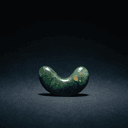
A sacred gem of Japanese tradition, worn by high-ranking women and shamans (miko). The magatama is one of the three Imperial Treasures of Japan and symbolizes the spiritual power that tradition attributes to Jingū.

A polearm traditionally associated with women of the Japanese warrior nobility. In iconographic depictions, Jingū is sometimes shown wielding such a weapon, emphasizing her role as a military leader.

According to legend, Jingū used cold stones to delay her labor during the Korean campaign. These stones are preserved as sacred relics at the Kashii Shrine (Fukuoka) and have become a symbol of her determination.
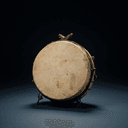
A central instrument in Shinto ceremonies and the military preparations of the era. The beat of the drum accompanied the divination rituals performed before expeditions, in which Jingū is said to have participated as a priest-queen.
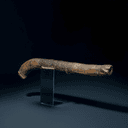
Jingū's legendary campaign hinged on crossing the Korea Strait by sea. The vessels of the Yayoi period — broad, flat-bottomed dugout canoes propelled by oars — are the tangible backdrop of this maritime legend.
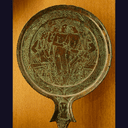
A major ritual object of the Yayoi-Kofun period, the bronze mirror is one of the three Imperial Treasures of Japan. It symbolizes wisdom and purity, virtues associated with the divine figure of Jingū in Shinto tradition.
📷 CC BY 3.0 · Wikimedia Commons ↗School Curriculum
Vocabulary & Tags
Key Vocabulary
Daily Life
Morning
Jingū began her day with purification rites (misogi) at the water's edge, in keeping with the Shinto practices of the era. As a shaman-queen, she consulted the deities through divination, interpreting signs to guide her political and military decisions.
Afternoon
Afternoons were devoted to audiences with clan chiefs (uji no kami) and strategic deliberations with her advisors. Managing alliances between clans and overseeing military preparations or agricultural works formed the core duties of her rule.
Evening
Evenings brought the court together for ritual banquets where rice sake offered to the gods was consumed. Epic recitations and songs (kataribe) recalling the deeds of divine ancestors were performed by specialized storytellers, orally preserving the clan's collective memory.
Food
The Yamato court's diet was based primarily on rice, a sacred food and symbol of wealth. It was supplemented by fish, seafood plentiful along Japan's coasts, fermented vegetables, and game. Rice sake, a ritual drink, was reserved for ceremonies and dignitaries.
Clothing
Textiles of the early Kofun period included linen fabrics and silk imported from the Asian continent. High-ranking women wore layered robes (mo-kinu) in symbolic colors — red, white, and indigo — adorned with jade magatama jewels and bronze ornaments, conspicuous markers of social and divine status.
Housing
The imperial residence (miya) was a hinoki cypress timber structure with a thatched roof, raised on stilts in the Yayoi tradition. Rooms were arranged around a central ritual space. The sacred enclosure included a raised rice granary, symbolizing the sovereign's authority over the clan's food resources.
Historical Timeline
Period Vocabulary
Visual Style
Style pictural inspiré des figurines haniwa et de la peinture de cour japonaise ancienne, entre représentation historique et évocation mythologique. Palette de bleus marins profonds, d'ocres et de vermillon.
Sound Ambience
Ambiance côtière et cérémonielle du Japon légendaire, entre rituels shinto et préparatifs d'une expédition maritime. Mêle les sons de la nature, des tambours rituels et de la vie d'une cour primitive.
Liens externes & ressources
Références
Œuvres
Régence de Jingū (神功皇后摂政)
vers 200-269 selon la tradition
Expédition en Corée (三韓征伐)
vers 200 selon la tradition
Fondation de sanctuaires shinto
IIIe siècle (légendaire)
Institution des relations diplomatiques avec la Corée
IIIe-IVe siècle (légendaire)