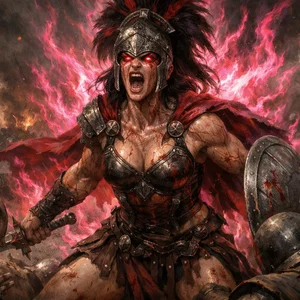

Greek goddess of war and destruction, Enyo is the companion or sister of Ares. She embodies the bloody turmoil of battle and spreads terror across the battlefield in Greek mythology.
Enyo
Enyo
7 min read
Frequently asked questions
Key Facts
- Mentioned in Homer's *Iliad* (c. 8th century BC) as a companion of Ares on the battlefield
- Associated with Eris (Discord) and the Keres as a deity bringing the misfortunes of war
- Her Roman equivalent is Bellona, the Roman goddess of war
- Sometimes depicted as the daughter of Ares and Aphrodite, sometimes as his sister
- Her name means "war" or "horror of war" in Greek
Works & Achievements
The first text to mention Enyo, this foundational epic poem presents her as a companion of Ares in the battles around Troy. It is the primary source for understanding her nature and role in war mythology.
This poem by Hesiod codifies the genealogy of the Greek gods and establishes the place of war deities within the Olympian pantheon. It helps define the mythological universe in which Enyo operates.
This epic, which continues the Iliad, gives Enyo a leading role, describing her descending from the heavens to inflame warriors. It is one of the most fully developed portrayals of the goddess in ancient literature.
This compilation of Greek myths includes references to Enyo and her divine entourage. It is a valuable source for mythographers seeking to reconstruct the Greek mythological tradition.
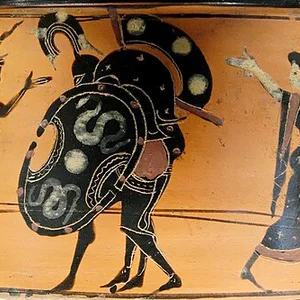
Scenes depicting Ares accompanied by war deities, possibly Enyo, adorn several vases from the Classical period. These works attest to the goddess's place in popular Greek iconography.
Anecdotes
In Homer's *Iliad*, Enyo is described as Ares's companion on the battlefield. She bears the epithet “destroyer of cities” (*poliporthos* in Greek), reflecting her role in the destruction of cities during battle. Her appearances are always associated with the most extreme violence and the chaos of the fray.
Enyo is closely linked to Eris (Discord), Phobos (Fear), and Deimos (Terror), sons of Ares. Together they form a terrible retinue that accompanies the god of war, spreading panic among soldiers. This association illustrates the many faces of war in ancient Greek thought.
Some ancient mythographers make Enyo one of the Graeae, the three white-haired sisters sharing a single eye who appear in the myths of Perseus. This confusion reveals the complexity of the Greek pantheon, where certain deities could belong to multiple divine lineages depending on regional traditions.
In Roman mythology, Enyo was assimilated to Bellona, Roman goddess of war, whose temple stood in Rome near the Campus Martius. This identification shows how the Romans absorbed Greek deities by integrating them into their own religion. Bellona had her own fanatical priests, the Bellonarii, who would wound themselves during ceremonies to offer their blood to the goddess.
Quintus of Smyrna, a Greek author of the 4th century AD, gives Enyo a major role in his epic *Posthomerica*, which recounts the events of the Trojan War after the *Iliad*. He depicts her descending from the heavens to breathe martial fury into the souls of the combatants, unable to satiate herself with blood and destruction. This late portrayal attests to the goddess's enduring presence in the Greek literary imagination.
Primary Sources
Ares the destroyer ranged back and forth, now before Hector, now behind him; Enyo, sacker of cities, followed at his side, bringing the shameful tumult of the fray.
Enyo, shrieking terribly, rushed into the midst of the combatants, drenched all over in blood, spreading panic among men and rousing their battle fury.
Ares himself owes his fearsome nature to those who share his domain — the gods who preside over bloody battles and the besieging of cities.
Among the deities who accompany Ares in battle are Enyo, Eris, Phobos, and Deimos, forming the terrible retinue of war.
Key Places
Home of the Greek gods, Olympus is Enyo's place of origin in mythology. It is from there that she descends to join the battlefields alongside Ares.
Site of the Trojan War, Troy is the main theater of action for Enyo as she is depicted in the *Iliad* and the *Posthomerica*. There, the goddess sows chaos among Greek and Trojan warriors alike.
A Greek city famous for its myths of legendary wars, Thebes is associated with stories in which Enyo and Ares influence the outcome of fratricidal battles between Greek heroes.
The warrior city par excellence, Sparta honored the deities of war. The cult of Ares was particularly vibrant there, and Enyo was venerated as the companion of the god of war.
The site where the temple of Bellona was erected — the Roman assimilation of Enyo. This *campus martius* was the center of Roman war worship, perpetuating in a new form the memory of the Greek goddess.
Typical Objects

The emblematic weapon of Greek combat, the spear is the symbolic attribute that Enyo brandishes to rouse warriors and unleash the melee. Its presence in depictions of the goddess reflects her fundamentally warlike nature.

Enyo is sometimes depicted carrying a torch, a symbol of the destruction of cities and the fires that follow battle. The torch also evokes the battle frenzy she breathes into the souls of fighters.

The Corinthian helmet, emblem of the Greek warrior, is associated with Enyo as a martial deity. Like Athena, she is sometimes depicted wearing a helmet, underscoring her authority over the domain of war.

The large round shield of the Greek hoplites symbolizes both protection and offensive force. Enyo seizes it to join Ares on the battlefield and amplify the clash of combat.

In certain mythological traditions, Enyo is depicted holding a cup filled with the blood of fallen warriors. This object expresses her insatiable thirst for destruction and her bond with violent death.

The Greek gods travel on chariots drawn by divine horses; Enyo accompanies Ares on his chariot to sweep down onto the fields of battle. The chariot represents the speed and unstoppable violence of the warrior's assault.
School Curriculum
Vocabulary & Tags
Key Vocabulary
Daily Life
Morning
At sunrise, Enyo, the immortal goddess dwelling on Olympus, awakens to the first sounds of battle stirring on Earth. She hones her martial fury by watching from the heavens as armies gather, ready to descend among mortals and breathe violence into their ranks.
Afternoon
At the height of day, when battles rage, Enyo is at the peak of her power. She strides across battlefields alongside Ares, Phobos, and Deimos, amplifying the chaos and sowing panic. Greek poets describe her screaming with joy at the sight of blood spilled and cities set ablaze.
Evening
When the sun sets and the fighting dies down, Enyo surveys the fields strewn with bodies and the cities left in ruins. She returns to Olympus with Ares, where the gods feast after the day's battles. Insatiable, she already awaits the next day's clashes.
Food
As an Olympian deity, Enyo sustains herself on nectar and ambrosia, the divine foods that grant immortality to the Greek gods. Some myths also depict her symbolically feeding on the blood of fallen warriors — a poetic expression of her destructive nature.
Clothing
Enyo is often depicted clad in full armor, with a bronze helmet on her head and a spear in hand, in the manner of Greek warrior deities. In some versions, she wears a blood-stained tunic (*chiton*), a reminder of her role in the most violent battles.
Housing
Like all Olympian deities, Enyo resides on Mount Olympus in a divine palace. Her dwelling is described as resounding with the clash of weapons and the cries of war, a reflection of her true nature and her insatiable thirst for destruction.
Historical Timeline
Period Vocabulary
Liens externes & ressources
Références
Œuvres
L'Iliade (Homère)
vers 750 av. J.-C.
La Théogonie (Hésiode)
vers 700 av. J.-C.
Posthomerica (Quintus de Smyrne)
IVe siècle apr. J.-C.
Bibliothèque mythologique (Apollodore)
IIe siècle av. J.-C.
Vases à figures noires et rouges (peintres athéniens)
VIe-Ve siècle av. J.-C.