
Eos is the Greek goddess of the Dawn, daughter of the Titans Hyperion and Theia, sister of Helios (the Sun) and Selene (the Moon). Each morning, she opens the gates of the sky to herald the rising of the day, riding her chariot drawn by two winged horses.
Eos
Eos
8 min read
Frequently asked questions
Key Facts
- Daughter of the Titans Hyperion and Theia, she belongs to the divine generation that preceded the Olympians
- She fell in love with Tithonus, a Trojan mortal, and obtained immortality for him from Zeus — without asking for eternal youth
- Mother of the winds (Boreas, Zephyr, Eurus, Notus) and the stars with the Titan Astraeus
- Homer describes her in the *Iliad* and the *Odyssey* with the recurring epithet "rosy-fingered Eos
- Her Roman equivalent is Aurora, goddess of the dawn in Roman religion
Works & Achievements
Eos obtained immortality from Zeus for her son Memnon after he fell in battle before Troy. This act of maternal love is one of the most moving myths in the Greek tradition.
Eos chose Tithonus as her eternal companion and secured his immortality from Zeus, but forgot to ask for eternal youth. This myth, which ends with Tithonus being transformed into a cicada, has become a symbol of the inevitability of old age.
Eos carried off the hunter Cephalus to make him her lover. This myth, taken up in Ovid's *Metamorphoses*, illustrates the power of divine desire and its tragic consequences for mortals.
Each dawn, Eos scatters drops of dew across the earth. This natural phenomenon, attributed to the goddess in Greek cosmology, represents her daily gift to nature and to the mortals who rise to work.
Eos's central cosmic role is to open the gates of heaven each morning so that the chariot of Helios may begin its course. Without her, day could not break — she is the indispensable intermediary between night and day.
Anecdotes
Eos fell desperately in love with the handsome Tithonus, prince of Troy, and asked Zeus to grant him immortality. But she forgot to ask for eternal youth at the same time. So Tithonus aged without end, shrinking and weakening until he was nothing but a faint murmur. The goddess, moved by his fate, finally transformed him into a cicada, according to some versions of the myth.
The son of Eos and Tithonus, Memnon, king of the Ethiopians, came to defend Troy against the Greeks. He faced Achilles in single combat and was slain. Eos implored Zeus to grant her son immortality, and Zeus agreed. According to the Ancients, the morning dew that beads on the grass at dawn is the tears the goddess sheds each day for her beloved son.
Eos fell for the hunter Cephalus, an Athenian renowned for his beauty, and abducted him even though he had just married Procris. From their union was born Phaethon the Brilliant. Cephalus was eventually returned to his wife, but Eos's jealousy had sown mistrust between the two spouses, with tragic consequences.
According to some myths, Aphrodite punished Eos for seducing her lover Ares by cursing her to fall endlessly in love with mortals. This curse would explain the many abductions attributed to the goddess of the Dawn, who could not resist the beauty of men and carried them off against their will.
In Homer's Iliad, Eos is consistently referred to by the epithet “rosy-fingered” (rhododaktulos in Greek). This poetic formula, repeated dozens of times, underscores the importance of Eos as a time marker: every new day of the Trojan War begins with her.
Primary Sources
And Hyperion united with Theia, who bore him great Helios, bright Selene, and Eos who shines upon all mortals on earth and upon the immortal gods who dwell in the broad sky.
When rosy-fingered Dawn appeared, the daughter of the morning — a recurring formula marking the dawn of each new day of battle before Troy.
Sing, O Muse, of Helios, son of Hyperion and Theia, brother of broad-armed Selene and saffron-robed Eos the Dawn.
Saffron-haired Aurora had carried off Cephalus and long cherished a tender memory of him, from the time he had just taken the daughter of Erechtheus as his wife.
When Dawn rises and spreads her rosy light across the fields, the farmer must set to work without delay.
Key Places
Each morning, Eos leaves her palace at the eastern edge of the world, at the boundary of the mythological Ocean, to open the great golden gates of heaven and let in the light of day.
Home of the Olympian gods, Olympus is the gathering place of the heavenly deities. Eos returns there after her morning journey to rejoin the assembly of the immortals.
A mythical city bound to Eos by several threads: Tithonus, her immortal lover and father of Memnon, was a prince of Troy. It was also before the walls of Troy that Memnon met his death, plunging Eos into eternal mourning.
Kingdom of Memnon, son of Eos and Tithonus. In Greek mythological geography, Ethiopia referred to the distant lands of the southeast, bathed in the first rays of the dawn that the goddess cherished above all.
Homeland of Cephalus, the hunter abducted by Eos. The Athenians claimed this myth as a celebration of the beauty of their city's men, whose looks could captivate even immortal goddesses.
Typical Objects

Eos crosses the sky each morning on a chariot drawn by two winged horses named Lampos (Brilliant) and Phaethon (Radiant). This chariot symbolizes the swiftness of daybreak and the movement of light at dawn.

Ancient texts describe Eos dressed in a saffron-colored veil, that characteristic golden-orange hue of dawn skies. Homer and the Homeric Hymns emphasize this color as distinctively her own.

Eos spreads the morning dew over fields and meadows. This crystal-clear water, associated with her tears shed for Memnon, symbolizes the freshness and renewal she brings with each dawn.

Eos is sometimes depicted holding a torch to herald the coming of the Sun. This attribute underscores her role as messenger and forerunner of Helios in the daily celestial race.

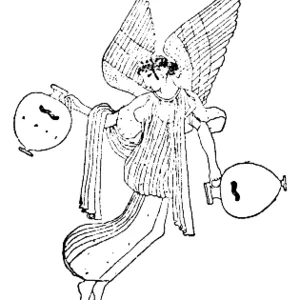
In Greek art, Eos is often depicted with great golden wings that allow her to soar across the sky. Her wings express her divine nature and her ability to traverse celestial spaces in an instant.

In certain iconographic representations, Eos wears a luminous crown reminiscent of the last stars of night. It symbolizes the transition between the darkness of night and the light of the nascent day.
School Curriculum
Vocabulary & Tags
Key Vocabulary
Daily Life
Morning
Éos rises before all other celestial deities, leaves her palace at the eastern edge of the Ocean, and mounts her gleaming chariot drawn by Lampos and Phaethon. She throws open the golden gates of heaven to herald the coming of her brother Helios, and spreads her rosy light across the horizon, painting the sky in saffron and purple hues.
Afternoon
Once her task is done, Éos yields to Helios and the full light of day. In the myths, she spends her days in her celestial palace surrounded by her mortal and divine lovers, watching over her sons Memnon and Emathion from the heights of Olympus and observing the world of mortals below.
Evening
As twilight draws near, Éos prepares her return to the eastern Ocean to rest until the next morning. She watches with quiet melancholy as her brother Helios sets — she who is his eternal forerunner in the great procession of the heavenly bodies.
Food
Like all Olympian deities, Éos feeds on nectar and ambrosia, the divine foods that bestow immortality and keep the gods in their eternal splendor. The dew she scatters upon the earth is said, in some traditions, to be a form of divine nectar shared with mortals.
Clothing
Éos is clothed in a saffron-colored veil or robe evoking the orange and golden hues of the rising dawn. Her great golden wings allow her to cross the sky at full speed. She sometimes wears a crown of light and gleaming adornments that reflect the ever-changing colors of the aurora.
Housing
Éos dwells in a palace at the eastern edge of the world, where the Ocean Sea meets the sky. This mythical abode, bathed in the first light of morning, is also the place from which Helios and Selene set out each day on their respective celestial journeys.
Historical Timeline
Period Vocabulary
Liens externes & ressources
Références
Œuvres
L'immortalisation de Memnon
Mythe antique, attesté vers 700-600 av. J.-C.
L'enlèvement de Tithon et sa transformation en cigale
Mythe antique, attesté dans la Théogonie et les Hymnes homériques
L'enlèvement de Céphale
Mythe antique, raconté par Hésiode et Ovide
La rosée du matin
Tradition mythologique ancienne
Ouverture des portes du ciel
Tradition cosmologique attestée dans l'Iliade et l'Odyssée