
Eshu is a trickster orisha from the Yoruba tradition of West Africa, guardian of crossroads and messenger between humans and the gods. Master of communication and cunning, he must be propitiated before any ritual.
Frequently asked questions
Key Facts
- Eshu is one of the principal orishas of the Yoruba pantheon, originating from Nigeria and Benin
- He is the guardian of crossroads and the messenger between the human world and the divine world (Orun)
- Through the transatlantic slave trade (16th–19th century), his cult spread to the Americas under the names Legba, Exu, or Elegguá
- He is present in Candomblé (Brazil), Vodou (Haiti), and Santería (Cuba)
- His unpredictable nature makes him a symbol of freedom, language, and communication
Works & Achievements
The 256 chapters of the Yoruba divination corpus in which Eshu appears in hundreds of mythic narratives. This corpus, transmitted orally by babalawos and inscribed on UNESCO's Intangible Cultural Heritage list, is the primary source of knowledge about Eshu and his cosmological role.
A body of Yoruba foundational myths in which Eshu is present from the very act of world creation. He is entrusted by Olodumare (the supreme deity) with the mission of serving as the universal messenger and guardian of the channels of communication between the world of the living and that of the spirits.
A corpus of poetic praises sung in honor of Eshu during Yoruba ceremonies. These texts describe his attributes and mythic exploits, forming a living sacred oral literature still recited today by priests and ritual musicians.
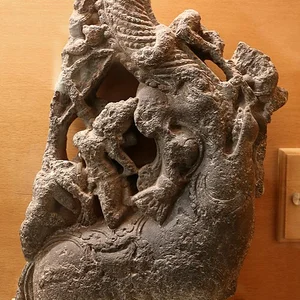
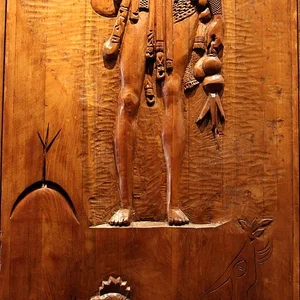
A Yoruba sculptural tradition representing Eshu in various forms: terracotta figurines at house entrances, wrought-iron sculptures on altars, ceremonial masks. These works constitute a living religious art in constant reinvention across three continents.
Initiation ceremonies in which Eshu is always the first orisha to be honored. These rituals, still practiced in Nigeria, Benin, and in Afro-American diasporas, constitute a living heritage of which Eshu is structurally the guardian and initiator.
Anecdotes
The legend of the two-colored hat is one of Eshu's most famous myths: he walks between two fields wearing a hat that is red on one side and black on the other. The two farmers observing him from opposite sides spend their entire lives arguing about the color of the stranger's hat. This story teaches that truth always depends on one's point of view — a profound philosophical lesson hidden in a simple anecdote.
In Yoruba ceremonies, Eshu is ALWAYS the first orisha to receive an offering, even before the most powerful gods such as Shango or Obatala. Without his permission, no human message can reach the other orishas. This rule is so absolute that even the most experienced priests never forget it, for fear that the ritual will fail or turn against the officiants.
Eshu is the master of crossroads: altars are erected to him at the intersection of paths, for it is there that destinies cross and life choices are made. In Yoruba villages in Nigeria and Benin, small iron or clay figurines are left for him, accompanied by palm nuts and tobacco, to obtain his help before a long journey or an important decision.
During the transatlantic slave trade (16th–19th centuries), the Yoruba people deported to the Americas carried the cult of Eshu with them in their memory. In Brazil, he became Exu in Candomblé; in Cuba, Elegguá in Santería; in Haiti, Legba in Vodou. Despite centuries of slavery and religious persecution, this god of the crossroads survived and thrived across three continents — proof of the extraordinary vitality of the Yoruba tradition.
In the stories of the Ifa corpus, Eshu tests humans and gods by sowing confusion or stealing offerings, but this trickery is never gratuitous: it reveals the true character of each individual. Those who remain honest and humble receive his precious help; those who yield to anger or arrogance suffer the consequences of their own flaws. He is thus less a demon than a revealer of truth.
Primary Sources
Eshu is the divine messenger who opens the paths between the world of the living (ayé) and the spirit world (ọrun). Without him, no human word reaches the orishas. He must be honored first at every sacrifice, for he holds the keys to all channels of communication.
Elegbara (Eshu) is one of the principal objects of Yoruba veneration. He presides over crossroads and pathways. Crude figurines dedicated to him are placed at house entrances and road intersections, where offerings of palm nuts and palm oil are made to him.
Legba, the Fon form of Eshu, is the deity of fate and communication. He is the required intermediary between humans and the invisible world. Without propitiating him first, no vodun ceremony can take place, and his anger manifests as repeated obstacles and misfortunes.
Exu owns all roads, all doors, all entrances and all exits. He is the guardian of homes and villages. He is capricious and mischievous, yet also a faithful protector of those who honor him regularly with the proper offerings.
Eshu-Elegba is described in the Odu as the one who can open or close the path of human destiny. His dual nature — benevolent and mischievous — reflects the fundamental unpredictability of life. He is both the first orisha invoked and the last to leave the ceremony.
Key Places
Sacred city considered the cradle of Yoruba civilization and the mythical place of origin of all orishas, including Eshu. It is here that the Ifa corpus was codified and that the first great orisha sculptures were created, over a thousand years ago.
The crossroads is Eshu's sacred space par excellence — a symbolic place where paths and destinies intersect. Throughout Yoruba Africa, his altars are erected there and offerings are left before journeys or important decisions.
Historic port of the Kingdom of Dahomey through which thousands of Yoruba slaves passed between the 16th and 19th centuries. Eshu, in his Fon form as Legba, is still venerated there today, with monumental sculptures placed at the entrances of villages and vodun temples.
Capital of Brazilian candomblé, where Eshu is venerated under the name Exu. This city preserves the most living Yoruba tradition outside of Africa, with *terreiros* (temples) where Eshu's rituals have been practiced since the 17th century.
Center of Cuban *santería*, where Eshu is honored under the name Elegguá. The Yoruba tradition, brought over by enslaved Africans, blended with Catholicism to create a syncretic religion in which Elegguá is associated with Saint Anthony of Padua.
Typical Objects

A small iron sculpture representing Eshu, often in the form of an expressive face or a stylized figure. Placed at the entrance of homes or at crossroads, it serves as a receptacle for his divine power (àṣẹ) and must receive regular offerings.

Sixteen palm nuts used in Ifa divination, closely associated with Eshu, who presides over the interpretation of oracles. Their ritual manipulation by the babalawo allows him to decipher the messages that the divine messenger conveys to humans.

A long carved staff, sometimes topped with a hook, and a key iconographic attribute of Eshu in many representations. It symbolizes his role as a tireless traveler who ceaselessly roams the paths between the human world and the divine world.

A metal bell used to summon Eshu at the beginning of Yoruba ceremonies. Its ringing marks the opening of dialogue with the world of the orishas and signals that the divine messenger is invited to manifest himself and open the channels of communication.

A symbolic attribute of Eshu drawn directly from the legend of the hat, red on one side and black on the other. These two colors are his own: red symbolizes his vital force and energy, while black represents his connection to the spirit world and the unpredictability of fate.

Strong alcohol offered to Eshu during rituals as a libation. He is particularly fond of these liquid offerings, symbols of warmth and vital energy, which the priest pours onto his altar or spills at a crossroads to seek his aid.
School Curriculum
Vocabulary & Tags
Key Vocabulary
Daily Life
Morning
In the Yoruba tradition, every day begins with a ritual greeting to Eshu before any other activity. The worshipper or priest places an offering (palm nuts, alcohol, a cigar) on the small iron or terracotta figurine set near the front door. Without this morning propitiation, one risks 'closing the paths' and bringing misfortune upon the entire day.
Afternoon
Babalawos (Ifa priest-diviners) consult Eshu in the afternoon during divination sessions. They manipulate the sixteen sacred palm nuts on a divination board dusted with white wood powder, tracing signs to interpret the messages Eshu conveys on behalf of the other orishas. Worshippers come to ask questions about their destiny, their health, or important decisions they face.
Evening
In the evening, during major communal ceremonies, Eshu is invoked first through ritual drumming and song. Trance dancers take turns before the congregation, dressed in red and black — his sacred colors. The atmosphere is festive and mischievous, for Eshu appreciates joy and celebration: he rewards communities that honor him with enthusiasm rather than with excessive solemnity.
Food
Food offerings to Eshu include palm nuts, palm oil, honey, sweets, rum, and tobacco for smoking or chewing. In some traditions, black roosters or goats are also sacrificed to him. These offerings are placed at crossroads or on his altars and are never consumed by worshippers — they belong entirely to the god.
Clothing
Eshu is depicted wearing red and black, his sacred colors symbolizing vital force and connection to the spirit world respectively. In iconographic representations he often wears a wide-brimmed bicolored pointed hat and a long tuft of hair standing upright toward the sky, a sign of his permanent link between the earthly realm and the divine world.
Housing
Eshu's domain is the threshold and the crossroads: he dwells symbolically at the entrance to homes, villages, and temples. His altar, called *Ile Eshu*, is typically a mound of earth or cement into which his iron figurine is planted, at the foot of a door or at the junction of two paths. He has no fixed abode, for he is a perpetual traveler between all worlds.
Historical Timeline
Period Vocabulary
Liens externes & ressources
Références
Œuvres
256 Odu Ifa (corpus de divination)
Codifié avant le XVe siècle
Cycle mythologique de la création yoruba
Tradition orale précoloniale
Oriki Eshu (hymnes de louange)
Tradition orale continue depuis au moins le XIIe siècle
Sculptures rituelles Eshu-Elegba
XVe siècle - présent
Rituels d'initiation aux orishas
Pratique continue depuis au moins le XIIe siècle