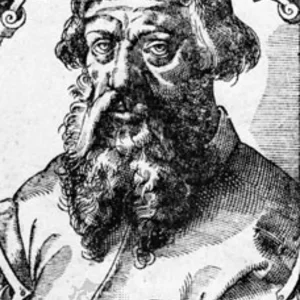

Humanist, printer, and philologist from Lyon (1509–1546), Étienne Dolet was one of the first great publishers of texts in French and Latin. A champion of the French language, he was condemned for heresy and burned at the stake on Place Maubert in Paris in 1546.
Étienne Dolet(1509 — 1546)
Étienne Dolet
France
8 min read
Frequently asked questions
Key Facts
- Born in Orléans in 1509, he studied in Paris, Padua, and Toulouse.
- He set up his printing workshop in Lyon in 1538, publishing humanist texts and translations.
- He published the 'Commentarii linguae latinae' (1536–1538), a major work of philology.
- Condemned multiple times for heresy and alleged atheism, notably for having translated Plato.
- Burned alive along with his books on Place Maubert in Paris on 3 August 1546.
Works & Achievements
A monumental two-volume philological encyclopedia commenting on and defining thousands of Latin words drawn from classical authors. This is Dolet's major scholarly work, which earned him a reputation as the foremost philologist of his time across Europe.
The first French treatise devoted to translation theory, in which Dolet sets out five rules for translating faithfully and elegantly. This foundational text shaped all subsequent French thinking on translation and the defense of the vernacular language.
A Latin poem composed on the occasion of his son Claude's birth, blending paternal tenderness with humanist ideals. This text reveals an intimate, poetic side of a man too often portrayed solely as a polemicist.
A French translation of a pseudo-Platonic dialogue on death, in which Dolet added the words 'rien du tout' — meaning 'nothing at all' — which were absent from the original. This addition became the primary proof of his atheism in the eyes of his judges and ultimately cost him his life.
Dolet published several editions of his friend Marot's poems, helping to widely disseminate Renaissance French poetry and making himself one of the chief architects of French's rise as a literary language.
Anecdotes
In December 1536, Étienne Dolet killed the painter Guillaume Compaing during a nocturnal brawl in the streets of Lyon. Imprisoned, he received a letter of remission signed by François I in 1537, thanks to the support of his humanist patrons. This episode illustrates the everyday violence of the Renaissance, even among the greatest scholars.
Dolet was largely condemned because of a translation of the dialogue 'Axiochus', attributed to Plato. He had added the words “nothing at all” — absent from the original text — to describe the state of the soul after death, suggesting its complete nothingness. This addition of three words was enough to charge him with atheism and ultimately cost him his life.
Dolet had chosen as his emblem a doloire (a carpenter's tool used to rough-hew wood), cleverly playing on his own name. His Latin motto, 'Scabra et impolita lima dolat', meant “The file polishes what is rough and unrefined” — a double allusion to his name and his humanist mission: to polish language and minds.
In 1540, condemned by the Parliament of Paris and threatened with the stake, Dolet managed to flee to Piedmont. But after two years of exile without resources or protection, he decided to return to Lyon to resume his work as a printer. He was immediately arrested, and this time no royal pardon was possible.
On August 3, 1546, Étienne Dolet was led to Place Maubert in Paris, surrounded by his books deemed heretical. After being strangled — a mercy granted to cooperative condemned men — his body was burned along with his works. Centuries later, in 1889, a statue was erected in his honor at Place Maubert, saluting him as a martyr of freedom of thought.
Primary Sources
A vast encyclopedia of humanist Latin, in which Dolet catalogs and comments on thousands of Latin terms with philological rigor, drawing on the finest authors of Antiquity to define proper usage of the language.
Dolet sets out five fundamental rules of translation: fully understanding the meaning of the source text, mastering both languages, avoiding word-for-word translation, choosing common words, and respecting the rhythmic flow of French prose.
A Latin poem addressed to his unborn son, in which Dolet expresses his humanist hopes, his faith in the French language, and his fears in the face of hostility from his theological enemies.
The king grants royal pardon to Dolet for the death of Guillaume Compaing, acknowledging that he had acted in self-defense during a nighttime brawl in Lyon.
The court condemns Dolet as an "atheist, blasphemer of the name of God, seditious disturber of the Republic" for his translations and printing of prohibited books, notably his translations of Plato, deemed heretical.
Key Places
Birthplace of Étienne Dolet in 1509. Orléans was at the time an active intellectual hub, close to Paris, where children of the bourgeoisie could receive a solid classical education.
The true capital of humanist publishing in the sixteenth century, Lyon was Dolet's spiritual home, where he opened his printing house in 1536 and published his major works. There he rubbed shoulders with Clément Marot, Rabelais, and other leading figures of the French Renaissance.
It was on this Parisian square — a traditional site for the execution of heretics — that Étienne Dolet was burned alive on 3 August 1546, along with his books. A statue in his honour was erected there in 1889.
Dolet studied rhetoric at the University of Toulouse, where he delivered notable speeches but also made enemies among the faculty. It was here that his combative character as a committed humanist was forged.
At this great Italian university, Dolet trained under the finest humanists of his day and discovered Latin philology at its source, definitively shaping his vocation as an editor of ancient texts.
Typical Objects

The central tool of Dolet's workshop in Lyon, the screw press allowed him to reproduce humanist texts and spread their ideas widely. It was at once his livelihood, his instrument of influence, and ultimately the primary source of his troubles with the censors.

Dolet had chosen a doloire — a carpenter's adze — as his printer's device, punning on his own name. This emblem appeared at the head of his publications and signed his identity as a humanist craftsman of language.

Dolet worked constantly with Latin manuscripts — ancient texts, works by Erasmus or Cicero — which he edited, annotated, and commented upon in order to deliver carefully produced printed editions to Europe's learned readers.

The everyday instruments of the philologist and author, these served Dolet for composing his own works, correcting proofs, and maintaining a correspondence with fellow humanists such as Marot and Rabelais.

Dolet distinguished himself by the aesthetic quality of his printed books, using typefaces close to Italian humanist italics that gave his volumes a legibility and elegance appreciated by cultivated readers.

Several works published or translated by Dolet were placed on the lists of books banned by the Sorbonne. These volumes — often small portable formats — circulated clandestinely among curious readers, at great peril to those who possessed them.
School Curriculum
Vocabulary & Tags
Key Vocabulary
Daily Life
Morning
Dolet began his day early in his Lyon printing workshop, where he supervised the typesetting and the work of the compositors. He proofread the sheets printed the day before, correcting errors with a philological rigor rare for his time.
Afternoon
The afternoon was devoted to writing and translation: seated before his Latin and Greek manuscripts, Dolet drafted his commentaries or prepared new editions. He sometimes received learned visitors passing through Lyon — Rabelais, Marot, or Italian scholars — with whom he debated philology and theology.
Evening
In the evenings, Dolet frequented Lyon's humanist circles, where the new ideas coming from Italy and the writings of Erasmus were discussed. These literary suppers were also an opportunity to exchange manuscripts and plan new publications.
Food
Like the Lyonnais bourgeoisie of his time, Dolet ate meat, fish on lean days, white bread, and vegetables. Lyon was already renowned for the quality of its cuisine; prosperous printers had the means to eat well, though periods of imprisonment imposed a far more frugal diet.
Clothing
Dolet wore the long black robe of scholars and well-to-do bourgeois, with the square cap characteristic of men of learning. In Lyon, a trading city open to Italy, he could afford quality fabrics; his clothes distinguished him from manual craftsmen while remaining sober, far removed from the splendor of the royal court.
Housing
Dolet lodged in Lyon in a bourgeois house adjoining his printing workshop, in the central merchant quarter. His dwelling probably included a study cluttered with books and manuscripts; his many imprisonments forced him on several occasions to abandon everything behind.
Historical Timeline
Period Vocabulary
Liens externes & ressources
Références
Œuvres
Commentarii Linguae Latinae
1536-1538
La Maniere de bien traduire d'une langue en aultre
1540
L'Avant-naissance de Claude Dolet (Genethliade)
1539
Traduction de l'Axiochus (attribué à Platon)
1544
Éditions des œuvres de Clément Marot
1538-1542