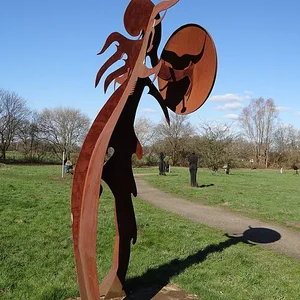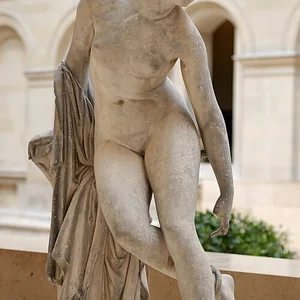

Nymph of Greek mythology and wife of the poet Orpheus. Bitten by a serpent, she descends to the Underworld. Orpheus attempts to bring her back to life through his music, but loses her forever by looking back.
Eurydice
Eurydice
9 min read
Frequently asked questions
Key Facts
- Eurydice is a nymph and wife of the poet and musician Orpheus
- She dies from a serpent bite on her wedding day
- Orpheus descends to the Underworld to bring her back, charming Cerberus and Hades with his music
- Hades agrees to let her return on one condition: Orpheus must not look back before leaving the Underworld
- Orpheus looks back, and Eurydice vanishes forever into the shadows
Works & Achievements
The first complete and poetically developed account of the myth in Latin literature. Virgil weaves the story of Orpheus and Eurydice into a poem about farming, giving it a universal resonance about grief and impossible love.
The most widely read and influential version of the myth in all of Roman antiquity. With unmatched narrative artistry, Ovid recounts the ill-omened wedding, Eurydice's death, the descent into the Underworld, and the fatal backward glance that seals her doom.
The first great opera in the history of Western music, premiered in Mantua for the Gonzaga court. Monteverdi stages the myth with revolutionary musical expressiveness, inaugurating a major artistic genre.
A landmark opera of the 18th-century lyric reform, premiered in Vienna. Gluck strips away dramatic complexity to foreground emotional intensity, giving Eurydice a far more developed vocal and dramatic role than in earlier versions.
A surrealist transposition of the myth into post-war Paris, with Death embodied by an elegant woman. Eurydice is a central figure whose final sacrifice illuminates the themes of absolute love and artistic creation.
An American play that retells the myth from Eurydice's point of view — her life in the Underworld, her relationship with her deceased father, and her own choice about returning. A feminist, poetic retelling that finally gives voice to a figure long reduced to silence.
Anecdotes
Eurydice's death is directly linked to the lust of the shepherd Aristaeus, son of Apollo. According to Virgil in the Georgics, Aristaeus tried to seize Eurydice by force; as she fled, she stepped on a snake hidden in the tall grass and died from its bite. This account gives her death a dimension of injustice that is particularly poignant.
When Orpheus descended into the Underworld to find Eurydice, his lyre enchanted every inhabitant of that realm. Charon, the ferryman of the dead who accepts only the deceased, made a unique exception for the musician. Even the Erinyes, the merciless goddesses of vengeance, burst into tears — a wonder absolutely without precedent in Greek mythology.
Hades and Persephone, moved by Orpheus's song, agreed to return Eurydice to life on a single condition: Orpheus would walk ahead of her and not look back until he had reached the light of day. This trial of absolute trust is one of the most famous in all mythology, and its failure one of the most heartbreaking endings in all of Antiquity.
According to Ovid, at the very wedding of Orpheus and Eurydice, the omens were dire: Hymenaeus, god of marriage, had carried a bridal torch that gave off acrid smoke rather than a bright flame. This literary detail underscores that the couple's tragic fate seemed written from the very start into the cosmic order.
After the final loss of Eurydice, Orpheus rejected all human love and devoted himself solely to music and mourning. The women of Thrace, the Maenads, offended by his indifference, tore him apart during a festival in honor of Dionysus. His head, thrown into the river Hebrus, continued according to legend to whisper Eurydice's name as it drifted toward the sea.
Primary Sources
Ipse cava solans aegrum testudine amorem / te, dulcis coniunx, te solo in litore secum, / te veniente die, te decedente canebat. — He, consoling his wounded love on his hollow lyre, sang of you, sweet wife, of you alone on the deserted shore, of you at the break of day, of you at the close of day.
Iamque pedem referens casus evaserat omnis, redditaque Eurydice superas veniebat ad auras pone sequens (namque hanc dederat Proserpina legem) cum subita incautum dementia cepit amantem. — Already he had avoided every danger, and Eurydice, restored, was making her way toward the light of day, following behind him, when a sudden madness seized the unwary lover.
The gods sent Orpheus back from the Underworld empty-handed, showing him only a phantom of the woman he had come to seek, but not giving him the woman herself, because they deemed him lacking in courage — for he had not dared to die for love as Alcestis had done.
O Persephone, queen of the depths, receive this purified soul that descends to you, guided by the sacred rites of the mysteries, so that it may reach the blessed meadows and the cool springs of Memory.
Orpheus of Thrace, of whom it is said that with his songs he charmed sheer rocks and the courses of rivers — he whose music was so powerful it could halt the mountain oaks in their tracks.
Key Places
The mythical region where Orpheus and Eurydice lived, associated in antiquity with magic, music, and mystery cults. It was here that Eurydice was bitten by the serpent, and where their ill-omened wedding took place.
The subterranean realm of the dead, ruled by Hades and Persephone. Eurydice descended there after her death, and it was there that Orpheus came to find her, charming Charon, Cerberus, the Furies, and the infernal sovereigns themselves with his music.
The mythical river separating the world of the living from the world of the dead, upon which the gods swore their most solemn oaths. Eurydice crossed it on Charon's boat; Orpheus, still alive, had to breach this forbidden boundary to reach her.
A mythical place with no fixed geographical location, where Orpheus — just steps from the light of day — turned back toward Eurydice and lost her forever. This threshold symbolizes the irreversible tipping point between hope and absolute loss.
A plain in the Underworld reserved for ordinary souls — neither heroes nor the condemned. It was there that Eurydice waited among the silent shades, drifting through a dim existence, until Orpheus demanded her return from Hades.
Typical Objects

A stringed instrument given by Apollo to Orpheus, whose music was so beautiful it charmed Hades himself into releasing Eurydice. The lyre symbolizes the absolute power of art over death and the forces of the underworld.

An ambiguous animal symbolizing both death and rebirth in Greek mythology. It was the bite of a serpent hidden in the grass that caused Eurydice's death, sending her down to the Underworld.

Asphodels are the flowers of the meadows of the Underworld where the souls of ordinary mortals wander. Before Orpheus came to claim her, Eurydice dwelled among these pale flowers like all the newly arrived shades.

A small coin placed in the mouth or over the eyes of the dead to pay Charon, the ferryman of the Styx. Eurydice had to cross this infernal river on his boat to reach the kingdom of Hades after her death.

According to Ovid, at the wedding of Orpheus and Eurydice, the torch carried by Hymen produced acrid smoke and refused to burn brightly — an ill omen foretelling the tragic fate of the couple from the very moment of their union.

A light, translucent garment traditionally worn by Greek nymphs. In ancient and modern artistic depictions, Eurydice is often shown veiled during her ascent from the Underworld, a symbol of the fragile in-between state that separates her from the living.
School Curriculum
Vocabulary & Tags
Key Vocabulary
Daily Life
Morning
As a meadow nymph, Eurydice began her day in the wild natural spaces of Thrace — forests, flowering meadows, riverbanks. Greek nymphs were associated with the vitality of nature and roamed freely through uncultivated lands at dawn, before mortals would populate them.
Afternoon
In the afternoon, nymphs gathered in groups to dance and sing in the woods, sometimes in the company of Artemis, goddess of the hunt and of the wild. Eurydice, wife of Orpheus the divine musician, was no doubt associated with the harmony between music and nature that the Greeks placed at the heart of the happy life.
Evening
In the evening, nymphs returned to their natural dwellings — caves, springs, sacred trees. Beside Orpheus, Eurydice shared a life intimately tied to music and poetry; their union represents in Greek mythology the ideal of love between an artist and a creature born of nature itself.
Food
Nymphs in Greek mythology do not eat as ordinary mortals do: they partake of nectar and ambrosia, the food of the gods, or sustain themselves on wild fruits, honey, and the pure waters of springs. Their diet symbolizes the lightness and partial immortality that characterizes their semi-divine nature.
Clothing
Eurydice is depicted in Greek and Roman art wearing a light tunic (*chiton*) or a sheer veil, often white or cream-colored, leaving the shoulders and arms bare. Her hair, sometimes crowned with wildflowers, sometimes pinned up with golden pins, reflects her status as a minor deity of nature.
Housing
As a nymph, Eurydice did not dwell in a house built by human hands: her home was nature itself — moss-lined caves, shaded riverbanks, and the flowering meadows of Thrace. After her marriage to Orpheus, texts suggest an existence shared between the wild and the human community of Thrace, at the boundary between two worlds.
Historical Timeline
Period Vocabulary
Liens externes & ressources
Références
Œuvres
Géorgiques, Livre IV — Virgile
29 av. J.-C.
Métamorphoses, Livre X — Ovide
8 apr. J.-C.
Orphée — Jean Cocteau (film)
1950
Eurydice — Sarah Ruhl (pièce de théâtre)
2003