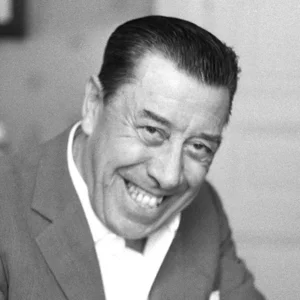

Actor, comedian, and singer born in Marseille in 1903, Fernandel is one of the greatest stars of French comic cinema. Famous for his radiant smile and beloved roles, he brought to life the character of Don Camillo in a series of films that have since become cult classics.
Fernandel(1903 — 1971)
Fernandel
France
8 min read
Frequently asked questions
Famous Quotes
« Laughter is the sun that drives winter from the human face.»
Key Facts
- Born on May 8, 1903 in Marseille under the name Fernand Contandin
- Started out in music hall in the 1920s before breaking through in cinema
- Portrayed Don Camillo from 1952 in the film series based on Giovanni Guareschi's novels
- Made over 150 films throughout his career
- Died on February 26, 1971 in Paris, leaving behind a major body of comic work
Works & Achievements
A Marcel Pagnol film in which Fernandel plays Saturnin, a naive and endearing farm hand. The role reveals his ability to blend comedy with emotion, and establishes him as a leading actor.
A comic song that became one of his greatest popular successes, showcasing his talent as a comedian-singer in the tradition of Marseille music hall. It remains closely associated with his image to this day.
A Marcel Pagnol film shot at the onset of the Occupation, in which Fernandel plays Felipe, a character who is both comic and deeply human in a story of war and love set in Provence.
The first film in the celebrated series adapted from Giovanni Guareschi's novels, in which Fernandel plays a stubborn village priest at odds with the communist mayor Peppone. The film was a resounding international success.
A comedy in which Fernandel plays five distinct roles, demonstrating the full range of his character-acting talent. The film was a massive box-office hit.
A Henri Verneuil film in which Fernandel plays a French soldier escaping from Germany with a cow. One of the greatest commercial successes in postwar French cinema, drawing over eight million admissions.
Fernandel's final film, shot despite his illness. A poetic story of an elderly Provençal farmer defending his horse against the march of progress, tinged with a particular melancholy bound up with his interpreter's twilight years.
Anecdotes
His real name was Fernand Joseph Désiré Contandin. The nickname "Fernandel" was given to him in childhood by his friends in Marseille — an affectionate, Provençal form of "Fernand." He kept it his entire life, to the point that even those closest to him rarely called him anything else.
Fernandel was famous for his extraordinary smile, which revealed teeth that journalists invariably compared to those of a horse. Far from taking offense, he turned it into his trademark. Marcel Pagnol said of him that all he had to do was smile and the audience would laugh before he had even opened his mouth.
The *Don Camillo* series, filmed mainly in the village of Brescello in Emilia-Romagna, gave rise to a genuine friendship between Fernandel and Italian actor Gino Cervi, who played the communist mayor Peppone. Although their characters were perpetually at odds on screen, the two men got along wonderfully and remained friends until Fernandel's death in 1971.
Fernandel made his stage debut at a very young age, accompanying his father — an amateur café-concert performer — at evenings in Marseille. By the age of fifteen, he was already performing in local shows, impersonating popular singers of the day. This hands-on training, far from any conservatory, forged in him an instinctive comic sense that resonated immediately with ordinary audiences.
In 1970, gravely weakened by lung cancer, Fernandel nonetheless appeared in Henri Colpi's *Heureux qui comme Ulysse*. He died in Paris on **26 February 1971**, leaving unfinished a sixth *Don Camillo* film he had been preparing. His passing was mourned as a national loss by millions of French people.
Primary Sources
«I was born in Marseille and I will remain a Marseillais at heart for the rest of my life. The South of France is a way of seeing things, of telling them. I could not act any other way.»
«Fernandel possesses something unique: the ability to make moving what is comic, and comic what is moving. That is the mark of the truly great.»
«M. Fernandel, in the role of Saturnin, is irresistibly true to life and hilarious. He creates a character who is at once grotesque and touching, one who will remain in the annals of French cinema.»
«When I saw Fernandel embody Don Camillo for the first time, I understood that my priest of paper had at last found his body. He is Don Camillo.»
Key Places
A working-class neighborhood of Marseille where Fernandel was born on May 8, 1903, and spent his childhood. It was in this Provençal, working-class environment that he developed his accent, his sense of humor, and his love of performance.
A famous music-hall venue in Marseille where Fernandel cut his professional teeth in the 1920s. The Alcazar was the great school of popular entertainment for generations of artists from the south of France.
Film studios founded by Marcel Pagnol on the Estaque plateau in Marseille, where several films uniting Pagnol and Fernandel were shot in the 1930s and 1940s. These studios embody the southern roots of Pagnol's cinema.
A village in northern Italy that served as the main setting for the Don Camillo film series. Fernandel stayed there on several occasions for filming, and the town still preserves a museum dedicated to the character today.
Fernandel settled in Paris after achieving national stardom, while never losing his attachment to Marseille. He died in the capital on February 26, 1971.
Typical Objects

Long black ecclesiastical garment worn by Fernandel throughout the entire Don Camillo series. The cassock has become inseparable from the character and from Fernandel's image in the public imagination.

Stand microphone used in cabarets and music halls of the 1920s–1950s, in front of which Fernandel sang his first comic songs. The object symbolizes the world of popular live entertainment in the pre-war era.

A device used on film sets to synchronize sound and image. Fernandel made more than 150 films between 1930 and 1970, making the clapperboard one of the most ever-present objects in his professional life.

A flat-brimmed straw hat with a ribbon band, emblematic of café-concert and music hall performers in the early twentieth century. Fernandel wore the boater in several comic routines during his early career in Marseille.

Large posters printed by lithography that adorned cinema facades. Fernandel's posters, often dominated by his distinctive grin, were among the most recognizable in French cinema from the 1930s to the 1970s.

A printed collection of song lyrics sold at newsstands, in which Fernandel published the words to his hits — "Ignace,
School Curriculum
Vocabulary & Tags
Key Vocabulary
Daily Life
Morning
Fernandel was known for his professional rigor: he was among the first to arrive on film sets, had learned his lines the night before, and had no tolerance for lateness. His mornings often began with a review of the press and a discussion with the director about the day's work.
Afternoon
Afternoons were devoted to filming, sometimes to dubbing or recording songs in the studio. Fernandel remained approachable and down-to-earth with technicians and actors in smaller roles. Between takes, he enjoyed joking around and telling Marseille stories to lighten the mood.
Evening
In the evenings, when he was not working, Fernandel would host friends or spend time with his family, to whom he was deeply devoted. A passionate football fan and supporter of Olympique de Marseille, he followed matches with great enthusiasm.
Food
Like many Southerners of his generation, Fernandel appreciated Provençal cuisine: bouillabaisse, aïoli, ratatouille, and grilled fish. His modest upbringing had given him a taste for simple, generous cooking, which he gladly rediscovered whenever he was back in Marseille.
Clothing
In everyday life, Fernandel dressed simply, without ostentation despite his fame. On stage or on screen, he wore whatever costumes his roles required: a cassock for Don Camillo, work overalls for his working-class characters, and city suits for his official appearances.
Housing
Fernandel divided his life between Paris — where he had an apartment in one of the upscale neighborhoods — and the Marseille region, to which he remained deeply attached. Unlike certain stars of his era, he did not flaunt an extravagant lifestyle and preferred to keep a low profile at home.