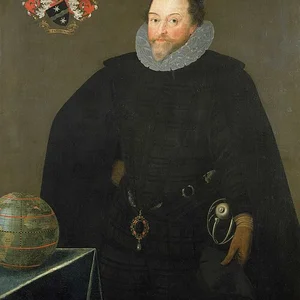

Francis Drake was an English privateer and navigator of the 16th century, famous for being the second person to circumnavigate the globe by ship (1577–1580). Vice Admiral of the English fleet, he played a decisive role in the defeat of the Spanish Armada in 1588.
Francis Drake(1540 — 1596)
Francis Drake
royaume d'Angleterre
8 min read
Frequently asked questions
Key Facts
- Born around 1540 in Tavistock, Devon (England)
- First Englishman to circumnavigate the globe (1577–1580), aboard the Golden Hind
- Knighted by Queen Elizabeth I in 1581 on the deck of his ship
- Vice Admiral during the defeat of the Spanish Armada in 1588
- Died on 28 January 1596 off Portobelo (Panama) during a Caribbean expedition
Works & Achievements
The second circumnavigation of the globe in history (after Magellan-Elcano), completed in 1,018 days. This voyage established English naval power and brought considerable wealth to the Crown.
Drake's first major operation against Spanish convoys in Panama. He intercepted a mule train carrying tons of silver from Peru, launching a career as a privateer in service of the English Crown.
Drake ravaged the Spanish ports of Santo Domingo and Cartagena de Indias, exposing the vulnerability of the Spanish colonial empire and contributing to the rise of English naval power.
A bold pre-emptive strike in the port of Cadiz that destroyed around thirty Spanish warships being fitted out, delaying Philip II's attempted invasion of England by a full year.
As Vice Admiral, Drake played a decisive role in the defeat of the Spanish fleet in the English Channel. His tactic of deploying fireships in the roadstead of Gravelines threw the Armada into disarray and contributed to its destruction.
Anecdotes
Francis Drake was the first Englishman to circumnavigate the globe, between 1577 and 1580, aboard the Golden Hind. This nearly three-year voyage earned him a knighthood from Queen Elizabeth I, conferred directly on the deck of his ship on April 4, 1581 — an exceptionally rare honor bestowed at sea.
The Spanish nicknamed him 'El Draque' and feared him as a pirate. King Philip II of Spain allegedly placed a bounty on his head worth the astronomical sum of 20,000 ducats — the equivalent of several million euros today — such was the damage his raids on Spanish coasts and convoys inflicted.
In 1587, Drake led a daring raid into the port of Cádiz and destroyed around thirty Spanish warships that were being fitted out. He himself described the operation as 'singeing the King of Spain's beard,' delaying the departure of the Spanish Armada by a full year.
During the battle against the Armada in 1588, Drake was reportedly playing bowls on Plymouth Hoe when the Spanish fleet was sighted. According to legend, he declared he had plenty of time to finish his game before going to defeat the Spanish — an anecdote likely apocryphal, but telling of the cool-headedness attributed to him.
Drake died of dysentery in January 1596 off Portobelo, Panama, during an expedition against Spanish colonial holdings. True to his life as a sailor, he was buried at sea in a lead coffin, as he had wished, in the depths of the Atlantic Ocean.
Primary Sources
The 5. day of June, wee were in 43. deg. and a halfe towards the pole Arctike, and found the ayre so colde, that our men being pinched with the same, complained of the extremitie thereof.
I have singed the King of Spain's beard. There must be a beginning of any great matter, but the continuing unto the end until it be thoroughly finished yields the true glory.
Drake is a man of short stature, sturdy, with blond hair tending toward red, a sharp gaze, a highly skilled navigator and very resolute in his undertakings.
The corsair Drake has plundered our ports, burned our ships, and pillaged our colonies in the West Indies with an audacity that cannot go unpunished and that undermines the dignity of the Crown of Spain.
Key Places
The home port from which all of Drake's major expeditions departed and returned. It was on Plymouth Hoe that he is said to have been playing bowls when he spotted the Spanish Armada in 1588.
A former abbey converted into a manor house, which Drake purchased in 1581 with the wealth he had amassed during his circumnavigation of the globe. It now houses the famous Drake's Drum and many other mementos of the navigator.
Drake navigated this treacherous passage at the southern tip of South America in 1578 during his circumnavigation. He accidentally discovered that an open passage lay even further south, now known as the Drake Passage.
A Spanish port town that Drake raided on several occasions to seize silver from Potosí. It was also here that he died of dysentery in January 1596 and was buried at sea.
A Spanish naval port that Drake boldly attacked in 1587, destroying around thirty ships being fitted out for war and delaying the sailing of the Spanish Armada by a full year.
Drake anchored in this bay in 1579 during his circumnavigation and claimed the territory in the name of Elizabeth I, naming it Nova Albion — the first English claim on the North American continent.
Typical Objects

An indispensable navigation instrument in the 16th century, the astrolabe allowed Drake to measure the altitude of the sun or stars to determine his latitude in open sea, far from any known coastline.

The compass guided Drake across unknown oceans. Combined with portolan charts, it was the essential tool of every Renaissance navigator.

Drake carried a ceremonial sword gifted by Elizabeth I, a symbol of his status as admiral and knight. He also wielded it during the boarding of Spanish ships.

Portolan charts were precious maritime maps, jealously guarded. Drake notably seized Spanish charts during his raids, giving him a considerable tactical advantage for navigating unknown waters.

The Golden Hind was armed with around twenty bronze cannons. These naval artillery pieces allowed Drake to attack Spanish galleons laden with gold and silver on the high seas.

A war drum that Drake is said to have taken with him on his circumnavigation of the globe. Now kept at Buckland Abbey, legend has it that the drum beats by itself whenever England is in danger.
School Curriculum
Vocabulary & Tags
Key Vocabulary
Tags
Daily Life
Morning
At dawn, Drake personally inspected his ship, checking the sails, rigging, and condition of the cannons. He consulted his nautical charts and astrolabe to calculate the ship's position and set the day's course. Sailors began their watch at sunrise under his direct orders.
Afternoon
Afternoons were devoted to active navigation: trimming the sails to the wind, scanning the horizon for enemy ships or unknown coastlines. In port, Drake conducted trade negotiations or planned raiding operations, meticulously mapping Spanish defenses.
Evening
In the evenings, Drake held council with his officers in his cabin by candlelight, planning the next day's operations. He was known for dining at the same table as his men — a rare practice for a commander — and for leading communal prayers, as Drake was a devout Protestant.
Food
On board, the diet was that of any 16th-century sailor: hardtack, salt-dried meat, fish, and beer (water spoiled quickly). In port or after a successful raid, Drake and his officers feasted on fresh meat, bread, wine, and spices taken from captured cargo.
Clothing
Drake wore the dress of an English gentleman of rank: a velvet or broadcloth doublet, breeches, and a starched ruff collar for formal occasions. At sea, he adopted the more practical attire of a naval officer — a doublet and leather boots — and put on a breastplate during combat and boarding actions.
Housing
At sea, Drake occupied the great cabin at the stern of the Golden Hind, relatively comfortable for the era, with his navigation table, chart chest, and trophies. On land, he lived at Buckland Abbey, a fine Devon estate he had purchased in 1581, a symbol of his remarkable rise from the son of a farmer to a knight of the Crown.
Historical Timeline
Period Vocabulary
Visual Style
Style Renaissance élisabéthaine, portraits d'apparat en armure et col fraisé sur fond de mer tempétueuse, couleurs profondes inspirées des maîtres flamands et des peintures navales de l'époque Tudor.
Sound Ambience
Ambiance sonore d'un galion anglais du XVIe siècle voguant entre l'Atlantique et le Pacifique, mêlant vie quotidienne des marins et tension des combats navals.
Liens externes & ressources
Références
Œuvres
Tour du monde à bord du Golden Hind
1577-1580
Expédition aux Antilles et en Amérique du Nord
1585-1586
Bataille contre l'Invincible Armada
1588