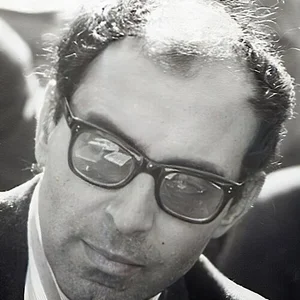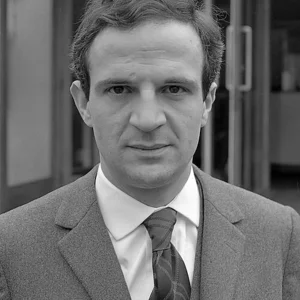

François Truffaut (1932–1984) was one of the pioneers of the French New Wave. A critic at *Cahiers du Cinéma*, he became an iconic filmmaker with movies such as *The 400 Blows* and *Jules and Jim*.
François Truffaut(1932 — 1984)
François Truffaut
France
9 min read
Frequently asked questions
Famous Quotes
« Cinema is truth twenty-four times per second.»
« A film must express either the joy of making cinema or the anguish of making cinema.»
Key Facts
- 1932: Born in Paris on February 6
- 1954: Begins as an influential critic at *Cahiers du Cinéma*
- 1959: *The 400 Blows* wins the Best Director Award at Cannes
- 1973: *Day for Night* wins the Academy Award for Best Foreign Language Film
- 1984: Dies on October 21 in Neuilly-sur-Seine
Works & Achievements
Truffaut's first feature film, autobiographical in nature, following young Antoine Doinel through working-class Paris. Winner of the Best Director prize at Cannes, it introduced the French New Wave to the world and remains one of the most influential French films in history.
An adaptation of an American noir novel by David Goodis, starring Charles Aznavour. A hybrid film blending comedy, drama, and thriller, emblematic of the New Wave's love of American genre cinema transplanted into a French setting.
A romantic drama starring Jeanne Moreau, tracing a Franco-German friendship tested by war and an impossible three-way love. Considered one of the greatest French films ever made, celebrated for its narrative freedom and lyricism.
A reconstruction of the true story of Victor of Aveyron, a feral child taken in by Dr. Itard in the 18th century. Truffaut himself plays the doctor, filming with a documentary restraint that sets the film apart from his earlier work.
A film about making a film — a declaration of love for cinema and the people who make it. Winner of the Academy Award for Best Foreign Language Film in 1974, it is Truffaut's most joyful and personal statement about his own craft.
A portrait of Victor Hugo's daughter, consumed by an obsessive, all-devouring passion. Isabelle Adjani delivers a shattering performance that reveals Truffaut's deep affinity for complex female characters and tragic destinies.
A drama set in a Parisian theater during the German Occupation, starring Catherine Deneuve and Gérard Depardieu. It swept the César Awards in 1981 with a record ten prizes, including Best Film and Best Director, making it Truffaut's greatest popular success.
Anecdotes
As a troubled teenager, François Truffaut regularly skipped school to spend his days in Parisian movie theaters. Caught by his father, he was placed in a juvenile reform center. This painful experience directly fed into his first feature film, The 400 Blows (1959), whose hero Antoine Doinel is his autobiographical alter ego.
Film critic André Bazin, co-founder of the Cahiers du Cinéma, took the young Truffaut under his wing and helped him get out of the detention center. Bazin became a surrogate father figure for him, passing on his passion and intellectual rigor. When Bazin died in October 1958, Truffaut dedicated The 400 Blows to him — the film premiered a few months later at Cannes.
In January 1954, Truffaut published a fiery article in the Cahiers du Cinéma titled “A Certain Tendency of the French Cinema.” In it, he launched a fierce attack on the cinéma de papa — those stiff literary adaptations he opposed to a living auteur cinema. This provocative text became the unofficial manifesto of the future New Wave.
In May 1968, at the Cannes Film Festival, Truffaut was one of the ringleaders of a spectacular act of protest: together with Godard and other filmmakers, he physically interrupted a screening by clinging to the theater curtains, in solidarity with the strikes and Parisian students. The festival was suspended — an unprecedented event in the history of world cinema.
In 1977, Steven Spielberg, a great admirer of Truffaut, offered him the role of French scientist Claude Lacombe in Close Encounters of the Third Kind. Truffaut, who was not a professional actor, accepted out of curiosity and delivered a performance that drew praise from international critics, bringing him even wider recognition in the United States.
Primary Sources
There is, then, a 'Tradition of Quality' that has earned the praise of foreign critics for ten years. These screenwriters, by adapting major literary works, believe they are paying homage to French literature. On the contrary, I think they betray its spirit by retaining only the psychological framework at the expense of a properly cinematic vision.
I wanted to make a book about Hitchcock that would be as technical as possible and, at the same time, reveal the man behind the films. Hitchcock is the only filmmaker in the world capable of filming and making us feel thought — a feeling, an abstract emotion — through the means of pure cinema alone.
A film is not made to be analyzed, but to be felt. Every film I have loved made me want to make films myself, and perhaps that is the definition of a cinephile: someone who loves cinema more than anything else.
What we were all searching for, in those years at the *Cahiers*, was a way of writing about cinema that was neither academic nor fashionable, but intimate and feverish — the way one might speak of a beloved person whose face one discovers anew each day.
Key Places
The neighborhoods where Truffaut grew up during a difficult childhood, between Pigalle and Montmartre. These working-class streets, their local cinemas, and their distinctive atmosphere left a deep imprint on the visual world of *The 400 Blows*.
The cinephile's temple founded by Henri Langlois, where the young Truffaut spent his days discovering films from around the world. It was here that he met Godard, Rivette, and Rohmer, the future directors of the French New Wave.
Truffaut triumphed here in 1959 with *The 400 Blows* (Best Director award), establishing the French New Wave on the international stage. In 1968, he helped bring about the festival's historic interruption in solidarity with the May 68 uprising.
Truffaut shot *Day for Night* (1973) here, among other films — a movie about the making of a movie that went on to win the Academy Award for Best Foreign Language Film. The location embodies his love for the filmmaking process itself.
The production company Truffaut founded in 1957, from which he managed his entire career in complete independence. Named in homage to Jean Renoir's film *The Golden Coach*, a director he deeply admired.