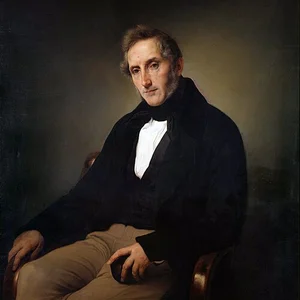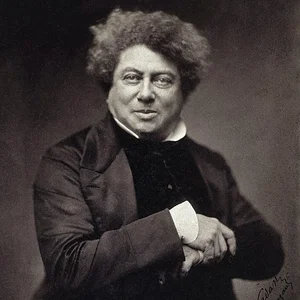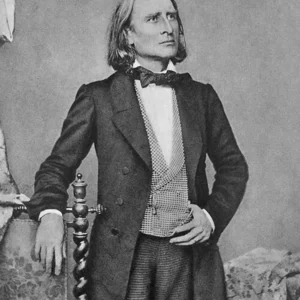

Hungarian composer and virtuoso pianist (1811–1886), Liszt revolutionized piano technique and invented the symphonic poem. A central figure of musical Romanticism, he profoundly influenced Wagner and European music as a whole.
Franz Liszt(1811 — 1886)
Franz Liszt
Autriche-Hongrie, empire d'Autriche, royaume de Hongrie
9 min read
Frequently asked questions
Famous Quotes
« Music is the language of God.»
« Genius is nothing but the greatest aptitude for patience.»
Key Facts
- 1811: Born in Raiding (Austrian Empire, present-day Hungary)
- 1823: Arrives in Paris and becomes a student of Czerny, then Salieri
- 1848–1861: Kapellmeister in Weimar, composes his major symphonic works
- 1865: Takes minor holy orders and becomes an abbé
- 1886: Dies in Bayreuth during the Wagner festival
Works & Achievements
A cycle of twelve piano études of extreme difficulty, considered the pinnacle of solo piano literature. They represent the synthesis of Liszt's technical revolution and bear evocative titles such as Mazeppa or Feux follets.
The most celebrated of the thirteen symphonic works that Liszt invented under the name "symphonic poem," an entirely new genre blending music and literature. Inspired by a poem by Lamartine, this work became the model for the entire genre up to Strauss and Debussy.
A monumental sonata in a single uninterrupted movement lasting thirty minutes, considered Liszt's absolute masterpiece. It radically renewed the sonata form and remains one of the most complex and most performed works in the piano repertoire.
A vast collection in three books inspired by Liszt's travels in Switzerland and Italy, illustrating landscapes, paintings, and poems through music. It is Liszt's most autobiographical work — a reflection on art, nature, and spirituality.
A set of nineteen pieces for piano inspired by Romani and Hungarian folk music, which became among the most performed and best-known works of Liszt. They helped bring Hungarian cultural identity to audiences across Europe.
A grand symphony in three movement-portraits — Faust, Marguerite, Méphistophélès — inspired by Goethe's masterpiece. It represents the pinnacle of Liszt's orchestral ambition and his constant dialogue between music and literature.
Anecdotes
The journalist Heinrich Heine coined the term “Lisztomania” in 1844 to describe the collective frenzy that seized audiences — mostly female — at Liszt’s concerts. Women fought over his gloves or cigar butts, and some wore his portrait in lockets. This phenomenon is considered one of the first modern forms of fan hysteria.
Liszt’s piano playing was so physically powerful that he regularly snapped strings mid-concert. The makers Érard and Bösendorfer had to reinforce their instruments especially for him. It is said that he sometimes went through two or three pianos in a single recital.
At 35, at the height of his fame as a virtuoso, Liszt made a stunning decision: he abandoned all commercial touring to devote himself to composition and teaching in Weimar. When he could have continued earning fortunes on stage, he chose instead to offer his lessons free of charge to young pianists who came from around the world.
In 1865, at the age of 53, Liszt received the minor orders of the Catholic Church and became “Abbé Liszt.” He now wore a black cassock, which astonished musical Europe. This sincere conversion did not prevent him from continuing to compose and teach, leading what he himself called his “trifurcated life” between Rome, Weimar, and Budapest.
Liszt was one of the first musicians to invent the solo recital as we know it today. Before him, concerts mixed multiple artists and genres. It was he who had the idea of taking the stage alone — sometimes with his back to the audience — to perform for an entire evening: a revolution in concert-going habits in the 19th century.
Primary Sources
Is the artist condemned to be nothing more than a public entertainer, a servant of the wealthy man's whims? We demand for him the dignity, the social recognition deserved by any man who devotes his life to an ideal.
I write to you from the depths of my dressing room, exhausted but elated. The Vienna audience gave me a twenty-minute ovation. And yet all of it feels empty without you, without our children, without the life we might have lived together.
Romani music is the very soul of Hungary. It is not learned — it is lived; it is not written down — it is felt. It is from this music that I drew the deepest accents of my Hungarian Rhapsodies.
I do not want to produce students who imitate me. I want to shape artists who think for themselves. Technique is merely a means: the goal is expression — it is life.
Key Places
Liszt's birthplace, now in Austria, where he was born into a modest German-speaking family. A house-museum there is dedicated to his memory, and an annual festival celebrates his work.
The city where the young Liszt trained and achieved his first successes, moving in the circles of Chopin, Berlioz, Hugo, and Lamartine. Paris was the crucible of artistic Romanticism that lastingly shaped his vision of art.
The cultural capital where Liszt served as ducal music director from 1848 to 1861, composing his greatest orchestral works and welcoming composers from across Europe. Weimar was the center of the “music of the future” movement.
Liszt lived here for several years after taking minor holy orders in 1865, composing numerous religious works and living in relative austerity at the Villa d'Este. The gardens of Tivoli inspired his celebrated Jeux d'eau à la Villa d'Este.
The capital of his Hungarian homeland, where Liszt founded the Royal Academy of Music in 1875 and was hailed as a national hero. He was one of the first to promote Hungarian musical culture on the international stage.
The city where Liszt died in 1886, during the Wagner Festival founded by his son-in-law. His death occurred in the very city devoted to the work of the composer he had championed, and whose festival his daughter Cosima now directed.
Typical Objects

Liszt was the foremost ambassador of the Érard firm, whose double-escapement pianos allowed rapid repetition of notes. He directly contributed to the technical evolution of the instrument by pushing its limits at every concert.

Liszt was an inveterate smoker, and his silhouette with a cigar at his lips is inseparable from his Romantic image. Entire boxes were gifted to him during his tours, and his admirers even collected his discarded cigar stubs.

After 1865, Liszt wore the black cassock of minor clerics, which became his instantly recognizable attire throughout musical Europe. This garment symbolized the tension between his life as a worldly artist and his deep spiritual aspirations.

Liszt composed and annotated at a prodigious speed, filling pages with corrections, expressive markings, and unprecedented fingerings. His manuscripts, often given as gifts to his students, are today invaluable documents on his musical thinking.

In Weimar, Liszt conducted the court orchestra for eleven years, premiering dozens of new works including those of Wagner and Berlioz. He was one of the first conductors to stand on a podium facing the musicians and to champion the works of his contemporaries.

Liszt wore white gloves which he removed with theatrical flair before sitting at the piano, creating an immediate dramatic effect on the audience. His female admirers would fight over these gloves left behind on stage, a symbol of his unprecedented celebrity.
School Curriculum
Vocabulary & Tags
Key Vocabulary
Daily Life
Morning
During his years as a traveling virtuoso, Liszt rose late after his evening concerts, often around ten o'clock. He devoted his mornings to correspondence — voluminous, in several languages — and to revising his scores. In Weimar and Rome, he rose earlier to attend Mass or pray before composing.
Afternoon
Afternoons were devoted to composition or teaching: in Weimar, many students crowded into his music room for masterclasses that lasted for hours. He accepted no payment from his students, considering the passing on of knowledge a sacred duty.
Evening
The evenings of his virtuoso period were taken up by concerts and fashionable receptions where he shone as much as a conversationalist as a musician. In Weimar, evenings could stretch until dawn in discussions about the “music of the future” with his composer friends.
Food
Liszt had an irregular diet, marked by the excesses of social life: lavish dinners at aristocratic households, fine wines and champagne at receptions. As he aged and drew closer to a religious life, he adopted simpler fare, though he always retained a weakness for cognac and Havana cigars.
Clothing
The young virtuoso Liszt sported clothing of theatrical elegance: a black tailcoat, a white shirt with a jabot, and white gloves that he removed in public with calculated theatricality. After 1865, the black abbé's cassock became his daily attire, creating a striking contrast between his clerical appearance and his reputation as a seducer.
Housing
In Weimar, Liszt lived in the Hofgärtnerei, a comfortable residence provided by the ducal court, where he received composers and princes in a Romantic setting filled with paintings and books. In Rome, he lived in an austere cell at the Madonna del Rosario on the Monte Mario, then at the Villa d'Este in Tivoli, whose gardens and fountains inspired him deeply.
Historical Timeline
Period Vocabulary
Visual Style
L'univers visuel de Liszt convoque le romantisme flamboyant des salons dorés du Second Empire et la solennité austère des appartements romains, entre lumière de bougie dorée et soutane noire d'abbé.
Sound Ambience
Les sons de l'univers de Liszt oscillent entre les tempêtes sonores du salon de concert parisien et le recueillement de la villa romaine, entre le fracas du virtuose et le silence méditatif de l'abbé compositeur.