
Geb is the Egyptian god of the Earth, son of Shu and Tefnut, and husband of Nut, the goddess of the sky. He belongs to the Ennead of Heliopolis and is the father of Osiris, Isis, Seth, and Nephthys.
Geb
Geb
9 min read
Frequently asked questions
Key Facts
- Geb is the god who personifies the Earth in the Egyptian cosmogony of Heliopolis
- He is depicted lying beneath Nut (the sky), separated from her by Shu (the air)
- As the father of Osiris, Isis, Seth, and Nephthys, he is the mythical ancestor of the pharaohs
- According to Egyptian tradition, his laughter causes earthquakes
- He is often depicted with a goose on his head, the animal sacred to him
Works & Achievements
By becoming the stable Earth after the separation brought about by Shu, Geb creates the livable space between ground and sky. This act is the founding cosmological event upon which all Egyptian life rests.
Geb is the third king of the divine lineage, succeeding Shu. His reign establishes the territorial and political order that all historical pharaohs would emulate by proclaiming themselves his rightful heirs over the Two Lands.
Geb acts as supreme judge in the conflict between his grandson Horus and his son Seth over the succession of Osiris. According to the Shabaka Stone, it is Geb who definitively rules in favor of Horus, establishing the legitimacy of every pharaoh.
In the form of a sacred goose, Geb lays the cosmic Egg from which the sun god Ra is born. This act makes him not only the father of the earthly gods, but also the symbolic progenitor of the light that governs the universe.
The solemn transfer of Geb's royal scepter to his son Osiris is the archetype of all legitimate succession in ancient Egypt. This mythological act was symbolically reenacted at every pharaonic coronation from the Old Kingdom onward.
Anecdotes
According to the Pyramid Texts, the god Shu violently tore Geb away from his wife Nut to create the space between Earth and Sky. From that day on, Geb lies stretched across the ground — sometimes depicted with his face turned toward the earth as a sign of mourning — while Nut arches over him in a great curve to form the vault of heaven. This painful separation is one of the founding acts of creation in Egyptian cosmology.
The Egyptians attributed earthquakes to Geb's laughter. When the ground rumbled and shook, priests explained that the god was amused, or that something was tickling his sides. This vivid image made the natural phenomenon both less terrifying and more relatable for the people living along the Nile Valley.
Geb is regarded as the first divine king of Egypt, before passing his throne to his son Osiris. Pharaohs claimed their legitimacy by proclaiming themselves 'heirs of Geb' — a consecrated formula carved into countless royal texts. This divine lineage guaranteed their absolute right to rule over the land of Egypt.
In the Heliopolitan cosmogony, Geb is associated with a sacred goose known as the 'Great Cackler.' Legend held that it was in this form that he laid the primordial Egg from which the sun god Ra was born, making Geb the symbolic father of light itself. Some texts identify him directly with this original bird.
During the funerary tribunal in the Duat, the deceased had to declare before Geb that he had not 'defiled the earth' — meaning he had committed no crime upon the god's earthly domain. Geb's goodwill was essential for the earth to accept the body of the dead, and for the soul to gain access to eternal life in the realm of Osiris.
Primary Sources
"O Geb, bull of the gods, your mother Nut embraces you as Atum. You are mighty, you are great." The texts invoke Geb as guarantor of royal resurrection and lord of the land of the living and the dead.
"I am Geb, Lord of the Earth. I am the ground upon which the gods set their feet. From me spring all the plants and all the seeds that nourish mankind."
"The heir of Geb is Osiris upon his throne, seated in the Duat." This passage establishes the divine chain of succession from Geb to Osiris, the archetype for all pharaonic royal legitimacy.
"Geb awarded the land to Horus and Seth, then settled their dispute and gave all of Egypt to Horus, son of Osiris, thus establishing the eternal order of the Two Lands."
"Hail to you, Geb, green-skinned god, whose laughter makes the hills tremble and whose breath nourishes the seeds buried within your generous belly."
Key Places
The main center of the Ennead cult, where the cosmogony placing Geb was codified. The priests of Ra developed a theology that positioned Geb at the heart of creation as the fourth primordial deity.
The Pyramid Texts carved in this tomb around 2350 BCE are the oldest written documents to mention Geb in detail. This site is the most valuable archaeological source for understanding his mythology.
The ancient administrative capital of Egypt, where the cult of Geb was intertwined with that of Ptah. Pharaohs claimed their title as heirs of Geb during coronation ceremonies, reenacting the primordial divine succession.
The sacred city of Osiris, son of Geb. Pilgrims came to honor the divine lineage descended from Geb, and Osirian rituals recalled that the earth of Abydos was the body of the earth god, who awaited and nourished the dead.
The realm of the dead located beneath the earth of Geb in Egyptian cosmology. Geb serves as its surface guardian, and the deceased had to cross his domain to reach the tribunal of Osiris and attain eternal life.
Typical Objects

The goose is Geb's totemic animal and his oldest symbol. In Heliopolitan cosmogony, this bird was said to have laid the primordial Egg containing the sun, making Geb the symbolic father of divine light.

Geb is sometimes depicted with a serpent on his head or in the form of a serpent, symbolizing the subterranean forces and mineral riches hidden within the belly of the earth. He thus embodies the cycle of life that emerges from the depths.

Plants grow directly from Geb's body in iconographic depictions, illustrating his role as god of earthly fertility. The wheat and barley that nourished the Egyptians literally sprang from his divine flesh.

As the first divine king of Egypt, Geb wields the was scepter, the emblem of royal power. It symbolizes his dominion over the land and his right to distribute that territory to his divine heirs, Osiris and Seth.

Geb is shown wearing the double crown of the pharaohs in several depictions, recalling his cosmic reign over Upper and Lower Egypt before passing power to his descendants. This headdress underscores his primacy as the first universal king.

The black silt deposited by the Nile flood onto Geb's earth — known as Kemet — is the sacred substance that made Egypt fertile. This dark mud, sometimes represented on ritual palettes, embodies the living, life-giving body of the god.
School Curriculum
Vocabulary & Tags
Key Vocabulary
Tags
Daily Life
Morning
At sunrise, when Ra emerges from the Duat to traverse the sky of Nut, Geb awakens and his earth-body receives the divine warmth that makes seeds germinate. In the temples of Heliopolis, priests offer libations of fresh water along with offerings of bread and onions drawn from the soil in homage to the god. Egyptian farmers begin their plowing by invoking his benevolence to bless the day's sowing.
Afternoon
At midday, Geb is present in every furrow carved by peasants along the Nile and in every underground gallery where miners extract copper from Sinai or gold from Nubia. The mineral riches belong to his belly and cannot be taken without his favor. In the palaces, royal scribes compose pharaonic titularies that solemnly recall the divine lineage between the king and Geb.
Evening
At sunset, when Ra plunges below the horizon to join the Duat, Geb welcomes within his depths the souls of that day's departed. Funerary priests recite spells from the Coffin Texts to ensure that the earth of Geb receives the buried bodies favorably. In the nocturnal silence, the earth god rests beneath the starry vault of his beloved Nut, waiting for dawn to separate them once more.
Food
Geb does not consume food as mortals do, but "receives" the vegetable offerings placed in his belly in the form of seeds, fruits, and grains. Wheat, barley, onions, figs, and bunches of grapes are the sacred foods associated with his nourishing generosity. The funerary offerings left in tombs were symbolically destined for him, to sustain the souls of the dead within his underground kingdom.
Clothing
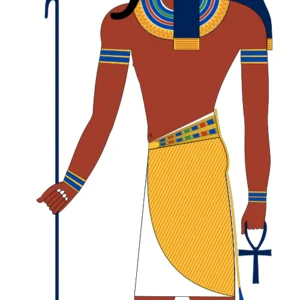
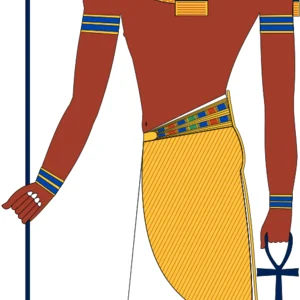
Geb is generally depicted nude or wearing a simple white linen kilt — the shendyt — an attribute of male gods in Egyptian iconography. On his head, depending on the context, he wears the sacred goose as a headdress, the white crown of Upper Egypt, or the double Pschent crown symbolizing his primordial kingship over the Two Lands. His dark green or black body reflects the color of the fertile earth after the life-giving Nile flood.
Housing
Geb's domain is the Earth itself: he does not dwell in a palace but is the ground, the mountains, the deserts, and the fertile fields of all Egypt. His most sacred space is the great temple of Heliopolis, where the Ennead was celebrated by initiated priests. In mythological topography, he reigns over the earth's surface while the Duat constitutes his depths — a kingdom he shares with his son Osiris.
Historical Timeline
Period Vocabulary
Visual Style
Style canonique de la peinture égyptienne de l'Ancien et du Nouvel Empire : silhouette allongée à la peau verte ou noire évoquant la terre fertile, ornée de plantes naissantes, sur une palette d'ocres profonds, de noirs nilotiques et d'ors divins.
Sound Ambience
Une atmosphère sourde et tellurique mêlant les grondements de la terre, le frémissement des cultures nilotiques après la crue et les chants graves des prêtres d'Héliopolis invoquant le dieu-sol primordial.
Liens externes & ressources
Références
Œuvres
Séparation de la Terre et du Ciel — Acte fondateur de la création
Zep Tepi (Temps Premiers, mythique)
Règne divin — Fondation de la royauté terrestre
Zep Tepi (Temps Premiers, mythique)
Arbitrage du conflit entre Horus et Seth
Après la mort d'Osiris (mythique)
L'Œuf primordial — Engendrement du soleil
Temps primordiaux (mythique)
Transmission du trône à Osiris
Temps des dieux (mythique)