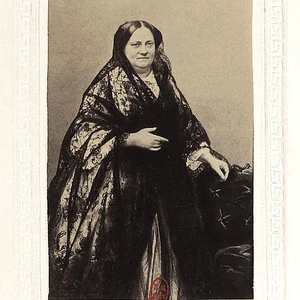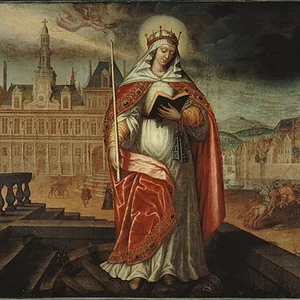

Christian saint born around 422, venerated for having protected Paris from Attila in 451 through her religious fervor. An advisor to Clovis I, she embodied the emerging alliance between the Church and Frankish royalty. Patron saint of Paris, her feast day is January 3.
Geneviève de Paris(423 — 502)
Geneviève de Paris
Empire romain d'Occident
8 min read
Frequently asked questions
Key Facts
- Around 422: born in Nanterre
- 451: she urges the Parisians not to flee from Attila and the Huns; Paris is spared
- Around 464–465: she organizes a river supply convoy for Paris, besieged by the Franks of Childeric I
- Late 5th century: she influences Clovis I and contributes to his embrace of Christianity
- Around 502: dies in Paris; a basilica is built over her tomb, later to become the church of Saint-Étienne-du-Mont
Works & Achievements
Organization of collective nights of prayer that convinced the Parisians to stay and preceded Attila's change of route. This episode is the founding act of Geneviève's role as protector of Paris and the heart of her legend.
Organization of a river supply operation using eleven boats loaded with grain to feed Paris while it was besieged by the Franks. This concrete act illustrates both the charitable and political dimensions of Geneviève's influence.
According to Gregory of Tours, Geneviève repeatedly obtained pardons for condemned prisoners from Clovis I, exercising a spiritual and moral influence that was unprecedented for a woman who had not been consecrated as an abbess.
Together with Clovis and Clotilde, Geneviève drove the construction of a great basilica on the hill of the Left Bank. Rededicated in her honor after her death, it became the main pilgrimage site in Paris until the 18th century.
An anonymous hagiography written a generation after her death, compiling accounts of miracles and deeds attributed to the saint. This text established the official cult of Geneviève and remains the primary source on her life and legend.
Anecdotes
At the age of seven, Geneviève met Saint Germanus of Auxerre as he was passing through Nanterre. According to hagiographic tradition, the bishop recognized in her one chosen by God and gave her a bronze coin engraved with a cross as a sign of divine election. He predicted that she would become the guardian of Paris — a prophecy that her entire life seemed to fulfill.
In 451, when rumors of Attila and his Huns' approach spread panic through Paris, Geneviève persuaded the inhabitants not to flee. She organized nightly prayer vigils in the churches, declaring that the city would be spared if the people kept their faith. Attila did indeed bypass Paris, heading instead toward Orléans — a detour immediately interpreted as a miracle granted through her prayers.
During the siege of Paris by Clovis around 486, the city suffered a severe famine. Geneviève is said to have organized a convoy of eleven boats traveling up the Seine from the granaries of Champagne, resupplying the besieged population. This perilous journey earned her a reputation as a woman of action as much as of prayer, inextricably linked to the Parisian river.
The Vita Genovefae recounts that a demon would regularly extinguish her candle during her solitary nightly vigils, and that an angel would immediately relight it. This symbolic spiritual struggle between darkness and light became the central image of her cult, and the candle remained her defining iconographic attribute throughout medieval art.
Geneviève maintained close ties with Clovis I and Clotilde: she interceded on several occasions to obtain clemency for those condemned to death, and helped persuade the king to build a basilica dedicated to Saints Peter and Paul. She was buried there in 502, alongside the Frankish king himself — symbolically sealing the alliance between the city's saintly protector and the nascent Christian monarchy.
Primary Sources
« Germanus episcopus vidit puellam in turba et interrogavit cuius filia esset. Parentibus respondentibus dixit : Benedictio Dei super hanc puellam ; scio enim spiritu quid futura sit. »
« Genovefa virgo, cuius sancta vita et multa miracula per totam Francorum patriam celebrabantur, pro captivis ad regem Chlodovechum intercessit et gratiam obtinuit. »
« Lux Parisiaca, columen fidei, Genovefa, cuius oratio barbarum hostem a moenibus avertit — nomen eius durabit quamdiu Sequana fluit. »
« Traditur quod anno CDLI, cum Parisienses fugam parabant ob adventum Hunnorum, virgo Genovefa eos exhortata est manere, promittens divina misericordia civitatem custodiendam esse. Eventus prophetiam confirmavit. »
Key Places
A Gallo-Roman village where Geneviève was born around 422–423 and met Saint Germanus of Auxerre. A basilica dedicated to her stands on the presumed site of her birthplace, where her cult has been active since the early Middle Ages.
A hill on the Left Bank of the Seine where the Basilica of Saints Peter and Paul was built, co-founded with Clovis I, in which Geneviève was buried. This medieval pilgrimage site is now occupied by the Panthéon.
The river used by Geneviève during her effort to resupply the besieged city of Paris: eleven grain boats sailed upstream from Champagne. The Seine is deeply intertwined with the image of the saint as protector of the city.
The site of the Battle of 451, where Aetius and Theodoric halted Attila's advance. Geneviève had predicted that Paris would be spared; the Roman victory confirmed this prophecy in hagiographic tradition.
The religious heart of the Île de la Cité, serving as the starting and ending point of major Parisian processions held in honor of Geneviève during the epidemics and floods that struck the city throughout the Middle Ages.
Typical Objects

The central iconographic attribute of Geneviève: according to the Vita Genovefae, a demon would extinguish her candle during her nightly vigils and an angel would relight it. The candle symbolizes her inextinguishable faith in the face of the powers of darkness.

Given to her by Saint Germanus of Auxerre when they met in Nanterre, this coin symbolized the young girl's divine election. According to the Vita, Geneviève wore it throughout her life as a spiritual talisman.

In medieval hagiography, Geneviève's cloak is associated with several miracles of healing and protection. Preserved as a relic in the basilica dedicated to her, it was venerated by Parisian pilgrims.

The eleven boats laden with grain sailing up the Seine represent Geneviève's concrete action in service of the people. The image of the river convoy has remained in collective memory as a symbol of her active charity.

After her death, Geneviève's relics were enshrined in a gold and silver casket carried in procession through Paris during great calamities — epidemics, flooding of the Seine — until the French Revolution.

Instruments of bodily penance that Geneviève reportedly wore throughout her life, according to medieval chroniclers, attesting to a rigorous asceticism in keeping with the ideal of consecrated virgins of Late Antiquity.
School Curriculum
Vocabulary & Tags
Key Vocabulary
Daily Life
Morning
Geneviève rose before dawn to recite Lauds in a cold, dark oratory or basilica. She practiced extended fasting — eating, according to tradition, only two or three times a week — and devoted the early hours of the day to silent prayer and meditation on Scripture.
Afternoon
Her afternoons were dedicated to practical works of charity: visiting the poor and the sick, distributing bread, and organizing relief for prisoners and the most destitute. She also guided a group of consecrated virgins gathered around her, forming an informal proto-religious community for women.
Evening
Her evenings stretched into long nocturnal vigils, sometimes lasting until dawn, with Geneviève praying alone by candlelight in an empty church. These night watches — at the heart of which legend places the episode of the demon and the angel — earned her a reputation as an exceptional woman of prayer.
Food
According to hagiographic sources, Geneviève followed a strict dietary asceticism: she abstained from meat, wine, and oil, subsisting on barley bread, legumes, and water. She broke her fasts only on major liturgical feasts such as Easter and Christmas.
Clothing
She wore plain coarse wool clothing, likely dark in color (dark blue or brown), and a white veil symbolizing her virginal consecration. Medieval iconography invariably depicts her in a dark cloak and light veil, with a candle as her distinctive attribute, setting her apart from all other saints.
Housing
Geneviève lived in a simple cell or house near the places of worship in Paris, without any particular comfort. She had renounced all material possessions from a very young age and likely shared her life with other consecrated virgins in a primitive form of communal religious life, predating the monastic institution.
Historical Timeline
Period Vocabulary
Visual Style
Enluminure mérovingienne d'inspiration byzantine : vierge au cierge auréolée d'or sur fond de pierre romane, palette de bleu cobalt, ivoire et or, style hiératique et symbolique propre à l'art chrétien du haut Moyen Âge.
Sound Ambience
Ambiance sonore de la rive gauche parisienne au début du VIe siècle : chant grégorien, cloches d'église, bruits du fleuve et murmures de prières latines dans la pénombre des basiliques mérovingiennes.
Liens externes & ressources
Références
Œuvres
Vigile de prières contre Attila
451
Convoi de blé sur la Seine
c. 475-486
Intercessions auprès de Clovis pour les prisonniers
c. 490-500
Fondation de la basilique Saint-Pierre-Saint-Paul
c. 500-511
Vita Genovefae (Vie de sainte Geneviève)
vers 520