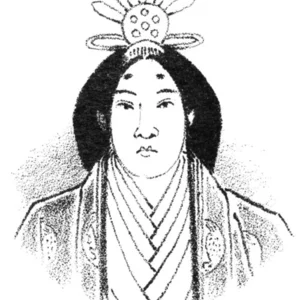

Reigning empress of Japan from 707 to 715, Genmei is one of the few women to have held supreme power in Japan. She is notably responsible for commissioning the Kojiki, Japan's first historical chronicle.
Frequently asked questions
Key Facts
- 707: ascended the throne as reigning empress following the death of Emperor Monmu
- 712: commissioned and oversaw the compilation of the Kojiki, Japan's first historical chronicle
- 715: abdicated in favor of her daughter, Empress Genshō
- Her reign was marked by the transfer of the capital to Nara (710)
Works & Achievements
On Genmei's orders, the scribe Ō no Yasumaro transcribed the oral recitations of Hieda no Are and produced the Kojiki, Japan's first historical and mythological work. This foundational text recounts the birth of the Japanese islands and the imperial genealogy tracing back to the gods.
Genmei ordered the construction and relocation of the capital to Heijō-kyō, designed after the model of Chang'an. This decision would inaugurate 84 years of occupation of the site and give rise to the Nara period, the classical age of Japanese civilization.
Following the discovery of copper in Musashi Province, Genmei had Japan's first official coins struck. This monetary reform aimed to unify economic exchange and strengthen the authority of the central state.
Genmei issued an edict ordering each province to compile geographical and ethnographic records. The surviving fragments — most notably the Izumo Fudoki — are a valuable source for the social and cultural history of early Japan.
The Taihō Code, promulgated under Emperor Monmu in 701, was put into practice and consolidated during Genmei's reign. This Tang-inspired penal and administrative code defined the structure of the Japanese state for centuries to come.
Anecdotes
In 712, Genmei ordered her scribe Ō no Yasumaro to transcribe in writing the ancient tales that Hieda no Are had memorized years earlier. The result was the Kojiki (古事記, 'Record of Ancient Matters'), the oldest surviving work written in Japanese, recounting the myths of Japan's origins and the genealogy of emperors from the founding deities.
In 708, following the discovery of a copper deposit in Musashi Province (present-day Tokyo region), Genmei decided to mint Japan's first official currency. The Wadō kaichin (和同開珎) — round copper coins with a square central hole, modeled on Chinese coinage — were circulated throughout the archipelago, marking a decisive turning point toward a centralized monetary economy.
In 710, Genmei moved the capital from Fujiwara-kyō to Heijō-kyō, on the site of present-day Nara. This new capital was built on the grid plan of Chang'an, the great metropolis of Tang China, with an imperial palace to the north and broad, structured avenues. This decision inaugurated the Nara period, an era of intense cultural and political flourishing for Japan.
In 713, Genmei issued an edict ordering each province to compile Fudoki (風土記), geographical records describing natural resources, local legends, and the etymologies of place names. These documents remain an invaluable source for understanding daily life and the traditions of the archipelago at the beginning of the 8th century.
Genmei is one of eight reigning empresses in Japanese history. After the premature death of her son Emperor Monmu in 707, she took the reins of power at the age of 46. When she abdicated in 715, she passed the throne to her own daughter, Empress Genshō — one of the rare examples in world history of two women succeeding each other directly at the head of state.
Primary Sources
Her Majesty the Empress commanded: "I have learned that the imperial chronicles transmitted among the various families have already departed from the truth. If these errors are not corrected now, their meaning will be lost before many years have passed." She therefore ordered that the stories memorized by Hieda no Are be written down and presented to the court.
In the first month of the third year of Wadō [710], the court was transferred to the palace of Nara. The city was built following the model of Tang China, and the empress took up residence in the new Heijō Palace to govern the empire.
In the fifth month of the sixth year of Wadō [713], an imperial edict was issued: each province was to compile a Fudoki recording its local products, the etymology of district and village names, the fertility of the land, and any notable traditions and legends handed down from ancient times.
In the first year of Wadō [708], copper was discovered in the province of Musashi. As a mark of good omen, the era was renamed "Wadō" (harmonious copper). Coins were minted and put into circulation throughout the country to facilitate trade and strengthen central authority.
In the beginning, when heaven and earth separated, the deities who came into being in the Plain of High Heaven were Ame-no-Minakanushi, then Takamimusubi, then Kamimusubi. These three deities were born alone and immediately hid themselves from sight.
Key Places
Capital founded in 710 by Genmei, built on a grid plan modeled after Chang'an, with the imperial palace to the north and wide boulevards. It remained Japan's capital for 84 years and lent its name to one of the most brilliant periods in Japanese civilization.
The residential and administrative palace complex in northern Nara, where Genmei lived and ruled from 710 to 715. Partially restored, the site is now a UNESCO World Heritage Site.
Japan's previous capital, founded in 694 by Empress Jitō, which Genmei left in 710 in favor of Nara. Its ruins stand as evidence of Japan's first attempt at a planned metropolis modeled on Chinese urban principles.
The political cradle of imperial Japan, home to successive courts since the early 7th century. Genmei spent part of her youth here, and it was in Asuka that the tradition of centralized monarchy she carried forward was forged.
The burial site of Genmei, located north of Nara. This burial mound (kofun) holds the remains of the empress, who died in 721.
Typical Objects
Japan's first official currency: a round copper coin with a square hole in the center, minted in 708 on Empress Genmei's orders. These coins symbolize her determination to modernize the Japanese economy, drawing inspiration from the Tang dynasty's monetary model.

Essential instruments at the imperial court of Nara, used to draft imperial edicts, chronicles, and the geographical surveys commissioned by Genmei. The paper (washi) was produced in Japan using techniques learned from China.

Small wooden planks inscribed with ink, used as administrative records and official court communications. Thousands of mokkan unearthed at Nara offer direct evidence of the active bureaucracy that flourished during Genmei's reign.

An object of prestige and symbol of divine authority, and one of the three Imperial Treasures of Japan. Genmei's court distributed finely decorated mirrors as diplomatic gifts and tokens of imperial favor.

A set of silk robes worn in multiple layers, with borders of different colors creating a visible gradient at the cuffs and neckline. This aesthetic of layered colors is characteristic of the emerging court fashion at Nara.

A ceramic or bronze vessel used to burn incense during Buddhist ceremonies at court. With Buddhism serving as the state religion under Genmei, incense rituals marked the daily rhythm of life at Heijō Palace.

An official stamp engraved with the imperial emblem, affixed to state edicts. It is Genmei's seal that formally authorized the compilation of the Kojiki, the minting of the first coins, and the transfer of the capital to Nara.
School Curriculum
Vocabulary & Tags
Key Vocabulary
Daily Life
Morning
Genmei rises at dawn in her apartments in Heijō Palace. Ladies-in-waiting assist her with ritual ablutions and dress her in layered silk robes. She then presides over the palace's morning ceremony, during which Buddhist monks chant sutras for the prosperity of the empire.
Afternoon
In the afternoon, Genmei holds audiences with her senior ministers and the heads of the Daijō-kan (Council of State) to conduct routine affairs: rice tax collection (koku), provincial administration, and oversight of the capital's construction projects. She also devotes time to reviewing imperial edicts before authenticating them with her seal.
Evening
In the evening, the court gathers for banquets accompanied by gagaku music — koto, biwa, flutes, and drums. Poems are exchanged according to court custom, and readings of classical Chinese texts are held. Before retiring, Genmei performs a final Buddhist prayer by oil lamps in the palace's private devotion hall.
Food
The diet of the Nara court centers on steamed white rice (gohan), served with pickled vegetables (tsukemono), dried or grilled fish, seaweed, and miso broth. Rice sake is consumed at banquets. Flavors are delicate and mildly seasoned; fruits such as persimmons and chestnuts complement meals according to the season.
Clothing
Genmei wears an ensemble of layered silk robes whose differently colored borders create a gradient visible at the wrists and neckline — an aesthetic known as kasane no irome. Her ceremonial dress includes an elaborate hairstyle held in place by lacquered and metal pins, all fashioned from silks dyed with indigo, saffron, or madder.
Housing
Genmei resides in Heijō Palace (平城宮), a vast complex of cypress-wood pavilions with curved gray-tiled roofs, surrounded by gardens and covered corridors. The interior walls are adorned with paintings of floral motifs and colorful clouds. Rooms are divided by painted silk folding screens (byōbu), and the floors are covered with polished wooden planks.
Historical Timeline
Period Vocabulary
Visual Style
Art de cour de la période de Nara sous influence Tang : compositions hiératiques en pigments minéraux sur soie, robes superposées aux couleurs dégradées, architecture laquée vermillon et blanche, dorures bouddhistes et calligraphie à l'encre sur fond ivoire.
Sound Ambience
Atmosphère sonore du palais de Heijō : musique de cour gagaku aux instruments à vent et à cordes, chants bouddhistes des moines du palais, bruits feutrés des scribes sur le plancher de bois verni, ponctués par les cloches de bronze des cérémonies rituelles.
Liens externes & ressources
Références
Œuvres
Compilation du Kojiki (古事記)
712 (Wadō 5)
Transfert de la capitale à Heijō-kyō (Nara)
710 (Wadō 3)
Émission des Wadō kaichin (和同開珎)
708 (Wadō 1)
Édit de compilation des Fudoki (風土記)
713 (Wadō 6)
Consolidation et application du Code Taihō
707-715