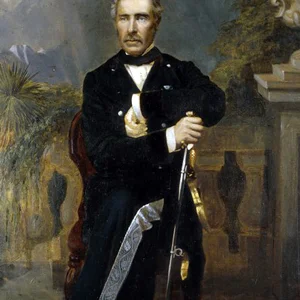

British colonial governor and ethnologist, George Grey successively administered South Australia, New Zealand, and the Cape Colony. Passionate about indigenous cultures, he devoted part of his life to collecting and publishing Māori myths and language.
George Grey(1812 — 1898)
George Grey
Royaume-Uni de Grande-Bretagne et d'Irlande
8 min read
Frequently asked questions
Key Facts
- 1812: Born in Lisbon, Portugal
- 1845–1853: Governor of New Zealand, key role in the Māori Wars
- 1854: Publication of 'Polynesian Mythology', a foundational collection of Māori myths
- 1861–1867: Prime Minister of New Zealand
- 1898: Died in London
Works & Achievements
Account of his two exploratory expeditions into Western Australia, then largely unknown to Europeans. The work contains the first detailed descriptions of Aboriginal rock paintings (Wandjina figures) and local fauna and flora.
The first major collection of Māori songs, laments, and proverbs transcribed in the original language. This pioneering philological work remains a key reference source for researchers in Polynesian culture.
A collection of Māori traditions, myths, and genealogies gathered from numerous indigenous informants. It meticulously documents creation narratives and divine figures from the Māori pantheon.
A masterpiece of Victorian ethnology on Māori cosmogony and mythology, widely circulated in Europe. The first work to introduce Western audiences to the richness of the Polynesian mythological system, including the figures of Maui, Ranginui, and Papatūānuku.
A dictionary and linguistic guide to the principal languages spoken in the Cape Colony, written during his tenure as governor of South Africa. A testament to Grey's intellectual curiosity about all the indigenous cultures under his administration.
Anecdotes
George Grey mastered the Māori language so thoroughly that he could speak directly with indigenous chiefs without an interpreter — an exceptionally rare feat among colonial governors of his era. This skill allowed him to forge unprecedented diplomatic ties with iwi (tribes) that harbored deep mistrust of the British.
During his expeditions in Western Australia (1837–1839), Grey was seriously wounded by an Aboriginal spear during a confrontation. Despite his injuries, he continued to record the oral traditions and vocabulary he heard, refusing to abandon his field notebooks even in a critical state.
Grey purchased Kawau Island in the Hauraki Gulf (New Zealand) and transformed it into an extravagant private estate: he had wallabies imported from Australia, zebras from Africa, and kookaburras, creating a veritable subtropical private zoo that astonished all his visitors.
A passionate collector of rare books, Grey assembled one of the largest private libraries in the Southern Hemisphere — over 5,000 volumes, including unique Māori manuscripts and Polynesian texts. He eventually donated them to the public libraries of Auckland and Cape Town, believing that such knowledge belonged to everyone.
Elected Prime Minister of New Zealand in 1877 at the age of 65, Grey championed positions that were progressive for the time: he advocated for universal male suffrage, land reform in favor of small landowners, and greater inclusion of the Māori in New Zealand civic life.
Primary Sources
We found the natives in a state of great excitement… I endeavoured, by means of a few words of their language which I had acquired, to calm their fears and explain our friendly intentions.
The mythology of the New Zealanders is not a mere collection of wild and fantastic legends; it forms a regular and well-defined system, bearing evident marks of great antiquity.
These songs carry the memory of the ancestors, the genealogies of the great families, and the founding events of the Māori nation, preserved from generation to generation through oral tradition.
The Maori people possess a civilization, a literature, and a social organization far more developed than is generally admitted in England. To govern them justly, one must first endeavour to understand them.
Key Places
Capital of New Zealand where Grey served as governor during both his terms (1845–1853 and 1861–1868). It was from Government House that he pursued his ambivalent policies, oscillating between military repression and dialogue with Māori chiefs.
A private island purchased by Grey in 1862, transformed into a retirement residence and personal nature reserve. He had Mansion House built there and imported exotic animals from around the world, making it an exceptional place that revealed much about his extraordinary personality.
The city where Grey served as Governor of the Cape Colony from 1854 to 1861, navigating the competing interests of the Boers, the British, and the Xhosa people. He continued his ethnological work there, studying the languages and traditions of local populations.
The starting point for Grey's exploration expeditions (1837–1839) into the Australian interior. It was during these journeys that he discovered Aboriginal rock paintings (Wandjina figures) and began developing his deep interest in indigenous cultures.
The city where Grey donated his celebrated library of 5,000 volumes in 1884. The Grey Collection, held at the Auckland Central Library, remains one of the most valuable archives on Polynesian cultures and the Pacific.
Liens externes & ressources
Références
Œuvres
Journals of Two Expeditions of Discovery in North-West and Western Australia
1841
Ko nga Moteatea, me nga Hakirara o nga Maori
1853
Ko nga Mahinga a nga Tupuna Maori
1854
Polynesian Mythology and Ancient Traditional History of the New Zealand Race
1855
A Key to the Kafir, Fingo, Koranna and Hottentot Languages
1858