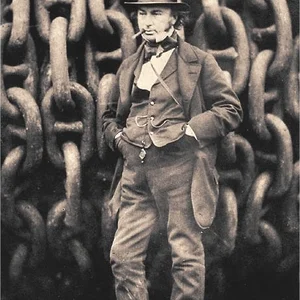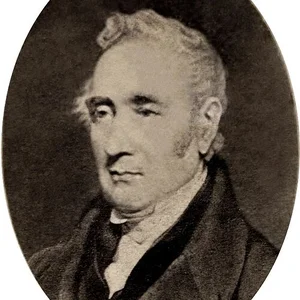

British engineer (1781–1848), George Stephenson is the father of the railway. He built the first efficient steam locomotive for passenger transport and designed the Liverpool-Manchester line, inaugurated in 1830.
George Stephenson(1781 — 1848)
George Stephenson
Royaume-Uni de Grande-Bretagne et d'Irlande
9 min read
Frequently asked questions
Key Facts
- 1781: born in Wylam, Northumberland, into a working-class family
- 1814: construction of his first locomotive, the Blücher, for the Killingworth collieries
- 1825: opening of the Stockton-Darlington line, the first public railway in the world
- 1829: his locomotive Rocket wins the Rainhill Trials at 47 km/h
- 1830: opening of the Liverpool-Manchester line, the first intercity passenger railway
Works & Achievements
The first locomotive built by Stephenson at the Killingworth Colliery, capable of hauling 30 tons of coal. It marked his debut as a railway engineer and allowed him to refine his construction techniques.
An independent invention of a shielded-flame lamp for working in coal mines without risk of explosion. It reflects Stephenson's concern for the safety of the workers he had lived alongside since childhood.
The first steam-powered railway line opened to the public, designed and built under Stephenson's direction. It demonstrated the economic viability of rail transport and triggered the railway revolution in Great Britain.
A technological masterpiece built with his son Robert for the Rainhill Trials. The Rocket introduced the multi-tube boiler and the steam blast up the chimney — innovations that became the foundation of all subsequent steam locomotives.
The first intercity railway line operated entirely by steam traction on a commercial basis. Its resounding success convinced the entire world of the future of rail travel and launched the construction of the British rail network.
The world's first locomotive manufacturing factory, established in Newcastle-upon-Tyne with his son Robert. It produced dozens of locomotives for the earliest railway networks and exported its engines across the globe.
Anecdotes
George Stephenson was born into a miner's family so poor that he could not afford to go to school. He learned to read and write on his own, at the age of 18, by attending evening classes after his long days working in the mine. This determination earned him the admiration of his contemporaries, who saw in him the very symbol of success achieved through merit and hard work alone.
In 1829, during the famous Rainhill Trials, Stephenson had to prove that his locomotive deserved a place on the Liverpool–Manchester line. His locomotive, named the Rocket, reached the spectacular speed of 47 km/h, astonishing spectators who believed it was impossible to exceed 30 km/h. The Rocket won the competition by a wide margin, and its designer was definitively recognized as the master of the railway.
During the triumphant inauguration of the Liverpool–Manchester line on 15 September 1830, a tragedy cast a shadow over the celebrations: William Huskisson, a former cabinet minister and Member of Parliament, stepped off the train to greet Stephenson and was struck by the Rocket locomotive arriving on the parallel track. He died from his injuries that same evening, becoming the first official victim of a railway accident — an event that shocked public opinion while at the same time revealing the formidable speed of the new machines.
In 1815, Stephenson independently invented a safety lamp for miners — separately from the work of the famous Sir Humphry Davy — allowing them to work without risking an explosion from firedamp. The dispute over priority between the two inventors was fierce, but Stephenson demonstrated that he had worked entirely alone, without any knowledge of Davy's research, illustrating how a practical genius could rival the greatest academic scientists.
Stephenson imposed a gauge of 1,435 mm — that is, 4 feet and 8½ inches — on all his railways, simply carrying over the gauge used by the old mine wagons of northern England. This empirical choice, mocked by some engineers, became the standard gauge adopted by more than 60% of the world's railway network. It is still known today as the Stephenson gauge.
Primary Sources
Stephenson defended his line against sceptical engineers, asserting that he could build the route and run locomotives along it at speeds his opponents dared not imagine. The committee, unconvinced by his demonstrations, rejected the project a first time.
Technical memoir describing improvements made to the boiler mechanism and the transmission of steam to the driving wheels, aimed at increasing the power and regularity of traction on the railway.
"Mr. Stephenson's Rocket locomotive completed the course at a sustained speed of 29 mph, with no mechanical failure whatsoever, hauling a load of nearly 13 tons. The judges unanimously award it the prize of £500."
"I am convinced that we can run locomotives on this route that will make the transport of coal less costly than by any other known means. Give me the means to build, and I will give you the results."
Key Places
George Stephenson's birthplace, a mining village where he was born in 1781 in a modest single-room cottage. The house is now preserved as a historic site by the British National Trust.
It was at this coal mine that Stephenson worked as chief engineer and in 1814 built his first locomotive, the Blücher, on the tracks used to haul coal down to the river.
Site of the famous Rainhill Trials of October 1829, where the locomotive Rocket triumphed over its rivals before thousands of spectators, decisively opening the way for the railway revolution.
The first inter-city railway to operate entirely by steam power, inaugurated on 15 September 1830. Stretching 56 km, it linked two major industrial cities and revolutionised the transport of passengers and goods across Britain.
The town connected to Darlington by the world's first public steam railway, inaugurated in 1825. The 40 km line designed by Stephenson proved the economic viability of rail transport.
A large Georgian mansion acquired by Stephenson in 1838, a symbol of his rise in society. He fitted it with greenhouses and a garden, and died there on 12 August 1848 after spending his final years in residence.
Typical Objects

The locomotive was Stephenson's masterwork. From the Blücher (1814) to the famous Rocket (1829), he continuously refined the boiler, steam distribution, and drive mechanism to achieve power and reliability on the railways.

Stephenson designed and standardised the wrought-iron rails of his network, fixing the gauge at 1,435 mm. This measurement, adopted worldwide, bore his name and became the international standard gauge still in use today.

Invented in 1815 for miners, this lamp featured a flame shielded by a metal screen that allowed workers to see in underground tunnels without igniting firedamp. It was nicknamed the Geordie lamp by miners in the north of England.

A decisive innovation in the Rocket, this boiler was threaded with numerous small tubes that greatly increased the heat exchange surface. Designed with his son Robert, it allowed steam pressure to build far more rapidly, multiplying the available power tenfold.

To lay out his lines through hills and marshes, Stephenson used theodolites and surveyor's levels that he taught himself to handle in the field, personally carrying out the land surveys for his major routes.

Before passenger trains, Stephenson's locomotives hauled these heavy wooden and iron wagons loaded with coal in the mines. It was these industrial demands that drove all his early research into mechanical traction.
School Curriculum
Vocabulary & Tags
Key Vocabulary
Tags
Daily Life
Morning
Stephenson rose very early, having grown accustomed since childhood to the schedules of the mines. During construction periods, he would inspect the works at dawn, speaking directly with the navvies and masons, checking the progress of tunnels, viaducts, and embankments — sometimes on horseback along miles of track under construction.
Afternoon
His afternoons were devoted to technical calculations, meetings with his partners, and negotiations with landowners who refused to allow railway lines across their property. In the workshop, he supervised the construction of locomotives, modifying on the spot any parts that did not satisfy him, his hands often black with grease and coal dust.
Evening
In the evenings, Stephenson entertained partners and investors at his table, winning over sceptics to fund his projects. Despite the wealth that came late in life, he remained a man of the field: he loved to recount his years as a miner, and went to bed early, worn out by days that had begun long before dawn.
Food
Like many working men who grew wealthy through the Industrial Revolution, Stephenson favoured plain, hearty food: roast meats, potatoes, bread, and cheese. Once settled at Tapton House, he became passionate about gardening and grew pineapples and grapes in his greenhouses — a source of pride for a man who had owned nothing as a child.
Clothing
On construction sites as in drawing rooms, Stephenson wore the dress of Victorian engineers and foremen: a dark frock coat, waistcoat, cravat, and top hat. This polished appearance allowed him to be received in business circles and to appear before Parliament, while still commanding authority over his working crews.
Housing
Born in a one-room cottage in Wylam, Stephenson purchased Tapton House in 1838 — a large Georgian mansion near Chesterfield — as a symbol of his meteoric rise in society. He fitted it out with greenhouses and gardens, enjoying middle-class comforts for the first time after decades spent in makeshift lodgings on his construction sites.
Historical Timeline
Period Vocabulary
Liens externes & ressources
Références
Œuvres
Locomotive Blücher
1814
Lampe de sécurité pour mineurs (Geordie lamp)
1815
Chemin de fer Stockton-Darlington
1825
Locomotive Rocket (avec Robert Stephenson)
1829
Chemin de fer Liverpool-Manchester
1830
Fondation de Robert Stephenson and Company
1823