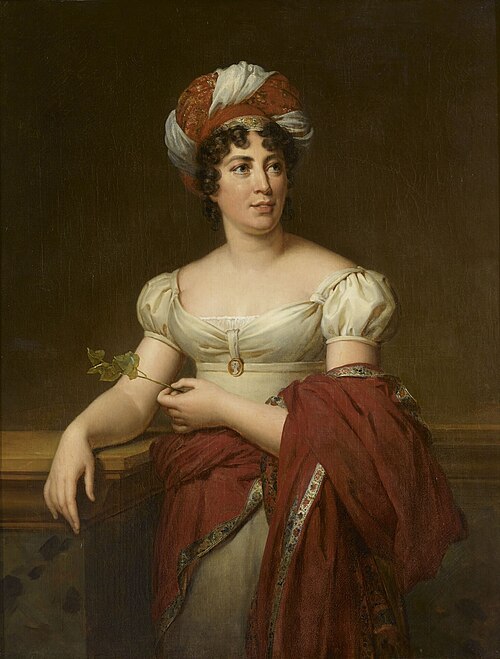
Germaine de Staël
Germaine de Staël
1766 — 1817
royaume de France, république de Genève
Franco-Genevan woman of letters (1766-1817), daughter of finance minister Necker. Novelist, essayist, and salon hostess, she opposed Napoleon and theorized European Romanticism in De l'Allemagne.
Famous Quotes
« Liberty is ancient; it is despotism that is new. »
« One becomes moral by performing moral actions. »
Key Facts
- 1766: Born in Paris, daughter of Jacques Necker, Genevan banker and future minister to Louis XVI
- 1788: Opens her salon on the Rue du Bac, which becomes a major intellectual and political hub
- 1800: Publication of De la littérature, linking literary genius to political institutions
- 1810: Napoleon orders the seizure and destruction of De l'Allemagne, a founding work of French Romanticism
- 1817: Dies in Paris after helping to spread liberal ideals across Europe
Works & Achievements
Her first published essay, revealing her admiration for Rousseau and launching an engaged writing career at just twenty-two years old.
A pioneering work that for the first time linked literary output to political and social contexts, laying the groundwork for a sociology of literature.
An epistolary novel championing female emancipation and freedom of conscience that scandalized conservative society and drew the wrath of Napoleon.
A masterpiece of fiction centered on a woman of genius misunderstood by society, considered one of the first great feminist novels in European literature.
A landmark essay that introduced French readers to German philosophy and literature, theorized Romanticism, and stood as a manifesto for intellectual freedom against Napoleonic despotism.
A political assessment of the French Revolution defending liberal and constitutional ideals, published after her death and highly influential on nineteenth-century liberalism.
An autobiographical account of her years of flight and exile under the Empire, serving as both a historical document and a literary testament to Napoleonic persecution.
Anecdotes
Napoleon Bonaparte deeply despised Germaine de Staël and considered her one of his most dangerous enemies. When she once asked him who he thought was the greatest woman in history, he replied: 'The one who has had the most children.' This cutting remark perfectly illustrates the mutual contempt between the master of Europe and the most celebrated intellectual of his time.
In 1803, Napoleon personally signed a decree of exile against Germaine de Staël, forbidding her from residing within forty leagues of Paris. She spent ten years traveling across Europe — Germany, Italy, Russia, Sweden — turning this forced exile into a sweeping intellectual inquiry into European cultures. From these travels came her masterpiece On Germany, which was seized and destroyed in 1810 on imperial orders before finally being published in London.
At her estate in Coppet, Switzerland, Germaine de Staël hosted one of the most brilliant salons in Europe. Writers, philosophers, and politicians of all nationalities gathered there to debate freely at a time when Napoleonic censorship was stifling intellectual life in France. The 'Coppet Group' thus became a center of cultural resistance to imperial despotism.
As the daughter of the celebrated banker and minister Necker, Germaine inherited a considerable fortune and a sharp political mind. At sixteen, she was already writing notes on debates in the National Assembly. She played an active role during the Revolution, saving several people from the guillotine through her connections and her remarkable boldness.
Primary Sources
The poetry of the ancients is purer as art; that of the moderns draws more tears. [...] The name 'Romantic' has recently been introduced in Germany to designate the poetry that originated with the songs of the troubadours.
The perfectibility of the human species is merely a consequence of this truth: that generations learn from one another.
Liberty is ancient; it is despotism that is new. In all countries and at all times, oppressors have begun by seizing control of communications.
I have never been able to accustom myself to the idea that a woman of great character could not also engage in political thought, since it is the concern of all.
Even a woman's glory is an unpleasant kind of fame, acquired at the cost of happiness. [...] She found herself in Rome as if in a temple raised to her own worship.
Key Places
Inherited from her father Necker on the shores of Lake Geneva, Coppet was her refuge and the center of a major European intellectual circle during the Napoleonic years.
Her Parisian salon was one of the most influential of the late Ancien Régime and the Revolution, gathering philosophers, politicians, and writers around her.
During her journey through Germany in 1803–1804, she met Goethe, Schiller, and the leading German intellectuals — a formative experience that shaped her work On Germany.
Her final refuge after fleeing Napoleonic Europe, it was in London that she published On Germany in 1813 and was welcomed as a towering figure of resistance to despotism.
A stop on her long exile in 1812, she was received there by Tsar Alexander I with full honors, a testament to her standing across Europe.
Gallery

French: Portrait de Germaine de Staël en Corinne au Cap Misène Portrait of Madame de Staël as Corinne on Cape Misenumtitle QS:P1476,fr:"Portrait de Germaine de Staël en Corinne au Cap Misène "label
Wikimedia Commons, Public domain — Élisabeth Louise Vigée Le Brun

Portrait of Mme de Staël
Wikimedia Commons, Public domain — After François Gérard / Marie-Éléonore Godefroid

Portrait de l'héroïne Corinne de par Louis-Ami Arlaud-Jurine
Wikimedia Commons, Public domain — Louis-Ami Arlaud-Jurine

Portrait de l'héroïne Corinne de par Louis-Ami Arlaud-Jurine
Wikimedia Commons, Public domain — Louis-Ami Arlaud-Jurine

Varvara Ivanovna Ladomirskylabel QS:Lfr,"Varvara Ivanovna Narichkine"label QS:Len,"Varvara Ivanovna Ladomirsky"label QS:Les,"Retrato de Varvara Ivanovna Ladomirsky"label QS:Lit,"Ritratto di Varvara I
Wikimedia Commons, CC BY-SA 4.0 — Élisabeth Louise Vigée Le Brun

French: Portrait de Mme de Staëllabel QS:Lfr,"Portrait de Mme de Staël"
Wikimedia Commons, Public domain — François Gérard

Corinne Gois Louvre LP1555
Wikimedia Commons, Public domain — Edmé Gois (French, 1765–1836)

Delphine, Madame de Staël, Paris, 1803 04
Wikimedia Commons, CC BY-SA 3.0 — Coyau

Rue Germaine Staël - Paris XV (FR75) - 2021-08-09 - 1
Wikimedia Commons, CC BY-SA 4.0 — Chabe01

An appeal to the nations of Europe against the continental system:
Wikimedia Commons, Public domain — Staël, Madame de (Anne-Louise-Germaine), 1766-1817